
🔬 Serial Dilution Calculator
| 🔢 Step | 📋 Label | 📉 Step DF | 🔗 Cumulative Factor | 🧪 Concentration |
|---|
Table of Contents
✍️ Author & Academic Authority: Dr. Nitish Kr. Bharadwaj
📘 Qualifications: B.Sc., B.Ed., M.Sc., Ph.D. (Biochemistry), MBA (Financial Management)
🧪 Serial Dilution Calculator
Instantly Calculate Dilution Factor, Concentration & CFU in Microbiology & Immunology
Whether you’re a biology student nervously preparing for your first microbiology lab practical, a seasoned researcher carefully crafting an ELISA assay, or a curious science enthusiast trying to understand how laboratories decode the invisible microbial world 🌍🦠 — the Serial Dilution Calculator is your most essential, time-saving companion. At AllCalculators.co.in, we’ve built this powerful free tool to eliminate guesswork, prevent costly lab errors, and give you instant, accurate dilution results in just a few clicks. Let’s dive deep into what serial dilution is, why it matters, and how this calculator transforms your lab experience! ⚗️✨
🔬 What is Serial Dilution?
Serial dilution is a stepwise laboratory technique in which a highly concentrated solution is diluted in a series of equal steps, each using the same dilution factor, resulting in a progressively less concentrated solution at every stage. Think of it like making a cup of tea ☕ — you start with a very strong brew and add water repeatedly until you reach your desired strength. In the world of microbiology and immunology, this method is far more precise and scientifically critical.
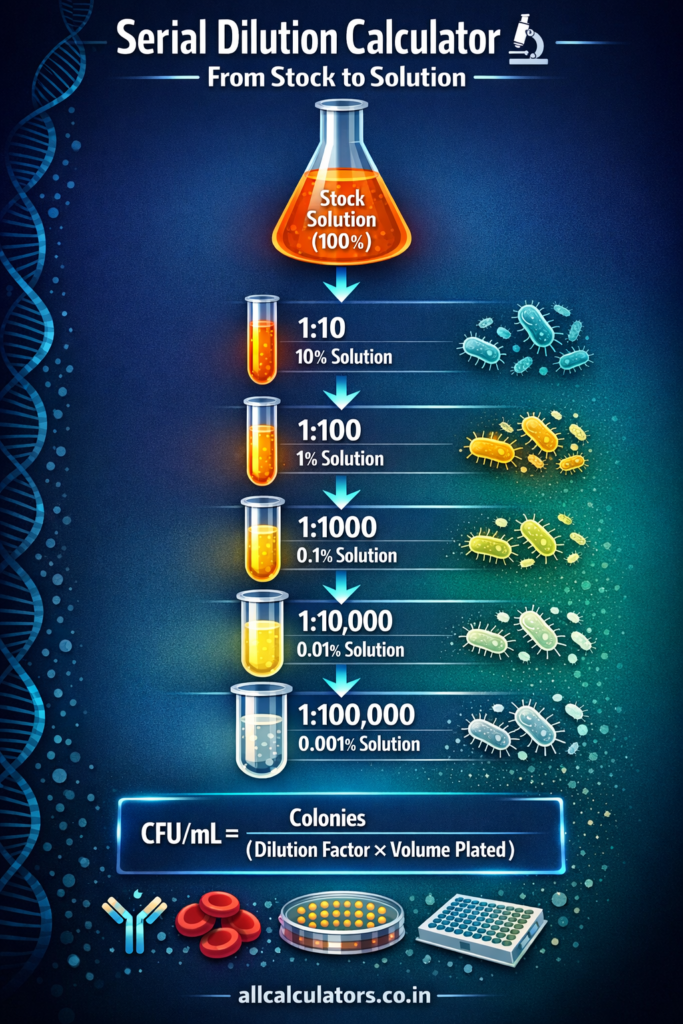
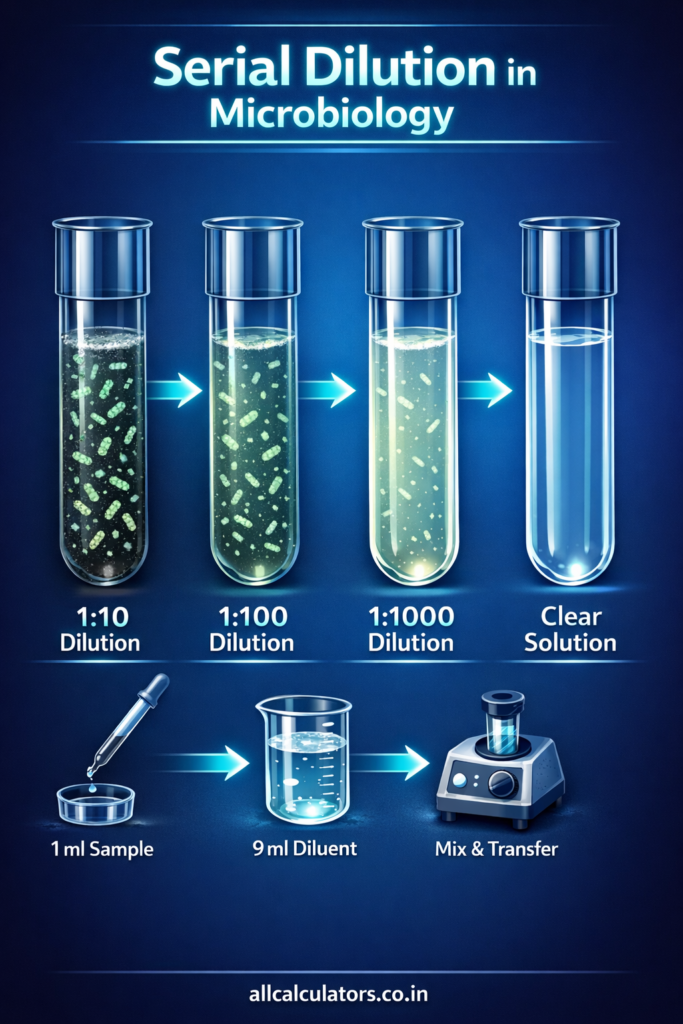
Each dilution step involves taking a fixed volume of the current solution and mixing it with a known volume of diluent (typically sterile water, buffer, or a growth medium 🧫). The result is a new solution with a concentration that is a specific fraction of the previous step. If 1 mL of solution is added to 9 mL of diluent, you’ve created a 1:10 (10-fold) dilution, reducing the concentration to 1/10th of its original value. This is one of the most widely used dilution ratios in science.
📐 The Serial Dilution Formula — Demystified
The core formula driving serial dilution calculations is beautifully simple:
Dilution Factor (DF) = Volume of Sample ÷ (Volume of Sample + Volume of Diluent)
For a series of dilutions, the total dilution factor is calculated by multiplying the individual dilution factors at each step:
Total DF = DF₁ × DF₂ × DF₃ × … × DFn
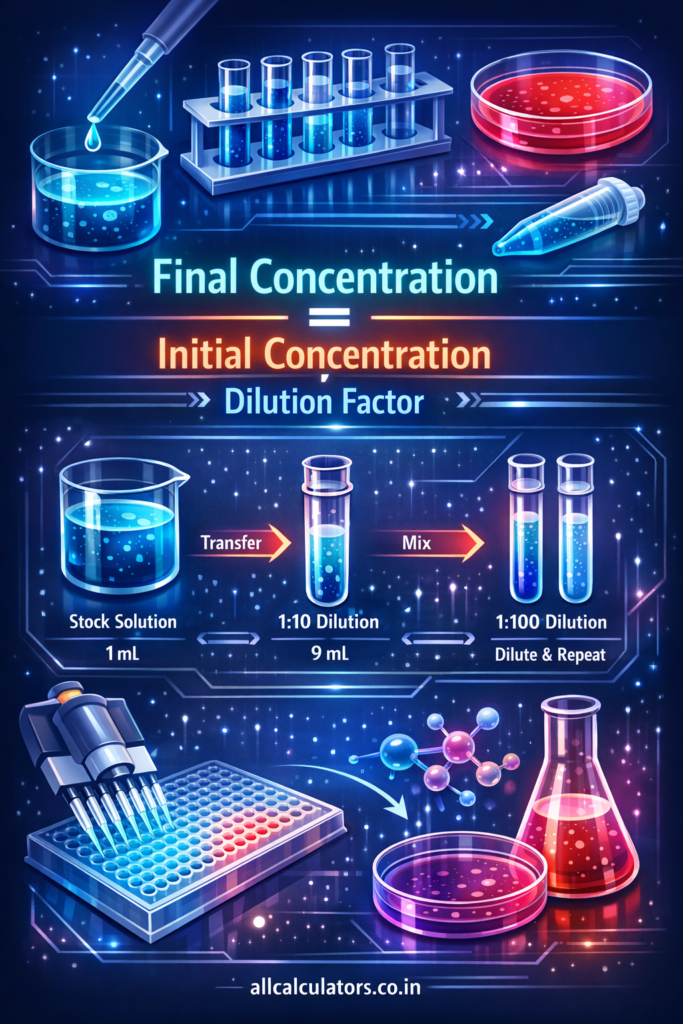
To find the final concentration at any step, you multiply the original (stock) concentration by the total dilution factor:
Final Concentration = Initial Concentration × Total Dilution Factor
And when counting bacterial colonies on a plate, the original sample concentration — expressed as Colony Forming Units per mL (CFU/mL) — is calculated as:
CFU/mL = Number of Colonies ÷ (Dilution Factor × Volume Plated in mL)
Our Serial Dilution Calculator handles ALL of these formulas automatically 🤖💡, so you can focus on science rather than arithmetic!
🧫 Why is Serial Dilution Critical in Microbiology & Immunology?
In microbiology, working with undiluted bacterial or viral samples is practically impossible — millions of colonies on a single plate would be completely uncountable! 😵 Serial dilution allows microbiologists to bring dense microbial populations down to countable levels (ideally 30–300 colonies per plate), making it possible to accurately back-calculate the original organism concentration in a sample. This technique is foundational in:

🔹 Bacterial enumeration — counting live bacteria in food, water, blood, or environmental samples 🔹 Antibiotic susceptibility testing — determining the minimum inhibitory concentration (MIC) of an antibiotic against a pathogen 🔹 Virus titration — measuring the infectious dose of a virus in immunology and vaccine research 🔹 ELISA assays — preparing antibody serial dilutions for immunological detection and titer determination in blood serum testing 🔹 Standard curve preparation — creating concentration gradients for spectrophotometric and biochemical assays
In immunology, serial dilution is indispensable for antibody titer testing 🩸. Blood banks, for example, use serial dilution to determine the highest dilution of a patient’s serum at which a specific antibody remains detectable — a critical measure of immune response, vaccination status, and pathogen exposure. Toxicologists also use serial dilution to determine LD50 values — the lethal dose of a substance that kills 50% of a test population, an essential measurement in drug and safety research.
⚡ How Our Serial Dilution Calculator Makes Your Life Easier
Manually computing serial dilution steps is not just tedious — it’s error-prone. A single arithmetic mistake can cascade across an entire dilution series and invalidate an entire experiment 📉. Our free online Serial Dilution Calculator at AllCalculators.co.in solves this by:
✅ Accepting your stock concentration, dilution factor, and number of steps as inputs ✅ Instantly displaying the concentration at every dilution step ✅ Calculating total dilution factor across the entire series ✅ Supporting 2-fold, 4-fold, 10-fold, and custom dilution series ✅ Providing results clean, fast, and formatted for both students and professionals 🎓🔬
No downloads. No registration. No formulas to memorize. Just pure, accurate science at your fingertips — right here on AllCalculators.co.in 🚀
Whether you’re preparing for a NEET biology practical, completing a BSc/MSc microbiology assignment, working in a clinical diagnostic laboratory, or conducting pharmaceutical research — this calculator is your trusted partner every single time. Bookmark it, use it, share it! 🌟
🌍 Applications in Daily Human Life
🍵 Food & Beverage Industry — Quality control labs use serial dilution to count harmful bacteria like E. coli or Salmonella in food and drinking water samples to ensure safety standards are met.
💉 Hospitals & Diagnostic Labs — Clinical labs perform serial dilutions to test blood serum antibody titers for diseases like dengue, typhoid, HIV, and hepatitis, guiding treatment decisions.
💊 Pharmaceutical Manufacturing — Drug companies use serial dilution to prepare precise concentrations of active compounds during drug formulation and quality testing.
🧴 Cosmetics & Personal Care — Safety labs test preservative effectiveness in cosmetics using serial dilution to detect microbial contamination.
🌊 Environmental Testing — Water treatment plants use serial dilution to measure bacterial contamination levels in rivers, lakes, and municipal water supplies.
🏥 Blood Banks — Technicians use serial dilution titer tests to verify donor blood antibody compatibility before transfusions.
🌾 Agriculture & Soil Science — Soil microbiologists use serial dilution to count beneficial bacteria and fungi in fertilizers and agricultural soil samples.
📚 Education & Student Labs — From high school biology to university microbiology practical’s, serial dilution is one of the first and most important lab techniques every science student learns.
⚠️ Disclaimer
🔬 The Serial Dilution Calculator on AllCalculators.co.in is designed strictly for educational and general reference purposes only. 📚 While we strive for the highest accuracy in our calculations, results should not be used as a sole basis for critical clinical, pharmaceutical, or research decisions without verification by a qualified professional. 🧑🔬 Laboratory procedures involve multiple variables — including equipment calibration, technique, and environmental factors — that this tool cannot account for. Always cross-check your results with standard laboratory protocols and consult a certified microbiologist or lab technician for professional-grade work. 💡 Use this tool responsibly and happy calculating! ✅
📌 Related Calculators
❓ FAQs
❓ What is a serial dilution in microbiology? 🧫
Serial dilution is a stepwise dilution process used to reduce the concentration of a solution, commonly applied in microbiology for bacterial analysis.
❓ What is the formula for serial dilution? 📊
The serial dilution formula is: Final Concentration = Initial Concentration ÷ Dilution Factor.
❓ What is a dilution factor? 🔬
Dilution factor is the ratio between the final solution volume and the original sample volume.
❓ Why is serial dilution important in immunology? 💉
It helps determine antibody concentrations and is widely used in ELISA and other immunological assays.
❓ How do you calculate a 1:10 serial dilution? 🧪
Mix 1 part sample with 9 parts solvent to achieve a ten-fold dilution.
❓ Can I use this calculator for two-fold dilution? 🔁
Yes, the calculator supports two-fold (1:2), ten-fold (1:10), and custom dilution series.