
| 🧫 Tube # | ⚗️ Concentration | 📉 Dilution Step | 👁️ Growth Observation |
|---|
Table of Contents
✍️ Author & Academic Authority: Dr. Nitish Kr. Bharadwaj
📘 Qualifications: B.Sc., B.Ed., M.Sc., Ph.D. (Biochemistry), MBA (Financial Management)
🧬 Minimum Inhibitory Concentration Calculator
Decode Antibiotic Power Instantly!
🔬 In the fascinating world of microbiology and immunology, one of the most critically important measurements that scientists, pharmacologists, clinicians, and students rely upon is the Minimum Inhibitory Concentration, universally abbreviated as MIC. Whether you are a pharmacy student trying to ace your pharmacology exam, a laboratory researcher studying antibiotic resistance, or a clinical microbiologist working to determine the best treatment protocol for a bacterial infection, understanding MIC is absolutely non-negotiable — and our free, easy-to-use Minimum Inhibitory Concentration (MIC) Calculator at AllCalculators.co.in is here to make the entire process effortless, fast, and accurate! 🧪
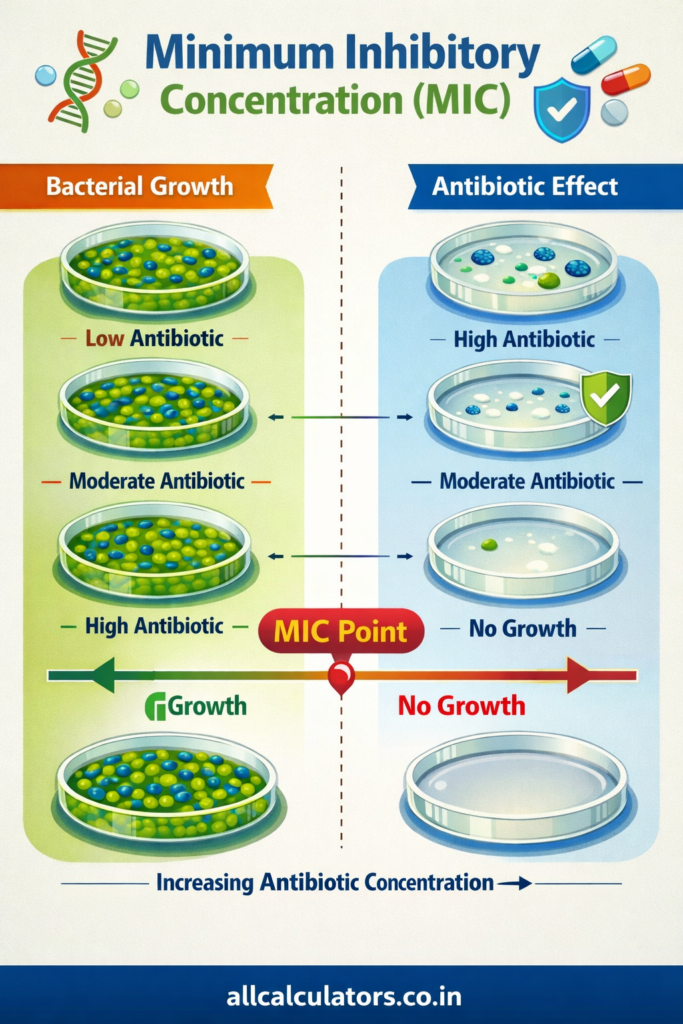
💡What Exactly is Minimum Inhibitory Concentration?
The Minimum Inhibitory Concentration is defined as the lowest concentration of an antimicrobial agent — typically an antibiotic, antifungal, or bacteriostatic compound — that completely inhibits the visible growth of a microorganism after a defined incubation period (usually 18–24 hours at 37°C). Put simply, MIC tells you the smallest dose of a drug required to stop bacteria or fungi from multiplying. It is expressed in micrograms per milliliter (µg/mL) or milligrams per liter (mg/L) and is the gold-standard metric in antimicrobial susceptibility testing (AST). 🦠
The concept of MIC was pioneered by the legendary microbiologist and pharmacologist Alexander Fleming, who developed the broth dilution technique — a foundational method where tubes or microwell plates filled with bacterial culture are exposed to progressively decreasing concentrations of an antibiotic. The tube showing no visible turbidity (clear broth) at the lowest drug concentration gives the MIC value. Later, in the 1980s, the Clinical and Laboratory Standards Institute (CLSI) standardized MIC protocols, and today the European Committee on Antimicrobial Susceptibility Testing (EUCAST) also provides globally respected guidelines that laboratories follow. 📋
🔬 How is MIC Determined? The Key Methods
There are three widely accepted laboratory methods for MIC determination:
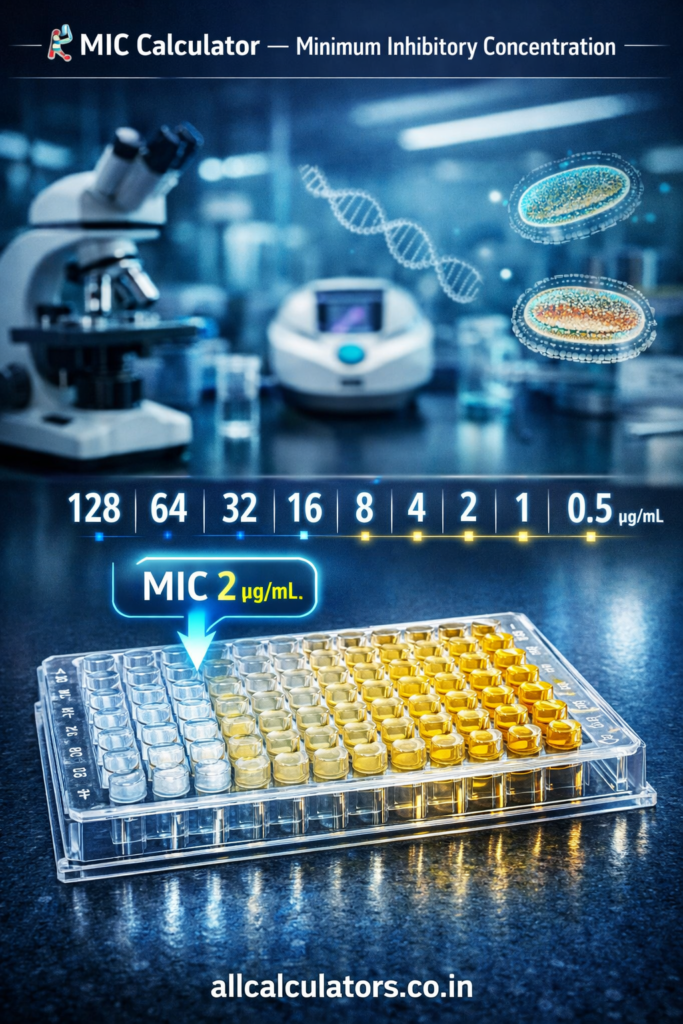
🧫 1. Broth Microdilution Method — This is the reference standard method endorsed by both CLSI and EUCAST. Serial two-fold dilutions of the antibiotic are prepared in 96-well microplates containing Mueller-Hinton Broth (MHB). A standardized bacterial inoculum (~5×10⁵ CFU/mL) is added to each well. After incubation, the lowest concentration showing no visible turbidity is reported as the MIC value. This is the most accurate and reproducible technique and is ideal for high-throughput laboratory screening.
🧫 2. Agar Dilution Method — Here, the antibiotic is incorporated at varying concentrations into solid Mueller-Hinton Agar (MHA) plates. Bacterial suspensions are spotted onto the agar surface. After incubation, the lowest concentration of agar that prevents visible bacterial colony formation is the MIC. This method is useful for testing multiple organisms simultaneously.
🧫 3. E-Test (Antibiotic Gradient Strip Method) — A commercially prepared plastic strip with a pre-defined continuous gradient of antibiotic concentration is placed on an inoculated agar plate. After incubation, an elliptical inhibition zone forms around the strip. The point where the lower end of this ellipse intersects the strip reveals the MIC value — making this method both visual and highly practical in clinical labs.
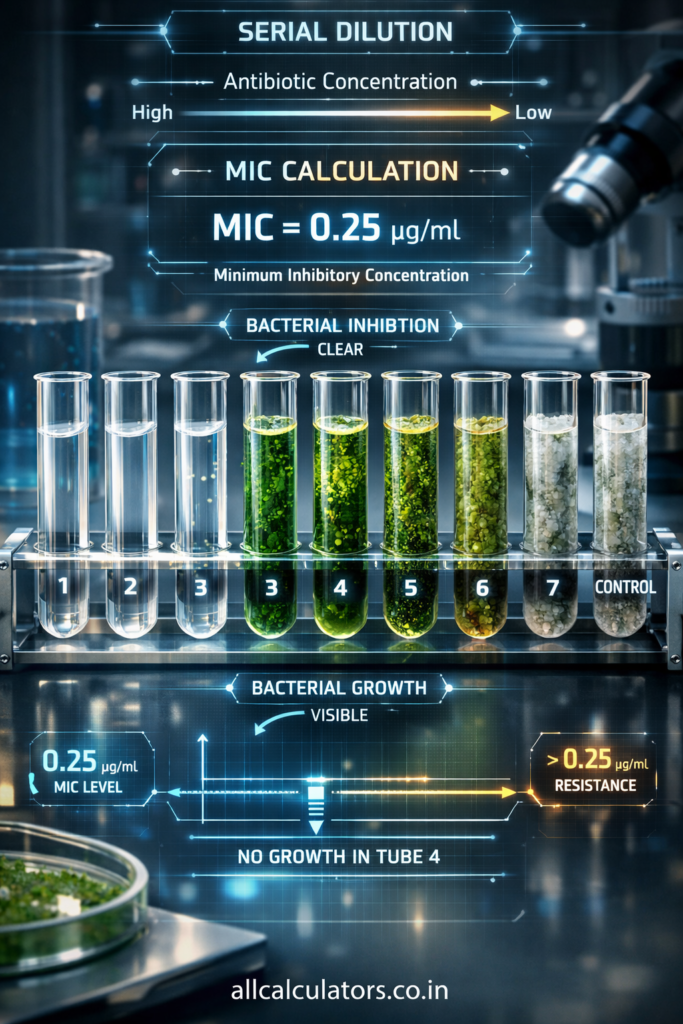
📊 Understanding MIC Breakpoints: Susceptible, Intermediate, or Resistant?
Once a MIC value is obtained, it must be interpreted against established clinical breakpoints — threshold values defined by CLSI or EUCAST for each antibiotic-organism pair. These breakpoints classify bacteria into three categories: ✅ Susceptible (S) — The organism is inhibited by normally achievable drug concentrations; treatment is likely to succeed. ⚠️ Intermediate (I) / Susceptibility Dose Dependent (SDD) — The organism may respond if higher doses are used or the drug accumulates at the infection site. ❌ Resistant (R) — The organism is NOT inhibited by standard drug concentrations; treatment will likely fail.
These interpretations are absolutely crucial for guiding antibiotic stewardship and preventing the dangerous global crisis of antimicrobial resistance (AMR). 🌍
🔢 MIC vs. MBC — What’s the Difference?
It’s also important to distinguish MIC from Minimum Bactericidal Concentration (MBC). While MIC is the lowest concentration that inhibits microbial growth (bacteriostatic effect), MBC is the lowest concentration that actually kills 99.9% of bacteria (bactericidal effect). The ratio of MBC to MIC reveals whether a drug is primarily bacteriostatic or bactericidal — vital information when treating serious infections like endocarditis or meningitis. 💊
🖥️ Why Use Our Online MIC Calculator?
Our free MIC Calculator at AllCalculators.co.in simplifies this complex calculation process instantly. Whether you are calculating MIC values from serial dilution data, determining MIC ratios, converting between µg/mL and mg/L units, or studying broth microdilution results — our intelligent tool does the heavy mathematical lifting for you in seconds. 🚀 No more manual errors, no more lengthy formula derivations. Just input your data, click calculate, and get accurate, reliable MIC results instantly — perfect for students, professors, researchers, and healthcare professionals alike! 🎓🏥
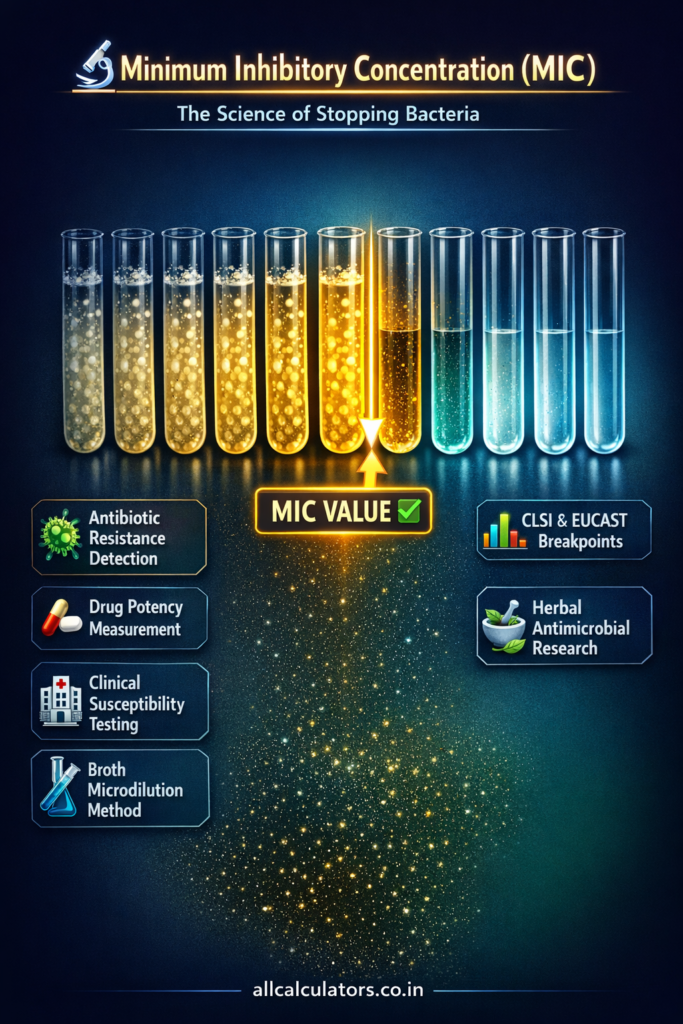
🌍 Applications in Daily Human Life
🏥 Real-World Applications of Minimum Inhibitory Concentration (MIC)
🔬 1. Clinical Medicine & Antibiotic Prescribing — Doctors and infectious disease specialists rely on MIC data to select the right antibiotic and the correct dose for treating bacterial infections like pneumonia, UTIs, skin infections, and sepsis. Getting the MIC right saves lives! 💉
🧬 2. Combating Antibiotic Resistance (AMR) — MIC testing is at the frontline of monitoring dangerous drug-resistant bacteria like MRSA, MDR-TB, and carbapenem-resistant Enterobacteriaceae (CRE) — a global public health emergency. 🦠🚨
💊 3. Pharmaceutical Drug Development — During drug discovery, scientists use MIC values to screen and shortlist promising new antimicrobial compounds and evaluate their potency before clinical trials. 🧪
🍔 4. Food Safety & Preservation — MIC testing of biocides (like sodium hypochlorite, benzalkonium chloride) helps food industry professionals determine safe, effective sanitizer concentrations to eliminate pathogens like Listeria monocytogenes in food processing plants. 🏭
🌿 5. Herbal & Natural Medicine Research — Researchers use MIC calculators to evaluate the antimicrobial activity of plant extracts, essential oils, and natural compounds — supporting the growing field of phytomedicine and nutraceuticals. 🌱
🎓 6. Microbiology Education & Lab Practicals — Students in medical, pharmacy, biotechnology, and life science courses use MIC calculations in lab experiments to understand antibiotic activity and resistance mechanisms practically. 📚
🐾 7. Veterinary Medicine — Vets rely on MIC testing to determine appropriate antibiotic dosing for animals — protecting both animal welfare and preventing zoonotic AMR transmission. 🐄🐕
⚠️ Disclaimer 📢
🔬 The Minimum Inhibitory Concentration (MIC) Calculator on AllCalculators.co.in is developed strictly for educational, academic, and research reference purposes only. 🎓 The results generated by this tool are based on standard mathematical formulas and generalized scientific principles.
🚫 This calculator is NOT a substitute for professional clinical laboratory testing, certified diagnostic procedures, or medical advice. MIC values used in real patient care must always be determined by accredited clinical microbiology laboratories following validated CLSI or EUCAST protocols.
🏥 Always consult a qualified microbiologist, infectious disease physician, or licensed healthcare professional before making any clinical or therapeutic decisions based on antimicrobial susceptibility. The creators and operators of AllCalculators.co.in assume no liability for any decisions or outcomes arising from the use of this tool. 🙏
📌 Related Calculator
❓ FAQs
❓ What is Minimum Inhibitory Concentration (MIC)?
MIC is the lowest concentration of an antibiotic that prevents visible growth of bacteria in a lab setting 🧫.
❓ How is MIC calculated in microbiology?
MIC is determined using serial dilution methods where different concentrations of antibiotics are tested against bacterial cultures 🔬.
❓ Why is MIC important in antibiotic testing?
It helps identify the most effective antibiotic and prevents misuse, reducing antibiotic resistance 💊.
❓ Can I use this MIC calculator for lab reports?
Yes, it’s ideal for educational use and quick verification of MIC values, but lab confirmation is recommended 📊.
❓ What does a high MIC value indicate?
A high MIC value suggests that the microorganism is resistant to the antibiotic ⚠️.