
🧪🌱 Pesticide Dilution Calculator
- 🧴 Concentrate strength is the concentration of active formulation/product being diluted.
- 🎯 Desired concentration is the target concentration of the final spray mixture.
- 🚿 Final volume is the total volume of pesticide mixture after dilution.
- 🧪 The calculator assumes both concentrations use the same percentage basis.
Table of Contents
🌱 Pesticide Dilution Calculator
Calculate Pesticide Mix Rate, Spray Dose & Tank Quantity
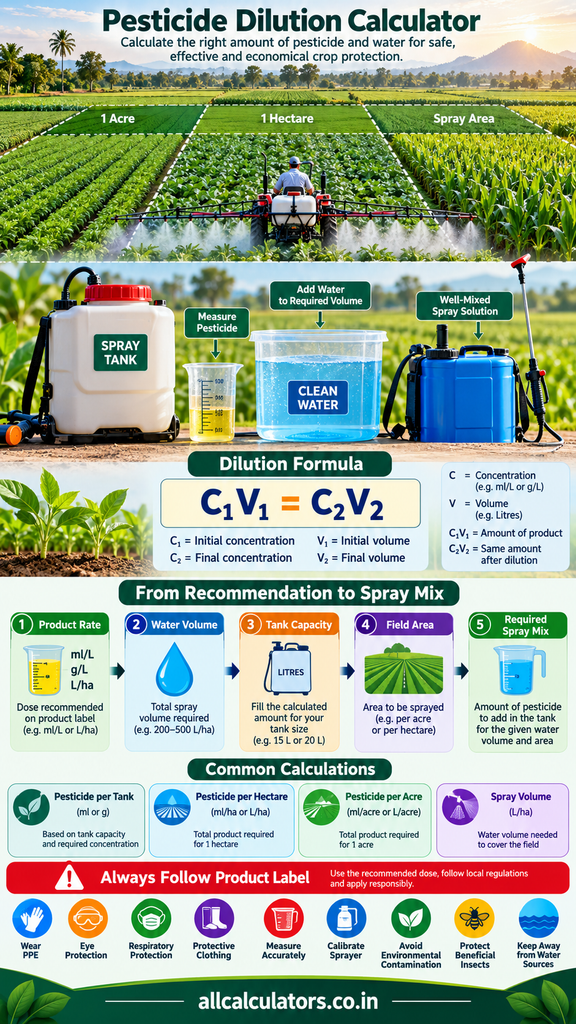
🌾 Pesticide Dilution Calculator is a practical online agriculture calculator designed to help farmers, agriculture students, gardeners, horticulture professionals, pesticide applicators, and researchers understand and calculate pesticide dilution, spray-mix quantities, tank requirements, and application-volume relationships quickly and conveniently. Instead of repeatedly performing manual calculations for pesticide per litre of water, pesticide per tank, pesticide per hectare, pesticide per acre, spray volume, and dilution ratio, this calculator can convert the relevant values into an easy-to-understand result. The underlying mathematics is based on standard dilution and application-rate relationships, but the pesticide product label always takes priority over any generic calculation. Official Indian pesticide labels can specify different formulation doses and water volumes for different crops and pests, so the calculator should be used to perform the arithmetic—not to invent or replace an approved application rate.
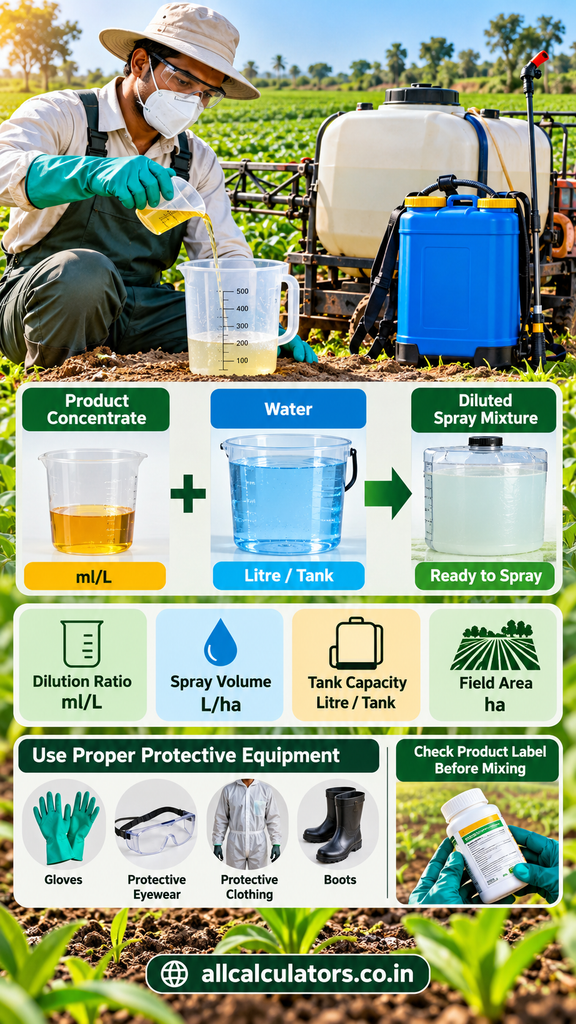
🔬 What is Pesticide Dilution?
Pesticide dilution is the scientific process of reducing a concentrated pesticide product to a safe, effective working concentration by mixing it with a measured volume of water or another carrier solution. Almost every commercial pesticide sold in the market — whether it's an insecticide, fungicide, herbicide, or bactericide — comes in a highly concentrated form that must be diluted before application. The label on the bottle gives you the rate (e.g., 2 mL per litre, or 200 mL per 100 litres, or 1:200 dilution ratio), but converting that into the exact amount for your tank size requires a formula that many people struggle with.
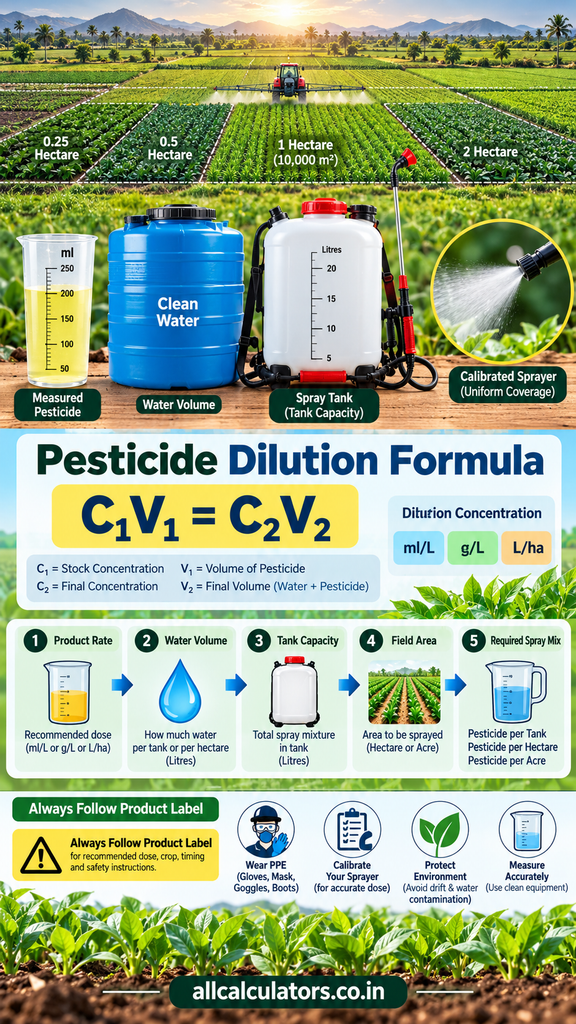
The most universally used formula in pesticide dilution science is the C₁V₁ = C₂V₂ equation — the same principle taught in chemistry labs around the world 🧬. Here:
- C₁ = Stock concentration of the pesticide concentrate 🧴
- V₁ = Volume of concentrate you need to take out
- C₂ = Target (final working) concentration 🎯
- V₂ = Total volume of spray solution you want to prepare
Solving for V₁ = (C₂ × V₂) / C₁ gives you the precise volume of pesticide concentrate needed. Our online Pesticide Dilution Calculator does this math instantly — no pen, no paper, no guesswork! ✏️❌
📐 Understanding Dilution Ratios & Concentration Formats
Pesticide labels express dilution requirements in several different formats, which is a major source of confusion 😵:
🔹 Percentage solution — e.g., "Apply as a 0.5% spray"
🔹 Dilution ratio — e.g., "Mix 1:200 with water" (1 part concentrate to 200 parts water)
🔹 Volume per area — e.g., "Use 250 mL per hectare in 200 litres of water"
🔹 Weight per volume — e.g., "2 g per litre of water"
🔹 Parts per million (ppm) — Used for systemic and soil-applied treatments
Each format requires a slightly different calculation approach. Our calculator handles all major formats and converts them into the exact measure of concentrate and water you need to prepare your spray tank — whether it's a 1-litre hand-pump sprayer 🪣 or a 200-litre tractor-mounted boom sprayer 🚜.
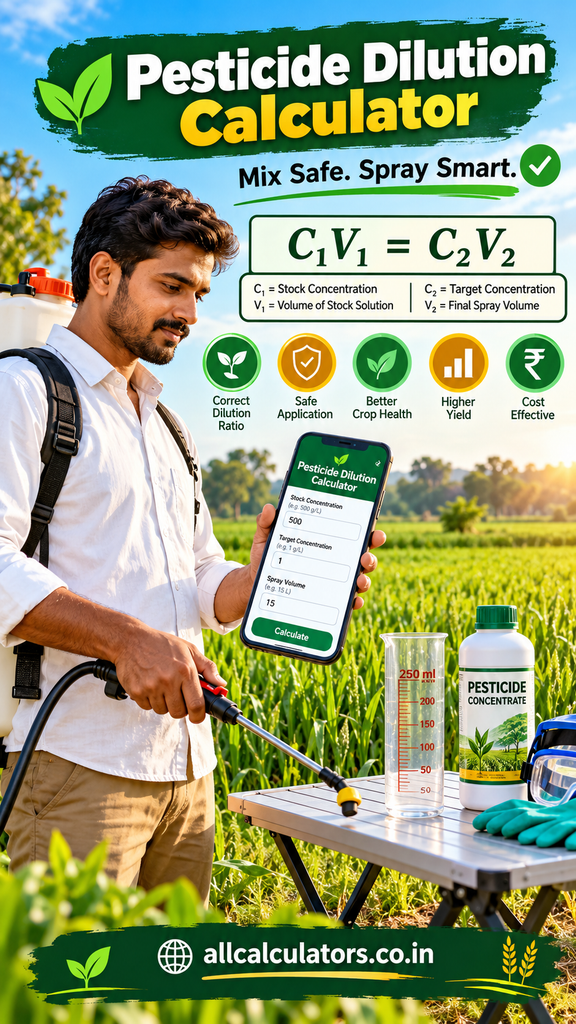
🌾 Why Precise Pesticide Dilution Matters in Agriculture
India is one of the world's largest consumers of agricultural pesticides, with farmers across Punjab, Haryana, Andhra Pradesh, Maharashtra, and beyond depending on chemical crop protection to safeguard their harvests 🌾. Yet, studies consistently show that incorrect pesticide mixing is one of the top causes of:
✅ Crop phytotoxicity (chemical burning of leaves and stems)
✅ Pest resistance development due to sub-lethal exposure
✅ Unnecessary financial loss from over-application 💸
✅ Environmental pollution in soil and water bodies 🌊
✅ Health hazards for farmers and farm workers 👨🌾
The World Health Organization (WHO) and FAO both emphasize that correct pesticide dilution and application rates are critical pillars of Integrated Pest Management (IPM) and sustainable agriculture 🌏.
For students of botany, agriculture, and environmental science, understanding pesticide dilution calculations is also a core examination topic — covered in CBSE Class 11 Biology (Chapter on Plant Diseases & Control), agricultural science courses, and university-level botany practicals 📚✏️.
🧪 How Our Pesticide Dilution Calculator Works
Using our calculator is incredibly simple and takes under 30 seconds ⏱️:
1️⃣ Enter the stock concentration of your pesticide product (from the label)
2️⃣ Choose your input format — percentage, ratio, ppm, or volume per area
3️⃣ Enter the total spray volume you want to prepare (in litres or gallons)
4️⃣ Hit Calculate 🔘 — and instantly get:
- 📦 Exact amount of concentrate to add
- 💧 Exact volume of water to add
- 📊 Final dilution ratio & concentration percentage
No more fumbling with calculators, misreading labels under bright sunlight, or making costly errors. Our free online pesticide dilution calculator works on mobile 📱, tablet, and desktop 💻 — right when you need it most, even at the edge of your farm! 🌿
Whether you're mixing glyphosate for weed control 🌱, chlorpyrifos for insect management 🐛, mancozeb for fungal diseases 🍄, or any other crop protection chemical — this calculator ensures every spray is safe, effective, and label-compliant every single time. 💯
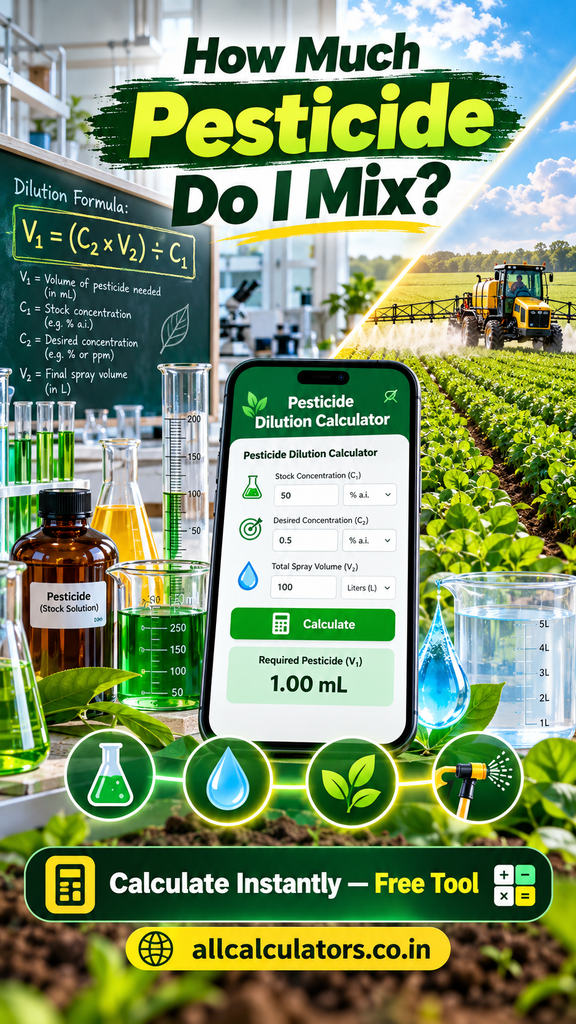
🌍 APPLICATIONS IN HUMAN DAILY LIFE
🌿 Real-World Applications of Pesticide Dilution in Daily Life:
🌾 Farming & Agriculture — Farmers calculate exact spray doses for crops like wheat, rice, cotton, and vegetables to protect yields without wasting costly chemicals.
🏡 Home Gardening — Home gardeners dilute pesticides to protect roses, tomatoes, herbs, and houseplants from aphids, mites, and fungal infections.
🌳 Horticulture & Nurseries — Nursery owners use precise dilution ratios for disease management in ornamental plants and saplings.
☕ Tea & Coffee Plantations — Plantation managers calculate pesticide concentrations for large-scale canopy spray programs in hills and estates.
🌲 Forestry & Tree Care — Arborists and forest departments use dilution calculations for bark treatments and aerial spraying.
🐜 Pest Control Services — Professional exterminators dilute insecticides correctly for indoor, kitchen, and warehouse pest management.
🏫 School & College Labs — Botany and agriculture students use dilution formulas in practicals for plant protection experiments.
🥗 Organic & IPM Farming — Even organic-approved pesticides like neem oil emulsions require precise dilution for effective and safe application.
🌺 Flower Farming — Floriculture farmers in states like Karnataka dilute fungicides to prevent botrytis and powdery mildew on cut flowers.
💊 Public Health & Vector Control — Government agencies dilute insecticides for anti-mosquito, anti-locust, and anti-dengue spray programs.
⚠️ Disclaimer — Please Read Before Use! 🌿
The Pesticide Dilution Calculator on AllCalculators.co.in is designed for educational and reference purposes only 📚. The results generated by this tool are based on standard mathematical formulas (C₁V₁ = C₂V₂) and the values you input. 🔢 This calculator does not replace the official pesticide product label, which is the legal authority on dosage, safety, and application method. ⚖️ Always read and strictly follow the manufacturer's instructions, safety data sheets (SDS), and applicable government regulations before mixing or applying any pesticide. 🧤 Wear appropriate Personal Protective Equipment (PPE) including gloves, masks, goggles, and protective clothing during mixing and spraying. 👁️🧣 Incorrect pesticide use can cause serious harm to human health, animals, plants, and the environment. 🌍🐝 The website owners and developers accept no liability for any damage, injury, or loss arising from reliance on this calculator. 🚫 When in doubt, consult a certified agronomist, plant protection expert, or agricultural extension officer. 👨🔬✅
❓ Frequently Asked Questions 🙋 — Pesticide Dilution Calculator 🌾🧪
❓ What is a Pesticide Dilution Calculator? 🌱
A Pesticide Dilution Calculator is an online tool that helps perform the mathematical calculations required to determine pesticide concentrate, water volume, dilution ratio, spray mixture quantity, and tank requirements from known application values.
❓ How do you calculate pesticide dilution? 🧪
Pesticide dilution depends on the concentration, final volume, product formulation, and label instructions. For general concentration-based dilution, the relationship C₁V₁ = C₂V₂ can be used when the concentration units are consistent.
❓ How much pesticide should I add per litre of water? 💧
There is no universal pesticide amount per litre of water. The correct quantity depends on the specific product, formulation, crop, pest, application method, and label instructions. Use the rate printed on the current product label rather than a generic internet dosage.
❓ Can I calculate pesticide dose per acre? 🚜
Yes, a pesticide calculation can be converted to an acre-based quantity when the applicable label rate and units are known. Care must be taken when converting between acre and hectare, because rates expressed per hectare cannot be used directly with an acre value without conversion.
❓ Can this calculator calculate pesticide per hectare? 🌾
Yes. When a pesticide label provides an approved formulation rate per hectare, the calculator can help perform the associated mathematical calculations for field area, spray volume, tank capacity, and total product quantity.
❓ What is the difference between pesticide dilution and pesticide dosage? 🧮
Dilution describes how a concentrated product is combined with water or another permitted carrier. Dosage/application rate describes how much product is permitted or recommended for a specified crop, pest, area, or application volume. They are related but are not interchangeable concepts.
❓ Does increasing water volume mean I can use more pesticide? ⚠️
No. Changing water volume does not automatically authorize an increase in pesticide dose. The approved product rate and label directions remain controlling. A different spray volume may affect concentration and tank requirements, but it does not by itself change the permitted product dose.
❓ Can I use the calculator for insecticides, fungicides and herbicides? 🌿
The mathematical principles can apply to different pesticide formulations, including insecticides, fungicides, and herbicides. However, each product has its own label requirements, formulation characteristics, approved crops/pests, and application directions.
❓ Why is sprayer calibration important? 🚜
Sprayer calibration verifies how much spray the equipment actually delivers. Even if the pesticide dilution calculation is mathematically correct, an improperly calibrated sprayer can result in under-application or over-application. Extension guidance recommends calibration and application verification. Fruit and Vegetable News
❓ Is this pesticide calculator safe to use? 🦺
The calculator performs mathematical calculations; it does not make pesticide-safety decisions. Always follow the pesticide label, required PPE, mixing/loading precautions, environmental restrictions, and applicable regulations. US EPA
❓ Is the Pesticide Dilution Calculator free? 💻
Yes. The calculator on AllCalculators.co.in is intended to provide a quick, accessible online calculation tool without requiring manual mathematical calculations.
📌 Related Calculators
📷 Pesticide Dilution Calculator is a practical online agriculture calculator designed to help farmers, agriculture students, gardeners, horticulture professionals, pesticide applicators, and researchers understand and calculate pesticide dilution, spray-mix quantities... https://t.co/9KiCJHecwR
— AllCalculators (@allcalcs4u) October 5, 2026