
🌱 Fertilizer NPK Ratio Calculator
Total Weight (g) × (NPK % ÷ 100)Available Nutrient (g/kg) =
Elemental % × 10Ratio Simplification:
N : P : K (divided by GCD of the three values)P is expressed as P2O5 equivalent; K as K2O equivalent in labelling.
| 📌 Parameter | 📈 Value |
|---|
Table of Contents
✍️ Author & Academic Authority: Dr. Nitish Kr. Bharadwaj
📘 Qualifications: B.Sc., B.Ed., M.Sc., Ph.D. (Biochemistry), MBA (Financial Management)
🌱 Fertilizer NPK Ratio Calculator
Know Exactly What Your Plants Are Hungry For!
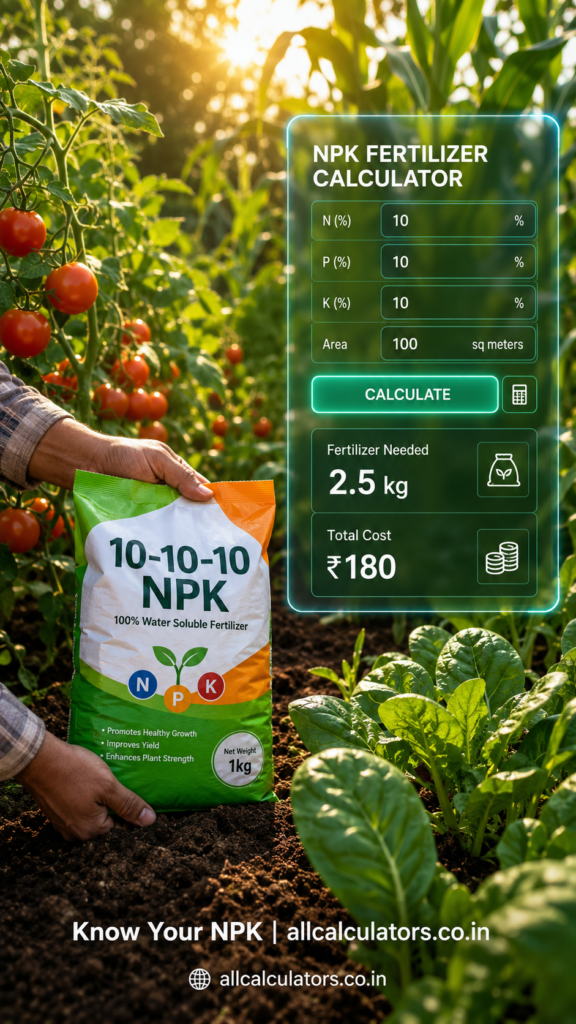
Have you ever stood in a garden store staring at fertilizer bags covered in cryptic numbers like 10-10-10 or 5-10-5, wondering what on earth they mean? 🤔 You’re not alone. Whether you’re a passionate home gardener nurturing juicy tomatoes on your balcony, a student of botany and agriculture eager to understand plant nutrition, or a professional farmer managing hectares of crops, understanding the NPK ratio is the single most powerful piece of knowledge that separates thriving, lush plants from stunted, nutrient-starved ones. That’s exactly why our Fertilizer NPK Ratio Calculator was built — to make plant nutrition science effortless, instant, and 100% accurate for everyone. 🎯
🌿 What Does NPK Actually Mean?
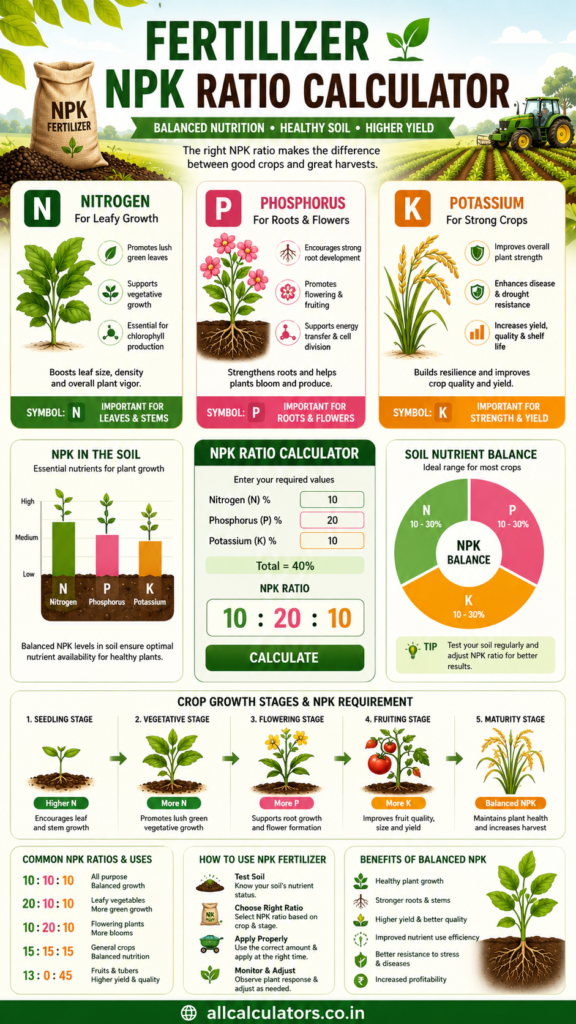
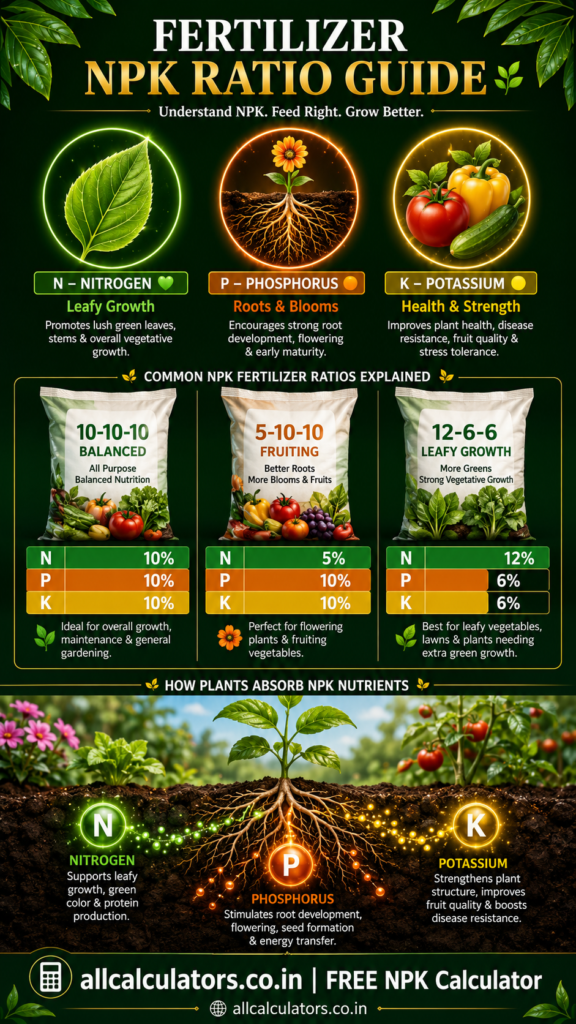
NPK stands for the three most critical macronutrients that plants require for healthy growth: N for Nitrogen 💚, P for Phosphorus 🟠, and K for Potassium 🟡. The three numbers printed on every fertilizer bag represent the percentage by weight of each of these nutrients in that product. For example, a fertilizer labeled 10-10-10 contains 10% Nitrogen, 10% Phosphorus, and 10% Potassium — making it a perfectly balanced, general-purpose fertilizer. Similarly, a bag labeled 5-10-5 is lower in nitrogen and higher in phosphorus, making it ideal for encouraging root growth and flower development in plants. Understanding these ratios is the cornerstone of smart, science-based fertilization. 🔬
🌾 The Role of Each Nutrient: Why the Balance Matters Each of the three macronutrients plays a completely distinct and irreplaceable role in a plant’s life cycle, and getting the balance wrong can have dramatic consequences.
Nitrogen (N) 💚 is the growth engine of your plant. It fuels the production of chlorophyll, which gives leaves their rich green color, drives vigorous stem growth, and accelerates the vegetative phase. Leafy crops like spinach, lettuce, kale, and cabbage absolutely thrive with higher nitrogen ratios such as 12-6-6 or 10-5-5. However, too much nitrogen during the flowering or fruiting phase can push a plant to keep producing leaves instead of fruits — a common mistake that devastates tomato and pepper harvests! 🍅
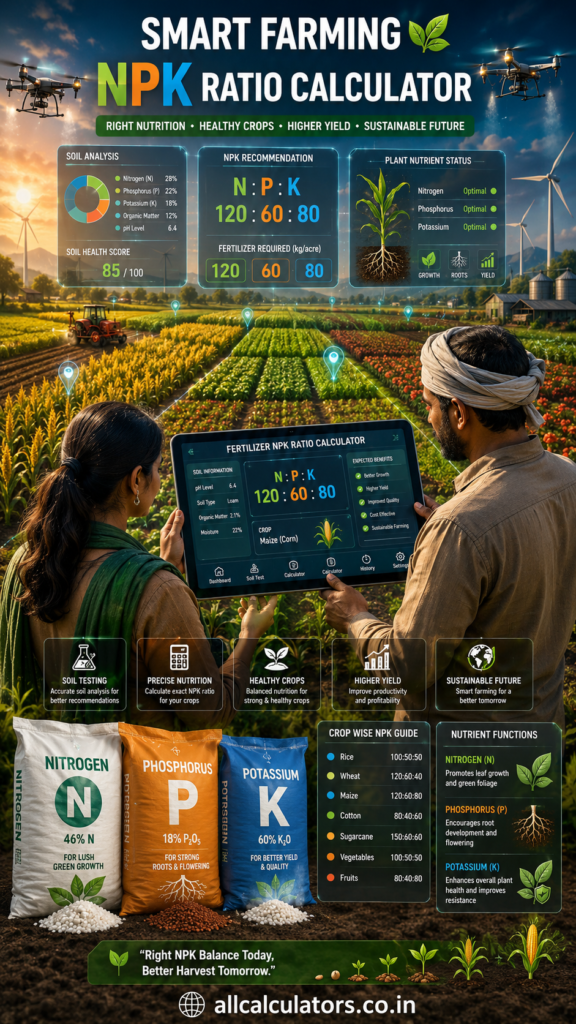
Phosphorus (P) 🟠 is the root builder and bloom promoter. It powers strong root systems, supports efficient energy transfer within the plant (via ATP), and drives the critical processes of flowering, fruiting, and seed development. When transplanting seedlings, a phosphorus-rich starter fertilizer like 5-10-5 or 10-20-10 is highly recommended by agricultural extension experts. For fruiting vegetables like tomatoes, peppers, and cucumbers, shifting to a higher-P formula such as 5-10-10 during the flowering stage can dramatically improve yield quality and fruit set. 🌸
Potassium (K) 🟡 is the plant’s immune system and stress shield. It regulates water uptake and retention within plant cells, improves disease resistance, enhances the quality and flavor of fruits, and helps the plant survive temperature stress, drought, and pest pressure. For fruit trees, root vegetables like potatoes, and crops in their late growth stages, high-potassium formulas such as 0-0-60 or 10-10-40 are often preferred by experienced agronomists. 🛡️
🧮 How Does the NPK Ratio Calculator Work?
Our online Fertilizer NPK Ratio Calculator simplifies the entire process of determining how much fertilizer you need, what custom blend to create, and how to match fertilizer grades to soil test results. You simply input the required nutrient quantities (in grams, kilograms, or pounds), the area to be fertilized (in square meters, acres, or square feet), and the NPK composition of your available fertilizer products — and the calculator instantly delivers precise application rates, total fertilizer weight needed, cost calculations, and even helps you compare different fertilizer grades or create custom blends. 📊 No more guesswork, no more wasted money on fertilizers your soil doesn’t even need.
🌍 Why Smart Fertilization Is More Important Than Ever Over-fertilization is one of the leading causes of environmental damage in modern agriculture. Excess nitrogen and phosphorus runoff into water bodies trigger dangerous algal blooms, pollute drinking water sources, and disrupt aquatic ecosystems — a process called eutrophication. 🌊 By using an NPK calculator to apply precisely the right amount of fertilizer based on your soil test results and crop needs, you’re not just helping your plants — you’re actively protecting the environment. Smart, data-driven fertilization means better yields, lower costs, and a healthier planet. ♻️
🌱 The Right NPK Ratio for Every Plant & Crop Different plants at different growth stages demand radically different NPK profiles. Tomatoes need a balanced 10-10-10 at seedling stage, then shift to 5-10-10 at flowering, and then to high-potassium blends at fruiting. Leafy greens prefer consistent nitrogen ratios like 12-6-6. Fruit trees thrive with higher potassium for quality and disease resistance. Lawns typically respond best to high-nitrogen spring fertilizers like 20-5-10, while fall feeding benefits from higher potassium to prepare roots for winter. 🍂 Our calculator accounts for all of these nuances so you can make confident, science-backed fertilization decisions every single time.
Whether you’re a student learning botany and agricultural science, a hobby gardener tending a kitchen garden, or a commercial farmer calculating costs per hectare, this free online NPK Ratio Calculator is your most reliable tool for growing more, spending less, and farming smarter. 🚀
🌎 Applications in Human Daily Life 🌿
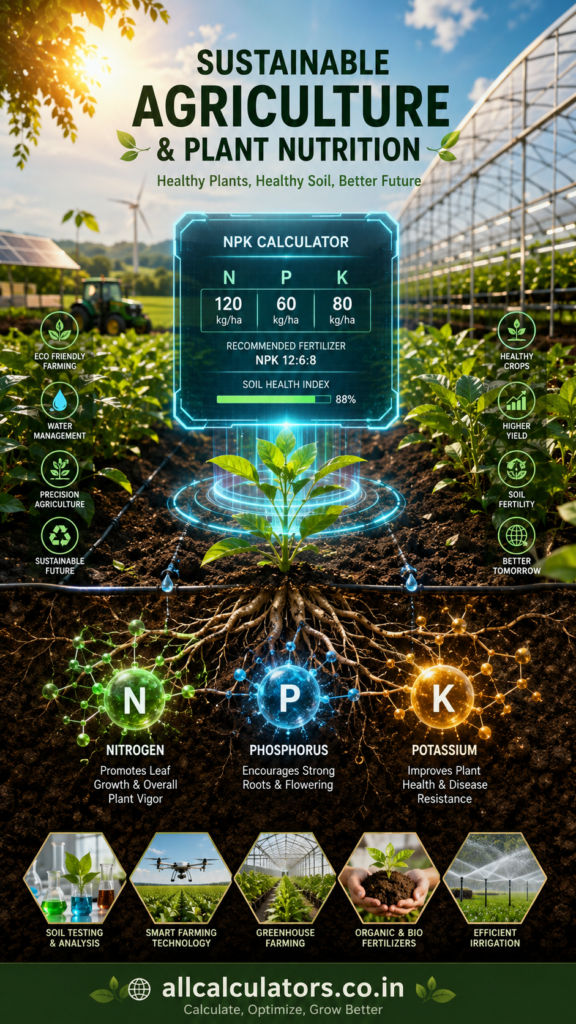
🌱 Home Gardening & Kitchen Gardens – Helps gardeners calculate the ideal NPK fertilizer ratio for vegetables, flowers, herbs, and indoor plants for faster growth and healthier leaves.
🚜 Modern Farming & Precision Agriculture – Farmers use the Fertilizer NPK Ratio Calculator to optimize fertilizer application, improve crop yield, and reduce nutrient wastage.
🌾 Crop Yield Improvement – Correct NPK balance supports stronger roots, healthy flowering, and better fruit production for commercial agriculture.
💧 Hydroponics & Greenhouse Farming – Essential for maintaining precise nutrient concentrations in soilless farming systems and controlled agricultural environments.
📘 Agriculture Education & Biology Studies – Useful for students learning plant nutrition, soil science, fertilizer chemistry, crop management, and sustainable agriculture.
🌍 Eco-Friendly Sustainable Farming – Prevents over-fertilization and helps reduce soil degradation, groundwater pollution, and environmental damage.
🍅 Fruit & Vegetable Production – Supports better quality produce with improved taste, color, size, and nutrient value.
🏡 Lawn & Landscape Maintenance – Assists homeowners and landscapers in maintaining green lawns, healthy grass, and ornamental plants.
🧪 Agricultural Research & Experiments – Researchers use NPK calculations for soil nutrient analysis, fertilizer trials, and scientific crop studies.
💰 Cost Reduction in Farming – Accurate fertilizer calculations help reduce unnecessary fertilizer expenses and maximize agricultural profits.
⚠️ Disclaimer — Read Before Using 📢
🌿 The Fertilizer NPK Ratio Calculator on allcalculators.co.in is provided purely for educational and general informational purposes. The results generated by this calculator are based on the values you enter and standard mathematical formulas used in agronomical science. 🔢 While we strive for maximum accuracy, actual fertilizer requirements for your specific plants, soil, and region may vary significantly. 🌍
📋 We strongly recommend conducting a professional soil test before applying any fertilizer to your garden, farm, or lawn. Always consult a certified agronomist, horticulturist, or local agricultural extension service for crop-specific fertilization recommendations. ❌ Over-fertilization can cause nutrient burn, soil degradation, and water pollution — apply fertilizers responsibly. ♻️
💡 allcalculators.co.in does not take any legal or agricultural liability for crop losses, plant damage, or soil imbalances resulting from the use of data obtained from this calculator. Use it as a smart starting guide, not a final prescription. 🙏
📌 Related Calculators
❓ FAQs – Fertilizer NPK Ratio Calculator 🌱
❓ What is an NPK Ratio in fertilizer?
The NPK ratio represents the percentage of Nitrogen (N), Phosphorus (P), and Potassium (K) in a fertilizer. These nutrients are essential for healthy plant growth and crop productivity.
❓ How does the Fertilizer NPK Ratio Calculator work?
The calculator analyzes fertilizer nutrient values and helps determine the correct fertilizer ratio required for crops, plants, or soil nutrient management.
❓ Why is the correct NPK ratio important?
A balanced NPK ratio improves root growth 🌱, flowering 🌸, fruiting 🍅, disease resistance 🛡️, and overall plant health while preventing nutrient deficiencies.
❓ Can this calculator be used for home gardening?
Yes ✔️. The calculator is useful for home gardens, indoor plants 🪴, lawns, terrace gardening, and kitchen gardening.
❓ Is the NPK fertilizer calculator useful for farmers?
Absolutely 🚜. Farmers can use it for precision farming, fertilizer optimization, sustainable agriculture, and improving crop yields.
❓ What happens if too much fertilizer is used?
Over-fertilization can damage roots, reduce crop quality, pollute water sources 💧, and negatively affect soil fertility.
❓ Can students use this agriculture calculator?
Yes 📘. Agriculture, biology, horticulture, and environmental science students can use it for educational learning and practical nutrient calculations.
❓ Does soil type affect fertilizer ratio requirements?
Yes 🌍. Different soil types contain different nutrient levels, which directly influence the required NPK fertilizer ratio.
Have you ever stood in a garden store staring at fertilizer bags covered in cryptic numbers like 10-10-10 or 5-10-5, wondering what on earth they mean? You’re not alone. https://t.co/1rjt0pe0tG pic.twitter.com/1M1Vnwd79Q
— AllCalculators (@allcalcs4u) May 6, 2026