
🧬 Effective Reproduction Number Calculator
🔬 Microbiology & ImmunologyR₀ = 1: Endemic equilibrium 🟡
R₀ > 1: Epidemic potential 🔴
R₀ ≈ 2-3: Typical for many respiratory infections
R₀ > 5: Highly contagious (e.g., measles)
Table of Contents
✍️ Author & Academic Authority: Dr. Nitish Kr. Bharadwaj
📘 Qualifications: B.Sc., B.Ed., M.Sc., Ph.D. (Biochemistry), MBA (Financial Management)
🧬 Effective Reproduction Number Calculator (Rₜ)
Decode the Power of Disease Transmission in Real Time! 🌡️📊
Understanding how diseases spread through a population is one of the most critical challenges in modern public health and epidemiology. Whether you are a biology student, a curious learner, a public health researcher, or a policy maker, the Effective Reproduction Number (Rₜ) is a metric you absolutely need to understand — and our free online Effective Reproduction Number Calculator makes computing it faster, smarter, and more accessible than ever before! 🚀
🔬 What is the Effective Reproduction Number (Rₜ)?
The Effective Reproduction Number, commonly written as Rₜ (R-sub-t) or simply R, is a time-varying epidemiological metric that tells us the average number of new infections caused by a single infectious individual at a specific point in time during an outbreak. Unlike the Basic Reproduction Number (R₀ or “R-naught”), which assumes a completely susceptible population with zero immunity and no interventions, Rₜ is a real-world, dynamic metric. It reflects the actual state of an epidemic by accounting for factors like population immunity, vaccination rates, behavioral changes, government interventions, and the proportion of people who are still susceptible to infection. 🏥💉
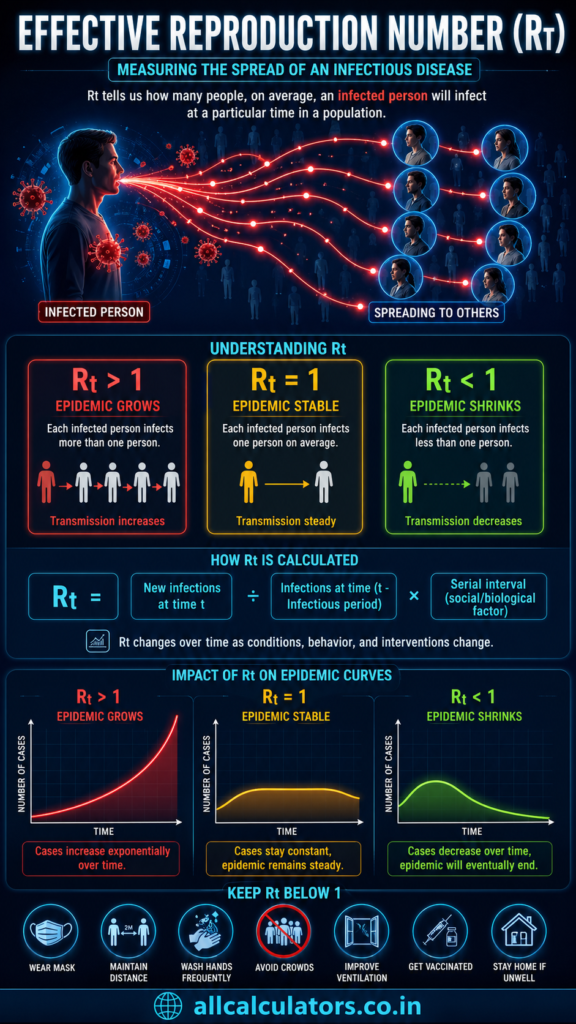
In simple terms:
- 🔴 Rₜ > 1 → The epidemic is GROWING. Each infected person spreads the disease to more than one other person, causing exponential increase in cases.
- 🟡 Rₜ = 1 → The epidemic is STABLE. The number of infections remains constant over time.
- 🟢 Rₜ < 1 → The epidemic is DECLINING. Infections are decreasing, and the outbreak is being brought under control.
This single number essentially acts as a real-time thermometer for disease outbreaks — and knowing it can guide life-saving decisions! 🌍
🧮 The Core Formula: How is Rₜ Calculated?
The most widely used formula for Effective Reproduction Number is based on the SIR (Susceptible-Infected-Recovered) epidemiological model:
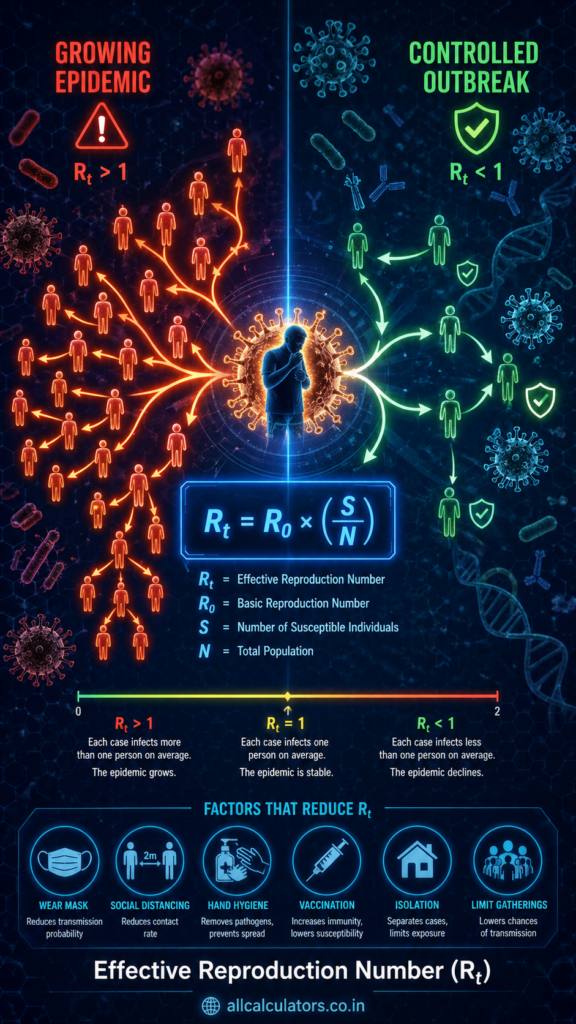
Rₜ = R₀ × (S/N)
Where:
- 📌 R₀ = Basic Reproduction Number (the maximum transmission potential of the disease in a fully susceptible population)
- 📌 S = Number of Susceptible individuals currently in the population
- 📌 N = Total population size
This elegant equation captures the essence of how immunity — both natural and vaccine-induced — reduces the spread of disease over time. As more people become immune (S decreases), Rₜ drops below R₀. When enough people gain immunity, Rₜ falls below 1, leading to the concept of herd immunity! 🛡️
For more advanced real-world applications, epidemiologists also calculate Rₜ using daily case counts and generation intervals (the average time between when one person gets infected and when they infect someone else). The CDC and WHO use sophisticated Bayesian statistical methods to estimate time-varying Rₜ from surveillance data across entire nations. 📈🔭
🌟 Why is Rₜ More Important Than R₀?
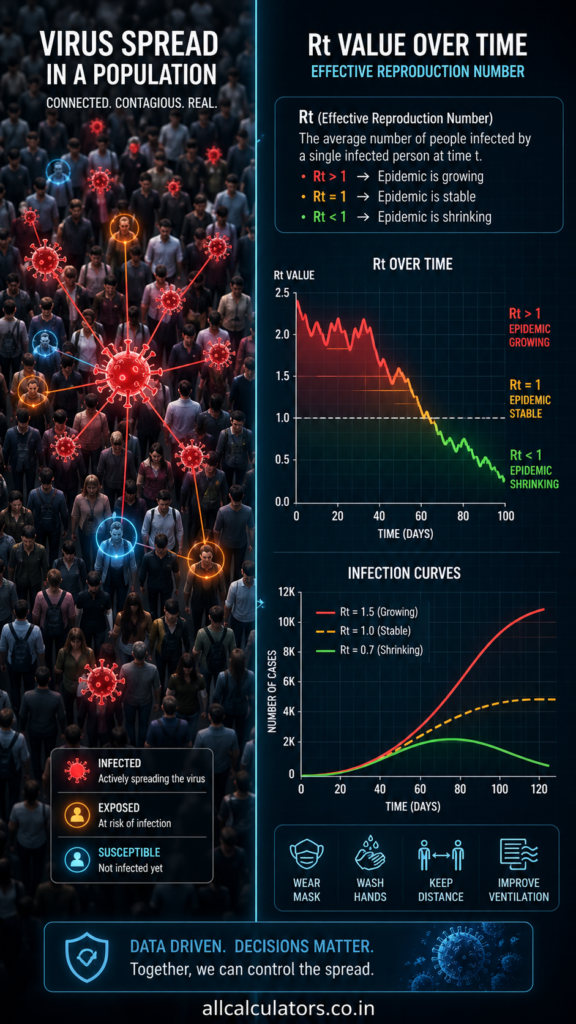
While R₀ tells you the theoretical contagiousness of a pathogen in ideal conditions, Rₜ tells you what is ACTUALLY happening right now in the real epidemic. During the COVID-19 pandemic, for example, interventions like lockdowns, masking, and vaccines dramatically reduced Rₜ even though the virus’s intrinsic R₀ remained unchanged. Studies showed that aggressive public health measures in Wuhan reduced Rₜ from approximately 3.86 to 0.32 in just five weeks! 😮 That is the extraordinary power of tracking and acting on Rₜ data.
Similarly, for diseases like Measles (R₀ ≈ 12–18), Influenza (R₀ ≈ 2–3), Ebola (R₀ ≈ 1.5–2.5), and Chickenpox (R₀ ≈ 10–12), the Effective Reproduction Number changes continuously depending on vaccination coverage and population behavior. 🦠
🖥️ How to Use Our Effective Reproduction Number Calculator?
Our user-friendly, free online Rₜ Calculator is designed for everyone — from high school biology students to university-level microbiology and immunology researchers:
- 🔢 Enter the Basic Reproduction Number (R₀) of the disease (you can look this up or estimate it)
- 👥 Enter the number of Susceptible individuals (S) in the population
- 🌍 Enter the Total Population (N)
- ⚡ Click “Calculate” and get your Rₜ value instantly — along with an interpretation of what the result means for the epidemic’s trajectory!
No complex equations. No textbooks needed. Just plug in the numbers and get answers! 📲✅
🎓 Academic & Scientific Significance
The concept of the Effective Reproduction Number sits at the very heart of Microbiology, Immunology, Virology, and Public Health. It is a fundamental topic in biology curricula worldwide — taught in undergraduate and postgraduate courses in Microbiology, Epidemiology, Immunology, Biotechnology, and Medicine. Students preparing for NEET PG, USMLE, public health exams, or biology olympiads will find this calculator an invaluable revision and problem-solving tool! 📚🏅
Understanding Rₜ helps you grasp deeper concepts like herd immunity thresholds, vaccination coverage requirements, epidemic modeling (SIR, SEIR models), serial intervals, generation time, and the critical role of non-pharmaceutical interventions (NPIs) in disease control. 🔬🧫
Use our Free Effective Reproduction Number Calculator at AllCalculators.co.in to sharpen your understanding, solve homework problems instantly, and stay ahead in your academic and professional journey! 💡🌐
🌍 Applications in Human Daily Life
🏠 Real-World Applications of Effective Reproduction Number (Rₜ) in Daily Life
🦠 1. Pandemic Monitoring & COVID-19 Tracking Governments and health agencies worldwide used Rₜ daily during COVID-19 to decide when to impose or lift lockdowns, restrict gatherings, or accelerate vaccine rollouts.
🏥 2. Hospital & Healthcare Planning When Rₜ rises above 1, healthcare administrators use it to predict upcoming surges in hospitalizations and pre-emptively allocate ICU beds, ventilators, and medical staff. 📋
💉 3. Vaccination Campaign Strategy Public health officials use Rₜ alongside herd immunity thresholds to determine what percentage of a population needs vaccination to bring Rₜ below 1 and halt the epidemic. 🩺
🏫 4. School & Workplace Safety Decisions During outbreaks of flu, measles, or other infectious diseases, Rₜ data helps schools and employers decide whether to close, mandate masks, or implement remote policies. 🎒💼
📱 5. News & Public Awareness Rₜ values are regularly reported in health news and government dashboards, helping the general public understand whether their region is safe or under epidemic threat. 📰
🌿 6. Travel & Quarantine Policy Airports and border authorities use real-time Rₜ data from different regions to make informed decisions about travel bans and quarantine requirements. ✈️🛂
🔬 7. Biology & Medical Education Students and researchers use Rₜ calculations daily for academic assignments, research papers, epidemiological projects, and public health internships. 📖

⚠️ Disclaimer 📋
🔔 The Effective Reproduction Number (Rₜ) Calculator on AllCalculators.co.in is designed purely for educational, academic, and informational purposes. The results generated by this tool are based on simplified mathematical formulas (Rₜ = R₀ × S/N) and should NOT be used as a substitute for professional epidemiological analysis, official public health guidance, or clinical decision-making. 🏥
Real-world Rₜ estimation by organizations like the CDC, WHO, and national health agencies involves complex Bayesian statistical models, surveillance data, and peer-reviewed methodologies that go far beyond this calculator. 📊 For any medical, public health, or policy-related decisions, always consult qualified healthcare professionals and official health authorities. 🩺
While we strive for accuracy, AllCalculators.co.in makes no warranty regarding the completeness, reliability, or fitness of the results for any specific purpose. Use responsibly and always cross-check with authoritative sources! ✅🌍
📌 Related Calculator
❓ FAQs
❓ What is the Effective Reproduction Number (Rt)?
Rt is the average number of people an infected individual transmits a disease to at a given time, considering immunity and interventions.
❓ What is the difference between R₀ and Rt?
R₀ assumes a fully susceptible population, while Rt reflects real-time conditions like vaccination and behavioral changes.
❓ How do you calculate Rt value?
Rt is calculated using infection data, transmission rates, and time intervals through epidemiological models or calculators.
❓ Why is Rt important in COVID-19 and other diseases?
It helps track virus spread, predict outbreaks, and guide public health decisions effectively.
❓ What does it mean if Rt is less than 1?
It indicates that the infection is declining and the outbreak is under control.
Understanding how diseases spread through a population is one of the most critical challenges in modern public health and epidemiology. Our free online Effective Reproduction Number Calculator makes computing it faster, smarter. https://t.co/CzhN0dXqqm pic.twitter.com/aANLsKrFdz
— AllCalculators (@allcalcs4u) April 28, 2026