
Infection Fatality Rate (IFR) Calculator
🧬 Microbiology & Immunology Calculator
📖 What is Infection Fatality Rate (IFR)?
The Infection Fatality Rate (IFR) is the proportion of deaths among all infected individuals. Unlike Case Fatality Rate (CFR), IFR includes asymptomatic and mild cases that may not be diagnosed. It’s crucial in understanding the true severity of an infectious disease.
📊 IFR Percentage: 0.00%
⚖️ Death to Infection Ratio: 0 : 0
🦠 Infection Rate: 0% (if population provided)
Table of Contents
✍️ Author & Academic Authority: Dr. Nitish Kr. Bharadwaj
📘 Qualifications: B.Sc., B.Ed., M.Sc., Ph.D. (Biochemistry), MBA (Financial Management)
🦠 Infection Fatality Rate Calculator
Understand the True Lethality of Infectious Diseases
When a new disease emerges and starts spreading across communities, one of the very first and most critical questions scientists, doctors, and public health officials ask is: “How deadly is this infection, really?” 🔬 The answer to that question lives in a powerful epidemiological metric called the Infection Fatality Rate (IFR) — and our free online Infection Fatality Rate Calculator is here to help students, researchers, medical professionals, and curious learners calculate and understand it with ease.
🧬 What is the Infection Fatality Rate (IFR)?
The Infection Fatality Rate (IFR) is a fundamental concept in microbiology and immunology that represents the proportion of deaths among all infected individuals — including those who were never diagnosed, tested, or showed any symptoms. In simple terms, IFR tells us: out of every 100 people who were actually infected with a pathogen, how many died?

The standard formula is: IFR (%) = (Total Deaths ÷ Total Estimated Infections) × 100
This sounds straightforward, but there’s a profound catch 🎯 — calculating the total number of actual infections is extremely difficult, especially during ongoing outbreaks. Many infected individuals remain asymptomatic (show no symptoms), never get tested, and are therefore never counted in official case reports. This invisible pool of infections is precisely what makes IFR so challenging — and so critically important — to estimate accurately.
⚡ IFR vs. CFR — What’s the Difference and Why Does It Matter?
This is where it gets truly interesting for biology and epidemiology students! 🎓 The Case Fatality Rate (CFR) and the Infection Fatality Rate (IFR) are two closely related but fundamentally different metrics:
🔵 CFR (Case Fatality Rate) = Deaths ÷ Confirmed Cases × 100 🟠 IFR (Infection Fatality Rate) = Deaths ÷ All Infected Individuals (including undetected) × 100
The key distinction? The denominator. CFR only counts confirmed, laboratory-tested cases, while IFR accounts for the entire infected population — including asymptomatic and undiagnosed cases. Because IFR’s denominator is always larger (more infections exist than confirmed cases), the IFR is always lower than the CFR for any given disease.
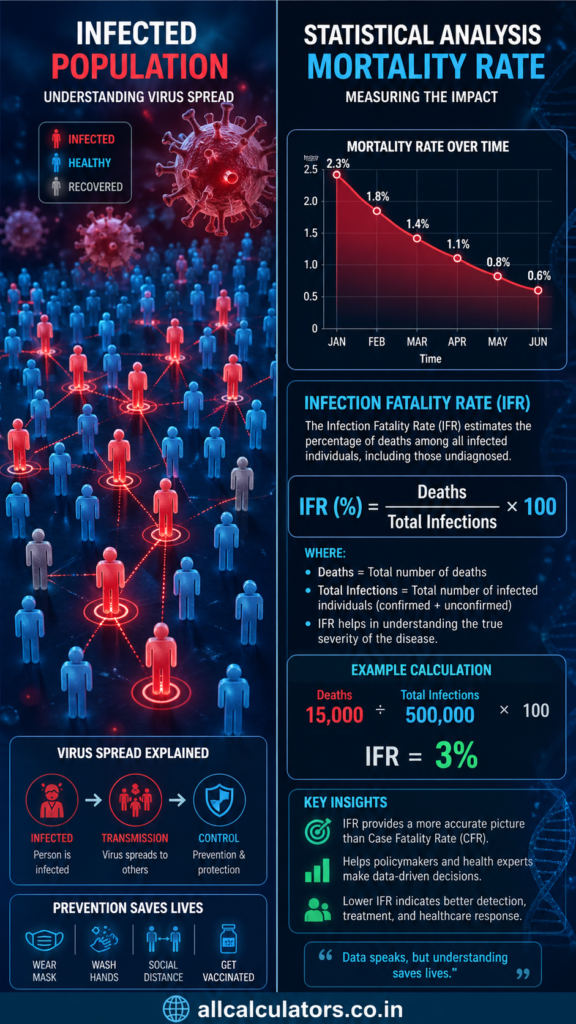
For example 📊, during the early phases of the COVID-19 pandemic, the World Health Organization initially reported a crude CFR of around 3.4%. However, after seroprevalence studies (blood antibody surveys across populations) began revealing the massive number of undetected infections, estimated IFR values dropped significantly — with many studies estimating an overall COVID-19 IFR in the range of 0.3%–0.7%. This dramatic difference had enormous implications for public health policy, lockdown decisions, vaccine prioritization, and global risk communication 🌍.
🔭 How is IFR Estimated? The Science Behind the Number
Accurately estimating the IFR requires sophisticated epidemiological methods. The most reliable approach uses seroprevalence surveys — large-scale blood tests that detect antibodies (signs of past infection) in random samples of a population 🩸. By measuring what percentage of a population has been exposed (seroprevalence rate), scientists can estimate the true total number of infections — even the ones that were never officially confirmed.
The formula then becomes: Estimated IFR = Total Deaths ÷ (Population × Seroprevalence Rate)
Other factors that scientists carefully correct for include: 🔹 Under-ascertainment bias — not all deaths are attributed to the disease 🔹 Right censoring — some infected individuals haven’t recovered or died yet at the time of analysis 🔹 Seroreversion — antibodies may fade over time, causing underestimation of past infections 🔹 Age stratification — IFR varies enormously across age groups; older populations carry much higher risk.
📈 IFR in the Context of Famous Diseases
Understanding IFR becomes more meaningful when applied to real diseases we know and study 🌡️:
🔴 Ebola Virus Disease — CFR up to 90%; IFR similarly high due to severe symptoms making detection nearly universal 🟡 COVID-19 (SARS-CoV-2) — Estimated overall IFR ~0.3–0.7%, but rising sharply with age (elderly populations 5%+) 🟢 Seasonal Influenza — IFR approximately 0.01–0.05%, very low due to widespread mild or asymptomatic infections 🔵 Spanish Flu 1918 — CFR exceeded 2.5%; IFR also historically high for that era 🟤 Rabies (unvaccinated) — CFR >99%, making IFR practically identical when no vaccination occurs.

🎯 Why is the Infection Fatality Rate Calculator Important for You?
Whether you’re a biology student calculating IFR for your microbiology assignment, a public health researcher estimating epidemic outcomes, a medical professional evaluating disease burden, or simply someone trying to understand the real risk of an ongoing outbreak — our free IFR Calculator simplifies all the complex mathematics into a single, intuitive online tool. ✅
🏫 Students can verify their manual calculations instantly 🧪 Researchers can quickly cross-check IFR estimates during data analysis 🏥 Healthcare workers can gauge population-level mortality risks 📰 Journalists & educators can fact-check published fatality figures 🌐 Policy thinkers can understand the epidemiological basis for public health decisions
The IFR is not just a number — it is a window into the true biological severity of an infectious disease, stripped of surveillance biases and testing inequalities. It is the closest we can get to understanding how deadly a pathogen truly is in the real world 🌏.
Use our Infection Fatality Rate Calculator now and master one of the most vital metrics in the world of Microbiology, Immunology, and Epidemiology! 🧬🔬💡
🌍 Applications in Human Daily Life
🧬 Real-World Applications of Infection Fatality Rate
🏥 Public Health Policy Making — Governments use IFR data to decide lockdowns, travel bans, and emergency measures during outbreaks.
💉 Vaccine Prioritization — IFR stratified by age helps health authorities identify who needs vaccines first (e.g., elderly, immunocompromised).
📊 Epidemic Modelling — Epidemiologists combine IFR with R₀ (reproduction number) to project total deaths and hospital demand during pandemics.
🎓 Biology & Microbiology Education — Students calculate IFR in exams, lab projects, and public health coursework worldwide.
📰 Fact-Checking Disease News — IFR helps citizens and journalists distinguish between CFR headlines and actual disease deadliness.
🏛️ Insurance & Risk Assessment — Life insurance and actuarial companies use IFR estimates to price pandemic risk policies.
🔬 Pharmaceutical Research — Drug and vaccine developers use IFR as a benchmark to evaluate clinical trial endpoints.
🌐 Global Health Surveillance (WHO, CDC) — International agencies track IFR across regions to monitor disease severity trends in real time.

⚠️ Disclaimer 🛡️
🔬 The Infection Fatality Rate (IFR) Calculator on AllCalculators.co.in is designed purely for educational, academic, and informational purposes only. 📚 The results generated by this tool are based on user-provided inputs and standard epidemiological formulas — they do not constitute medical advice, clinical diagnosis, or official public health guidance. 🏥 IFR estimation in real-world disease outbreaks requires complex seroprevalence data, demographic corrections, and expert epidemiological analysis that goes beyond simple calculation. 🧪 Always consult qualified healthcare professionals, certified epidemiologists, or official health authority publications (WHO, CDC, ICMR) for any health-related decisions. 🌐 Fatality rate data for specific diseases may vary by region, time period, population demographics, and healthcare capacity. ✅ Use this tool responsibly and always verify results against peer-reviewed scientific literature. 💡
📌 Related Calculator
❓ FAQs🔥
❓ What is an Infection Fatality Rate Calculator?
🦠 It is an online tool that calculates the infection fatality rate (IFR) by dividing total deaths by total infections, including undiagnosed cases.
❓ What is the difference between IFR and CFR?
📊 IFR includes all infections, while CFR only considers confirmed cases, making IFR more accurate for real mortality estimation.
❓ How do you calculate infection fatality rate?
🧮 Use the formula: IFR = (Deaths / Total Infections) × 100. Our calculator automates this instantly.
❓ Why is IFR important in epidemiology?
🌍 It helps measure the true severity of a disease and guides public health decisions.
❓ Can IFR be lower than CFR?
✅ Yes, IFR is usually lower because it includes undetected infections, unlike CFR.
When a new disease emerges and starts spreading across communities, one of the very first and most critical questions scientists, doctors, and public health officials ask is: “How deadly is this infection, really?”https://t.co/2uRFJM8o06 pic.twitter.com/T50oIQAr1u
— AllCalculators (@allcalcs4u) April 28, 2026