
🧬 Cytokine Storm Risk Calculator
📐 Formula Used
Where: CSRI = Cytokine Storm Risk Index
Risk Levels: Low (<10) | Moderate (10-25) | High (25-50) | Severe (>50)
⚠️ Medical Disclaimer
This calculator provides indicative risk assessment based on biomarker levels. It is NOT a substitute for professional medical diagnosis. Always consult a healthcare provider for proper evaluation and treatment. Cytokine storm is a serious medical condition requiring immediate clinical attention.
Table of Contents
✍️ Author & Academic Authority: Dr. Nitish Kr. Bharadwaj
📘 Qualifications: B.Sc., B.Ed., M.Sc., Ph.D. (Biochemistry), MBA (Financial Management)
🧬 Cytokine Storm Risk Calculator
Understand Your Body’s Immune Overdrive
🔬 In the world of microbiology and immunology, few phenomena are as dramatic, dangerous, and scientifically fascinating as a cytokine storm. Also called Cytokine Release Syndrome (CRS) or Cytokine Storm Syndrome (CSS), this is a life-threatening condition where your own immune system goes into a catastrophic overdrive — flooding the body with an uncontrolled torrent of chemical messengers called cytokines. Our Cytokine Storm Risk Calculator is a powerful educational tool designed to help biology students, medical aspirants, researchers, and health-aware individuals understand and estimate the risk of this dangerous immune event based on clinically recognized biomarkers. 🩺
🧪 So, what exactly is a cytokine storm?
Under normal conditions, your immune system releases cytokines — tiny signaling proteins like Interleukin-6 (IL-6), Interleukin-1β (IL-1β), and Tumor Necrosis Factor-alpha (TNF-α) — to coordinate the body’s response to pathogens like viruses or bacteria. This is a beautifully balanced process. However, in certain individuals and under certain disease conditions, this process spirals completely out of control. Instead of a measured, targeted response, the immune system unleashes a massive, unregulated wave of pro-inflammatory cytokines, triggering widespread tissue damage, multi-organ failure, and in severe cases, death. 💥
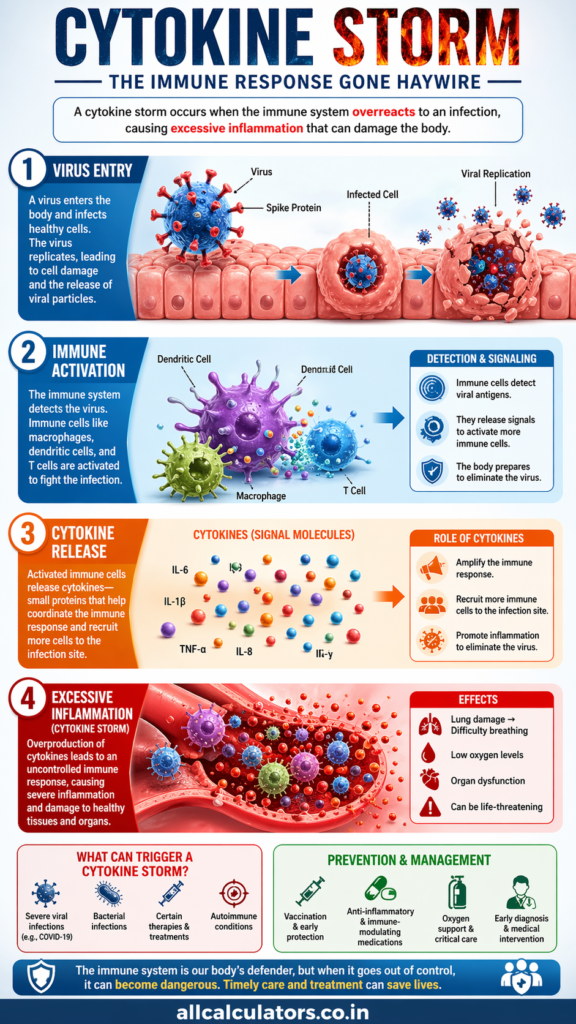
🦠 Cytokine storms became globally recognized during the COVID-19 pandemic, when researchers discovered that a significant number of deaths were not caused directly by the SARS-CoV-2 virus itself — but rather by the victim’s own immune system attacking the body in response. Studies revealed that elevated serum IL-6 levels above 23 pg/mL, CRP (C-Reactive Protein) of 50 mg/L or greater, and serum ferritin exceeding 400 ng/mL were all powerful red-flag biomarkers indicating a dangerous cytokine storm was underway or imminent. These findings were echoed across hundreds of peer-reviewed clinical studies worldwide, cementing these markers as the gold standard for cytokine storm risk assessment. 📊
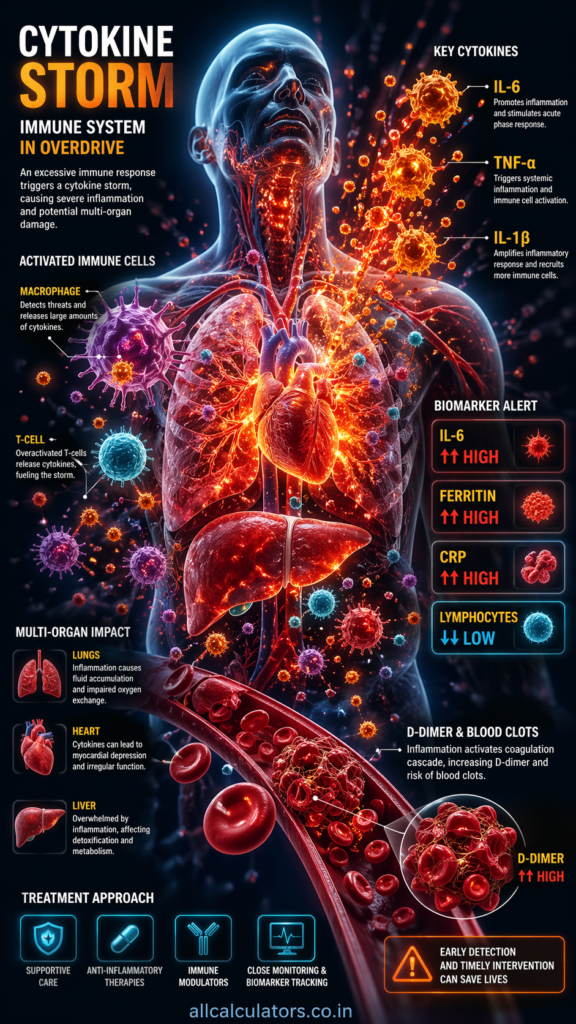
⚗️ Key biomarkers used in cytokine storm risk assessment include a constellation of measurable laboratory values. IL-6 is perhaps the most critical single marker — it is a master pro-inflammatory cytokine directly driving the hyperinflammatory cascade. Ferritin, an iron-storage protein, skyrockets during immune activation and serves as a sensitive marker of macrophage activity and systemic inflammation. CRP (C-Reactive Protein) is a classic acute-phase reactant that climbs sharply during any significant inflammatory episode. D-dimer reflects blood clotting abnormalities that accompany severe cytokine storms. LDH (Lactate Dehydrogenase) signals tissue damage across multiple organ systems. And critically, absolute lymphocyte count (ALC) — when it falls below 0.72 × 10⁹/L — indicates the immune system is paradoxically both over-activated and increasingly compromised. 🧫
🔴 Who is at higher risk?
Clinical research has identified several key risk factors that increase an individual’s susceptibility to developing a cytokine storm. These include: age above 40 years 👴, male biological sex 👨⚕️, presence of active viral infections (especially SARS-CoV-2), autoimmune conditions, cancer immunotherapy treatments (CAR-T cell therapy), hemophagocytic lymphohistiocytosis (HLH), sepsis, and macrophage activation syndrome (MAS). Understanding these risk factors is critical not just in clinical medicine, but also for students studying for competitive biology, NEET, USMLE, and biomedical science exams. 📚
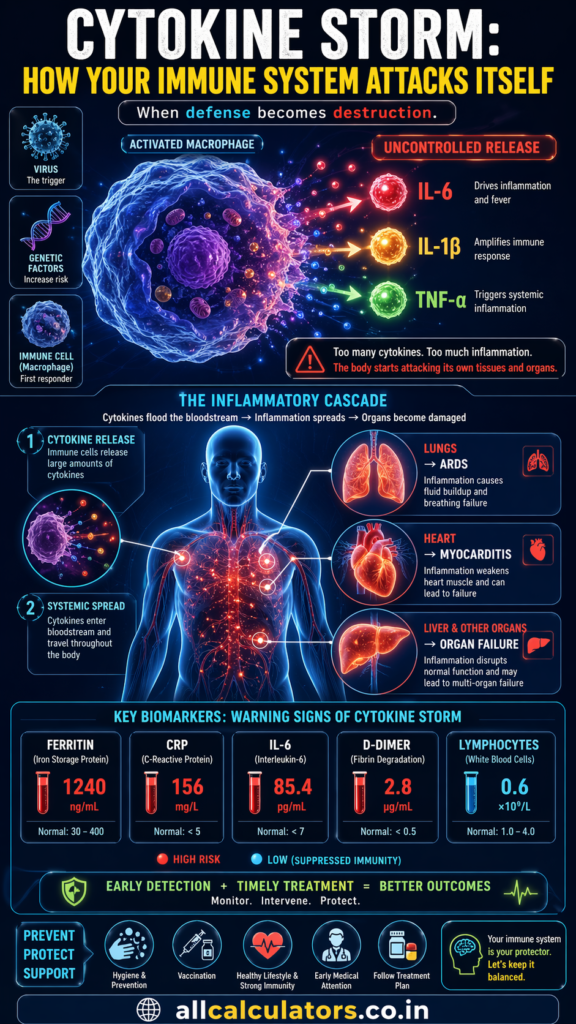
🧠 The science behind the storm is rooted in the concept of immune dysregulation. Normally, regulatory T-cells and natural killer cells keep the immune response balanced and proportionate. In a cytokine storm, this feedback loop breaks down catastrophically. Aberrant pathogenic T-cells and inflammatory monocytes rapidly produce excessive cytokines, creating a devastating amplification loop. The result? Acute Respiratory Distress Syndrome (ARDS), capillary leak syndrome, widespread endothelial damage, disseminated intravascular coagulation (DIC), and multi-organ failure — all within a dangerously short time window. ⏱️
💡 Why use a Cytokine Storm Risk Calculator?
Our free online calculator at AllCalculators.co.in integrates the most clinically validated biomarkers — including IL-6 levels, serum ferritin, CRP, D-dimer, lymphocyte count, LDH, and demographic risk factors — to compute an estimated risk score. This tool is perfect for: 🎓 biology and medical students understanding inflammatory pathways, 👩🔬 researchers and educators teaching immunology concepts, 🏥 pre-clinical learners studying critical care scenarios, and 💻 health-curious individuals who want to understand what their lab results may indicate in the context of hyperinflammation. Whether you’re preparing for a university exam, writing a research paper, or simply trying to understand a complex lab report, this calculator empowers you with science-backed insights.
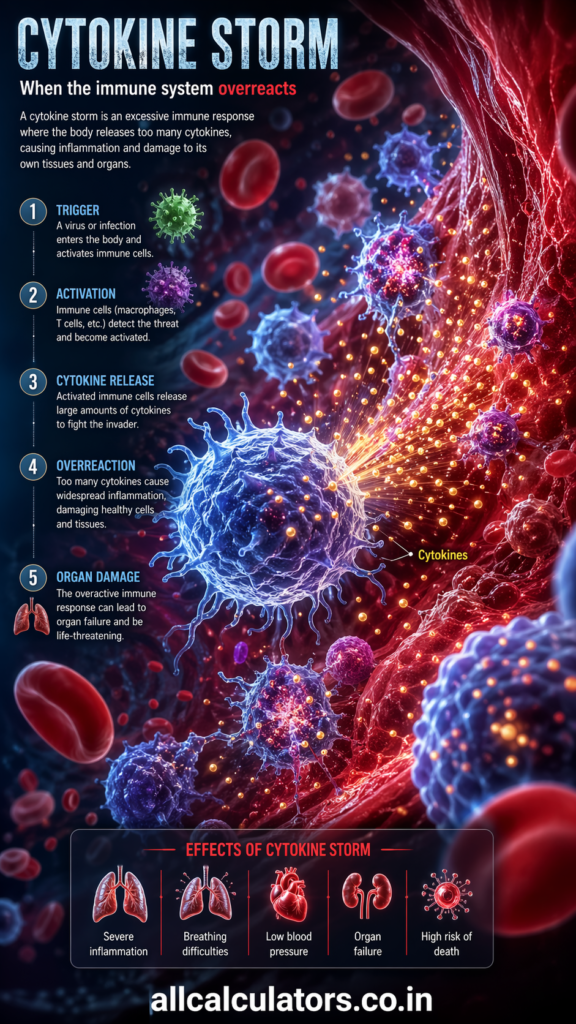
🌐 Beyond COVID-19, cytokine storms are relevant across a wide spectrum of clinical conditions — including sepsis, influenza, dengue fever, Ebola, systemic lupus erythematosus (SLE), and even certain cancer treatments. As immunotherapy becomes an increasingly dominant force in oncology, cytokine release syndrome is now a regularly monitored risk factor in patients receiving CAR-T cell therapy and checkpoint inhibitors. The ability to assess and predict this risk using quantifiable biomarkers is one of the most exciting frontiers in modern clinical immunology. 🔭
🧬 Use our Cytokine Storm Risk Calculator today — completely free, no sign-up required — and take your understanding of immune biology to the next level! 🚀
🌍Applications in Human Daily Life
🏥 Clinical & Hospital Settings — Doctors and ICU teams use cytokine storm biomarkers (IL-6, CRP, ferritin) to monitor critically ill patients and decide when to start anti-inflammatory treatment like tocilizumab or corticosteroids.
🦠 Infectious Disease Management — During flu season, dengue outbreaks, or respiratory viral pandemics, understanding cytokine storm risk helps families and patients know when mild illness may be escalating into a dangerous hyperinflammatory state. ⚠️
🎓 Students & Academic Learning — Medical, nursing, pharmacy, and biology students use cytokine storm concepts daily in pathophysiology, microbiology, and pharmacology studies — especially for competitive exams like NEET PG, USMLE, and AIIMS. 📖
🧬 Cancer & Immunotherapy Patients — People undergoing CAR-T therapy or immune checkpoint inhibitor cancer treatment are regularly screened for Cytokine Release Syndrome (CRS) — making this calculator highly relevant for oncology patients and caregivers. 💊
🩺 Autoimmune Disease Monitoring — Patients with lupus, rheumatoid arthritis, or juvenile idiopathic arthritis face periodic cytokine storm risk (called Macrophage Activation Syndrome) and benefit enormously from understanding inflammatory markers. 🔍
👨👩👧 Parental Awareness — Parents of children with inflammatory disorders like MIS-C (Multisystem Inflammatory Syndrome in Children) can use this educational calculator to better understand their child’s blood work. 🧒
💪 Fitness & Recovery — Elite athletes and fitness enthusiasts experiencing prolonged intense exercise sometimes face elevated inflammatory cytokines — understanding the threshold between healthy inflammation and risk is empowering. 🏃♂️
⚠️ Disclaimer 📋
🔬 The Cytokine Storm Risk Calculator on AllCalculators.co.in is strictly an educational and informational tool designed for academic learning, biology students, and health-awareness purposes only. 🎓 The results generated by this calculator are NOT a medical diagnosis, and should NOT be used as a substitute for professional medical advice, clinical diagnosis, or treatment decisions. 🏥
🩺 All biomarker thresholds and risk parameters used in this calculator are based on published scientific research and peer-reviewed clinical studies — however, individual medical conditions vary significantly. Always consult a qualified doctor or healthcare professional for interpretation of your personal lab results. 👨⚕️
📌 AllCalculators.co.in is not liable for any health decisions made based on the use of this tool. If you believe you or someone you know may be experiencing symptoms of a cytokine storm or hyperinflammation, seek emergency medical care immediately. 🚨
📌 Related Calculator
❓ FAQs
❓ What is a cytokine storm? 🌪️
A cytokine storm is an extreme immune response where the body releases excessive inflammatory cytokines, potentially causing tissue damage and severe complications.
❓ How does a cytokine storm risk calculator work? 🧮
It evaluates symptoms, immune markers, and health conditions to estimate the likelihood of immune system overreaction.
❓ Can this calculator diagnose diseases like COVID-19? 🦠
No, it only provides risk awareness. It does not diagnose diseases like COVID-19.
❓ Who should use this cytokine storm calculator? 👨⚕️
Students, researchers, and individuals interested in understanding immune response and inflammation risk.
❓ What are common cytokine storm symptoms? 🤒
High fever, fatigue, inflammation, breathing difficulty, and organ stress are common indicators.
In the world of microbiology and immunology, few phenomena are as dramatic, dangerous, and scientifically fascinating as a cytokine storm. https://t.co/JNbIgiJcIg pic.twitter.com/GUuSfUJPrw
— AllCalculators (@allcalcs4u) April 24, 2026