
🧫 Antimicrobial Synergy Calculator
Where FIC = Fractional Inhibitory Concentration
| FIC Index | Effect | Description |
|---|---|---|
| ≤ 0.5 | 🟢 Synergy | Combined effect significantly greater than expected |
| 0.5 – 1.0 | 🟡 Additive | Combined effect equals sum of individual effects |
| 1.0 – 4.0 | 🟠 Indifferent | No meaningful interaction between drugs |
| > 4.0 | 🔴 Antagonism | Combined effect less than expected from individual effects |
Table of Contents
✍️ Author & Academic Authority: Dr. Nitish Kr. Bharadwaj
📘 Qualifications: B.Sc., B.Ed., M.Sc., Ph.D. (Biochemistry), MBA (Financial Management)
🧬 Antimicrobial Synergy
Calculator Your Smart Tool to Decode Antibiotic Combination Power 💊🔬
In a world where antimicrobial resistance (AMR) is rapidly becoming one of the deadliest global health crises of the 21st century, understanding how antibiotics work — especially in combination — has never been more critical. The Antimicrobial Synergy Calculator is a powerful, easy-to-use educational and research tool that helps microbiology students, pharmacology researchers, clinical laboratory scientists, and healthcare educators instantly calculate and interpret the Fractional Inhibitory Concentration Index (FICI) — the gold-standard metric used to evaluate whether two antimicrobial drugs work better together, independently, or against each other. 🌍💡
🔬 What is Antimicrobial Synergy?
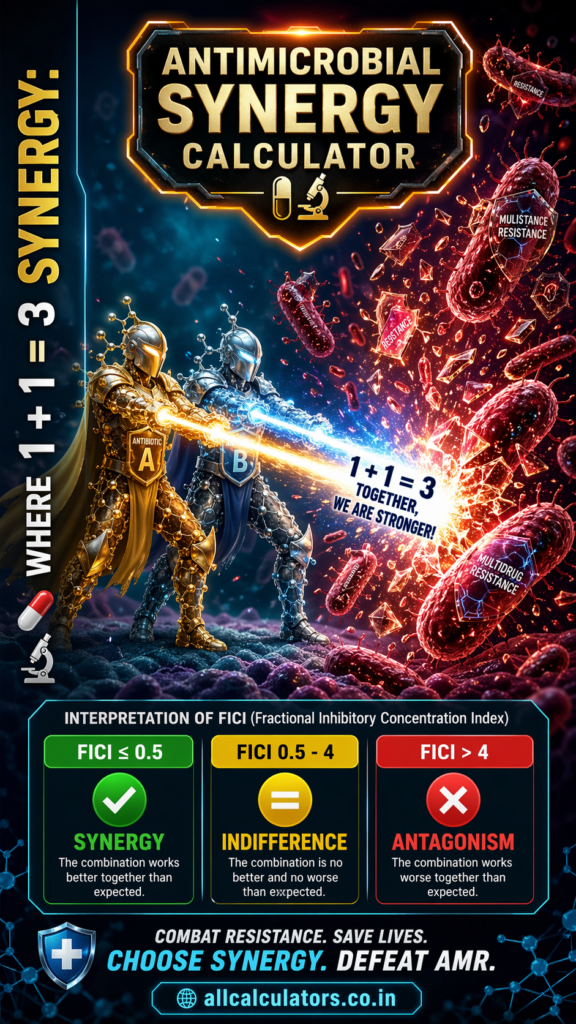
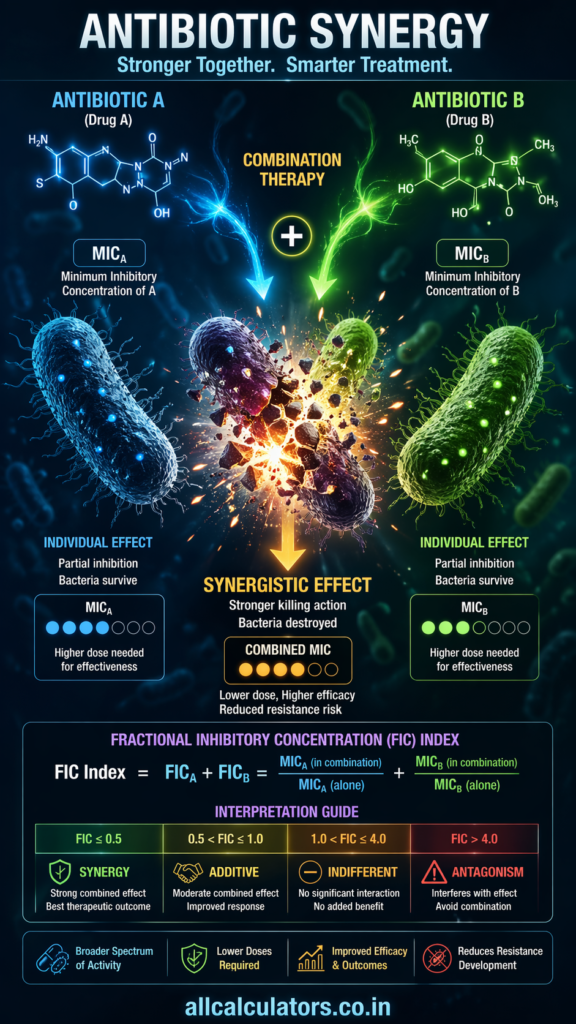
Antimicrobial synergy occurs when two drugs, used together in combination, produce a greater antibacterial effect than the sum of their individual effects. Think of it as a "1 + 1 = 3" phenomenon in pharmacology! This is the exact opposite of antagonism, where one drug actually weakens the other. Between these two extremes lies "indifference" or additivity, where the combined effect simply equals what each drug would do alone. Understanding these interactions is fundamental not just for academic microbiology but for real-world antibiotic stewardship programs aimed at fighting drug-resistant superbugs. 🦠⚔️
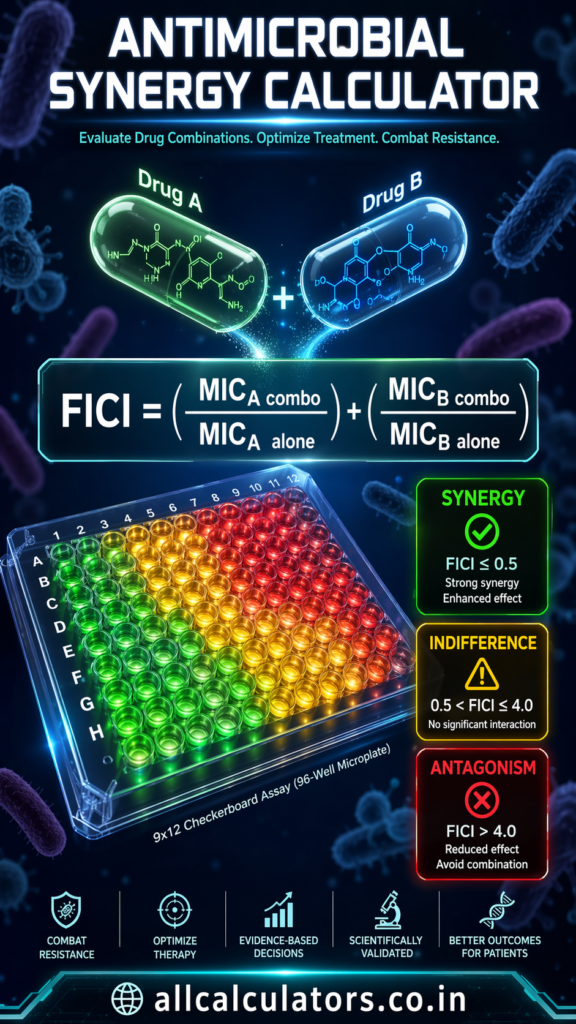
📐 The Science Behind the FIC Index The Fractional Inhibitory Concentration (FIC) Index is the most widely used mathematical formula to quantify antibiotic interactions. It is calculated using the checkerboard assay method, where two antibiotics are tested in a matrix of varying concentrations against a target microorganism. The formula is:
FICI = (MIC of Drug A in Combination ÷ MIC of Drug A Alone) + (MIC of Drug B in Combination ÷ MIC of Drug B Alone)
Where MIC stands for the Minimum Inhibitory Concentration — the lowest concentration of a drug that prevents visible bacterial growth. Once the FICI is calculated, the result is interpreted as follows:
🟢 FICI ≤ 0.5 → Synergy — The combination is significantly more effective than either drug alone. This is the most desirable outcome, especially when combating multidrug-resistant (MDR) organisms like MRSA, carbapenem-resistant Enterobacterales (CRE), and XDR Acinetobacter.
🟡 FICI > 0.5 and ≤ 4.0 → Indifference / Additivity — The drugs work independently without either enhancing or reducing each other's effect.
🔴 FICI > 4.0 → Antagonism — The combination is harmful; one drug inhibits or counteracts the effect of the other, potentially making treatment worse. This outcome must always be avoided clinically. ❌
🧪 How the Checkerboard Method Works?
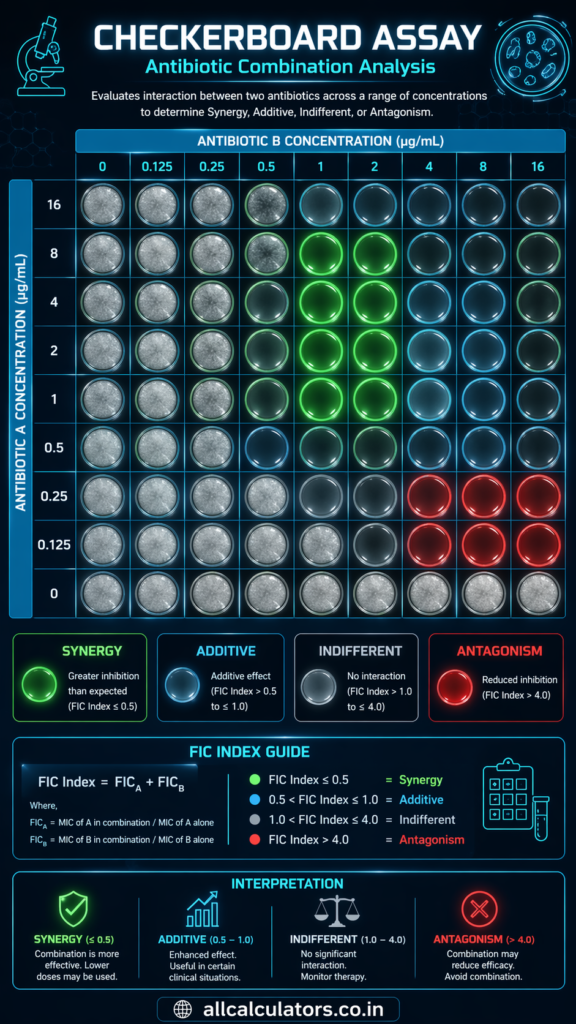
The checkerboard assay is the benchmark laboratory technique upon which synergy calculators are built. In this method, serial dilutions of Drug A (horizontal axis) are tested against serial dilutions of Drug B (vertical axis) in a 96-well microtiter plate. Each well in the resulting "checkerboard" contains a unique combination of both drugs at different concentrations. The wells are then incubated with the target bacterium, and growth is monitored. The well that shows the lowest FICI value while still inhibiting bacterial growth indicates the most effective concentration pair — and determines whether the combination is synergistic, indifferent, or antagonistic. 🔭🧫
💻 Why Use an Online Antimicrobial Synergy Calculator?
Traditionally, calculating the FICI requires careful manual computation and data interpretation, which can be prone to human error — especially for students learning microbiology for the first time. Our online Antimicrobial Synergy Calculator at AllCalculators.co.in eliminates this complexity. All you need to do is enter the MIC values of each drug — both when used alone and when used in combination — and the calculator instantly computes the FICI and delivers a clear, color-coded result: Synergy ✅, Indifference ⚠️, or Antagonism ❌. This makes it an invaluable tool for:
🎓 Students studying microbiology, pharmacology, medical lab technology (MLT), pharmacy, MBBS, BVSC, and allied health sciences. 🔬 Researchers conducting in-vitro antimicrobial combination studies. 👩⚕️ Clinicians & Pharmacists who need to review drug combination rationale for complex infections. 📊 Educators building teaching models around antibiotic pharmacodynamics.
🌐 Why Antimicrobial Synergy Matters in 2025 and Beyond ?
According to the WHO's Global Antimicrobial Resistance and Use Surveillance System (GLASS) 2025 report, AMR is now directly or indirectly linked to millions of deaths globally every year, with projections suggesting up to 10 million annual deaths by 2050 if unchecked. Resistance rates for key pathogens like methicillin-resistant Staphylococcus aureus (MRSA) and carbapenem-resistant E. coli continue to rise alarmingly across 110 countries. In this landscape, synergistic antibiotic combinations represent one of the most important strategies available — attacking bacteria through multiple mechanisms simultaneously to both enhance efficacy and reduce the emergence of resistance. 🏥🌏
Our Antimicrobial Synergy Calculator bridges the gap between complex laboratory science and accessible digital education — making advanced microbiology concepts available to every student and researcher, right from their smartphone or laptop. 📱💻
🌍 Application in Daily Human Life
🌿 Real-Life Applications of Antimicrobial Synergy Knowledge
🏥 Hospital Infection Control: Doctors treating ICU patients with multidrug-resistant infections regularly rely on synergy data to select the most effective antibiotic combinations, saving lives when no single drug works alone.
💊 Pharmacy & Prescription Optimization: Pharmacists use synergy principles to flag potentially antagonistic drug combinations in prescriptions, ensuring patients receive the most effective treatment possible.
🎓 Medical & Pharmacy Education: Medical students, nursing students, and pharmacy learners use FIC index calculations in labs and exams as a core part of their antimicrobial pharmacology curriculum worldwide.
🔬 Microbiology Research Labs: Scientists studying new antibiotics or natural antimicrobials (like plant extracts, peptides, and nanoparticles) use synergy calculators as a first step in screening drug candidates for combination potential.
🐄 Veterinary Medicine: Animal health professionals use antimicrobial synergy testing to treat livestock infections with resistant bacteria, ensuring food safety and preventing zoonotic disease spread.
🌱 Food Safety & Preservation: Food microbiologists apply synergy testing to evaluate combinations of natural antimicrobials (like nisin + chitosan) used as preservatives in food products — reducing chemical usage while maintaining safety.
🧫 Biofilm & Chronic Infection Research: Synergy testing is critical for studying how antibiotic combinations can better penetrate and disrupt biofilms, which are highly resistant bacterial communities responsible for chronic infections.
📱 Student Exam Preparation: Students preparing for NEET PG, USMLE, GPAT, CSIR NET, and other competitive exams can use this tool for quick practice calculations of FICI-based questions.
⚠️ Disclaimer
⚠️ This Antimicrobial Synergy Calculator is intended for educational and research purposes only 🧪. While it provides accurate FIC index calculations based on user input, it should not replace professional medical advice, laboratory validation, or clinical judgment 🏥. Always consult qualified healthcare or microbiology experts before making treatment decisions 💊.
📌 Related Calculator
❓ FAQs
❓ What is an antimicrobial synergy calculator? 🧬
It is a tool used to evaluate how two antibiotics interact, determining whether they produce synergistic, additive, or antagonistic effects using FIC index calculations.
❓ How does the FIC index calculator work? 📊
It calculates the ratio of MIC values of drugs in combination versus alone and sums them to determine the interaction type.
❓ What is considered synergy in antibiotic combinations? 🚀
Synergy occurs when the FIC index is ≤ 0.5, indicating enhanced effectiveness when drugs are combined.
❓ Why is antimicrobial synergy important? 🌍
It helps combat antibiotic resistance, improves treatment outcomes, and reduces drug toxicity.
❓ Can students use this antibiotic combination calculator? 🎓
Yes, it is highly useful for microbiology, pharmacology, and immunology students to understand drug interactions practically.
In a world where antimicrobial resistance (AMR) is rapidly becoming one of the deadliest global health crises of the 21st century, understanding how antibiotics work — especially in combination.https://t.co/7l893d448g pic.twitter.com/q0zsZPkgpb
— AllCalculators (@allcalcs4u) April 24, 2026