
🏎️ 1. Mechanics & Motion Calculators
- Velocity Calculator
- Acceleration Calculator
- Displacement Calculator
- Speed Calculator
- Distance Calculator
- Force Calculator
- Momentum Calculator
- Impulse and Momentum Calculator
- Projectile Motion Calculator
- Friction Calculator
- Normal Force Calculator
- Gravitational Force Calculator
- Terminal Velocity Calculator
- Tension Calculator
- Hooke Law Calculator
- Inclined Plane Calculator
- Conservation of Momentum Calculator
- Relative Motion Calculator
- Newtons Laws Calculator
- Magnitude of Acceleration Calculator
- Speed vs Velocity Calculator
⚡ 2. Energy, Work & Power Calculators
- Kinetic Energy Calculator
- Potential Energy Calculator
- Kg to Newtons Calculator
- Work Done Calculator
- Power and Work Calculator
- Conservation of Energy Calculator
- Efficiency of Machine Calculator
- Watt to Horsepower Calculator
- Gravitational Potential Calculator
- Collision Calculator
- Spring Potential Energy Calculator
- Heat Energy Calculator
- Work Energy Calculator
- Impact Energy Calculator
- Impact Energy Calculator
- Electrical Power Calculator
- Watt Calculator
- Watt Converter
- Capacitor Energy Calculator
- Nuclear Binding Energy Calculator
- Photon Energy Calculator
🌀 3. Rotational & Circular Motion Calculators
- Torque Calculator
- Angular Velocity Calculator
- Angular Acceleration Calculator
- Centripetal Force Calculator
- Centrifugal Force Calculator
- Circular Motion Calculator
- Moment of Inertia Calculator
- Rotational Kinetic Energy Calculator
- Angular Momentum Calculator
- Rolling Motion Calculator
- Angle of Banking Calculator
- Gyroscope Precession Calculator
- Quarter Mile Calculator
- Ground Speed Calculator
- Pulley Calculator
- Gear Ratio Calculator
- Centripetal Acceleration Calculator
- Conical Pendulum Calculator
- Coriolis Effect Calculator
- Flywheel Energy Calculator
📡 4. Waves, Sound & Optics Calculators
- Frequency Calculator
- Wavelength Calculator
- Wave Speed Calculator
- Speed of Sound Calculator
- Doppler Effect Calculator
- Simple Harmonic Motion Calculator
- Simple Pendulum Calculator
- Harmonic Wave Equation Calculator
- Resonance Frequency Calculator
- Decibel Calculator
- Snell’s Law Calculator
- Lens Focal Length Calculator
- Mirror Image Distance Calculator
- Magnification Calculator
- Refractive Index Calculator
- Young’s Double Slit Calculator
- Diffraction Grating Calculator
- Critical Calculator
- Amplitude Calculator
- Standing Wave Calculator
♨️ 5. Thermodynamics & Heat Transfer Calculators
- Specific Heat Calculator
- Thermal Expansion Calculator
- Ideal Gas Law Calculator
- Gas Laws Calculator
- Heat Transfer Calculator
- Carnot Engine Efficiency Calculator
- Entropy Calculator
- Newton’s Law of Cooling Calculator
- Gas Laws Calculator
- Stefan Boltzmann Law Calculator
- Latent Heat Calculator
- Thermal Stress Calculator
- Real Gas Equation Calculator
- Adiabatic Process Calculator
- RMS Velocity Calculator
- Heat Engine Efficiency Calculator
- Temperature Conversion Calculator
- Dew Point Calculator
🧲 6. Electricity & Magnetism Calculators
- Ohm’s Law Calculator
- Series Parallel Resistance Calculator
- Capacitor Size Calculator
- RC Circuit Calculator
- Resistor Color Code Calculator
- Coulomb’s Law Calculator
- Electric Field Calculator
- Voltage Drop Calculator
- Drift Velocity Calculator
- RMS Voltage Calculator
- MOSFET Calculator
- Magnetic Force Calculator
- Faraday’s Law Calculator
- Lorentz Force Calculator
- Gauss’s Law Calculator
- Hall Coefficient Calculator
- Magnetic Dipole Moment Calculator
- Generator Power Calculator
- Watts to Amps Lux Calculator
🌌 7. Modern Physics, Quantum & Relativity Calculators
- de Broglie Wavelength Calculator
- Photoelectric Effect Calculator
- Heisenberg’s Uncertainity Principle Calculator
- Bohr Model Calculator
- Rydberg Equation Calculator
- Time Dilation Calculator
- Length Contraction Calculator
- Emc2 Calculator
- Radioactive Decay Calculator
- Nuclear Fission Calculator
- Relativistic Momentum Calculator
- Compton Scattering Calculator
- Quantum Tunneling Calculator
- Davisson-Germer Calculator
- Pair Production Calculator
- Work Function Calculator
- Cyclotron Frequency Calculator
- Redshift Calculator
- Radiation Energy Calculator
- Carbon Dating Calculator
🔭 8. Gravitation, Astronomy & Space Calculators
- Orbital Period Calculator
- Orbital Velocity Calculator
- Escape Velocity Calculator
- Gravitational Acceleration Calculator
- Schwarzschild Radius Calculator
- Orbital Velocity Calculator
- Luminosity Calculator
- Light Year Calculator
- Parallax Calculator
- Rocket Thrust Calculator
- Satellite Altitude Calculator
- Tidal Force Calculator
- Hubble’s Law Calculator
- Synodic Period Calculator
- Planetary Weight Calculator
- Chandrasekhar Limit Calculator
- Moon Phase Calculator
- Kepler’s 2nd Law Calculator
- Kepler’s 3rd Law Calculator
- Gravitational Potential Orbit Calculator
- Star Magnitude Calculator
- Solar Irradiance Calculator
⚙️ 9. Fluid Mechanics, Solid Mechanics Calculators
- Density Calculator
- Pressure Calculator
- Buoyancy Calculator
- Archimedes’ Principle Calculator
- Bernoulli Equation Calculator
- Continuity Equation Calculator
- Reynolds Number Calculator
- Poiseuille’s Law Calculator
- Surface Tension Calculator
- Young Modulus Calculator
- Bulk Modulus Calculator
- Poisson Ratio Calculator
- Hoop Stress Calculator
- Shear Stress Calculator
- Hydraulic Press Calculator
- Torricelli’s Theorem Calculator
- Buckling Load Calculator
- Angle of Twist Calculator
- Pascal’s Law Calculator
- Angle of Repose Calculator
- Impact Test Calculator
📡 10. Applied Physics, Optoelectronics & Advanced Calculators
- Trajectory Calculator
- Speed vs Velocity Calculator
- Debye Length Calculator
- Speed of Electron Calculator
- Volt to Electron Volt Calculator
- Magnetic Permeability Calculator
- Electromagnetic wave Calculator
- Laser Power Calculator
- Fiber Optic Calculator
- Signal to Noise Ratio Calculator
- Resolving Power Calculator
- Planck’s Radiation Calculator
- Bug-Rivet Paradox Calculator
- Coulomb vs Gravity Calculator
- Jee Physics Calculator
- AP Physics Calculator
- A-Level Physics Calculator
- Dimensional Analysis Calculator
- Significant Figures Calculator
- Physics Formula Calculator
✨ 11. Physics Miscellaneous Calculators
- Damping Ratio Calculator
- Buckling Calculator
- Dipole Moment Calculator
- Wheatstone Bridge Calculator
- Solenoid Magnetic Field Calculator
- Wire Resistance Calculator
- Quantum Number Calculator
- Frequency of Light Calculator
- Magnetic Moment Calculator
- Wien’s Law Calculator
- Calorimetry Calculator
- Carnot Efficiency Calculator
- Heat Capacity Calculator
- Curie’s Law Calculator
- Particles Velocity Calculator
- Thermal Energy Calculator
- Mixed Air Temperature Calculator
- Air Density Calculator
- Air Pressure at Altitude Calculator
- Dew Point Calculator
- Poise-Stokes Converter
- Stokes’ Law Calculator
- Water Density Calculator
- Water Viscosity Calculator
- Darcy’s Law Calculator
- Ampere Circuital Law Calculator
- Hysteresis Loop Calculator
- Biot-Savart Law Calculator
✍️ Author & Academic Authority: Dr. Nitish Kr. Bharadwaj
📘 Qualifications: B.Sc., B.Ed., M.Sc., Ph.D. (Biochemistry), MBA (Financial Management)
⚛️ Physics Calculators – Free Online Scientific Tools for Accurate Physics Solutions 🚀🔬
Physics is not just a subject in your textbook 📚 — it is the invisible language the universe uses to communicate with us every single day. From the moment you wake up and feel gravity pull you out of bed 🛏️, to the momentum of a car speeding on the highway 🚗, to the sound waves 🔊 bouncing off your room’s walls — physics is everywhere. But let’s be honest: solving physics equations manually can feel overwhelming, especially when you are juggling multiple formulas, unit conversions, and step-by-step calculations all at once ⚡. That’s exactly why we built our comprehensive collection of free Physics Calculators right here at AllCalculators.co.in — your one-stop destination 🎯 for instant, accurate, and easy-to-use physics problem solvers.
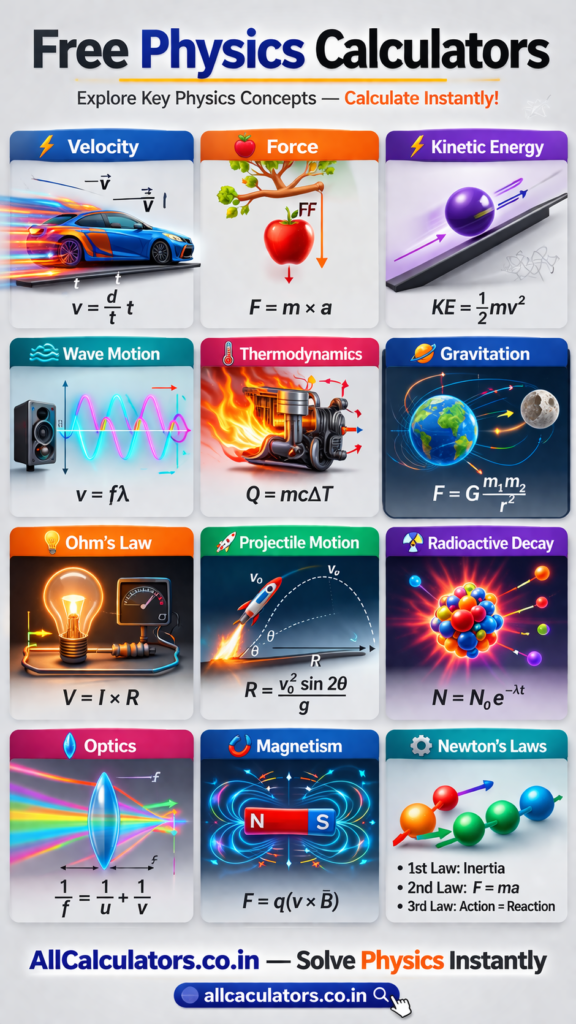
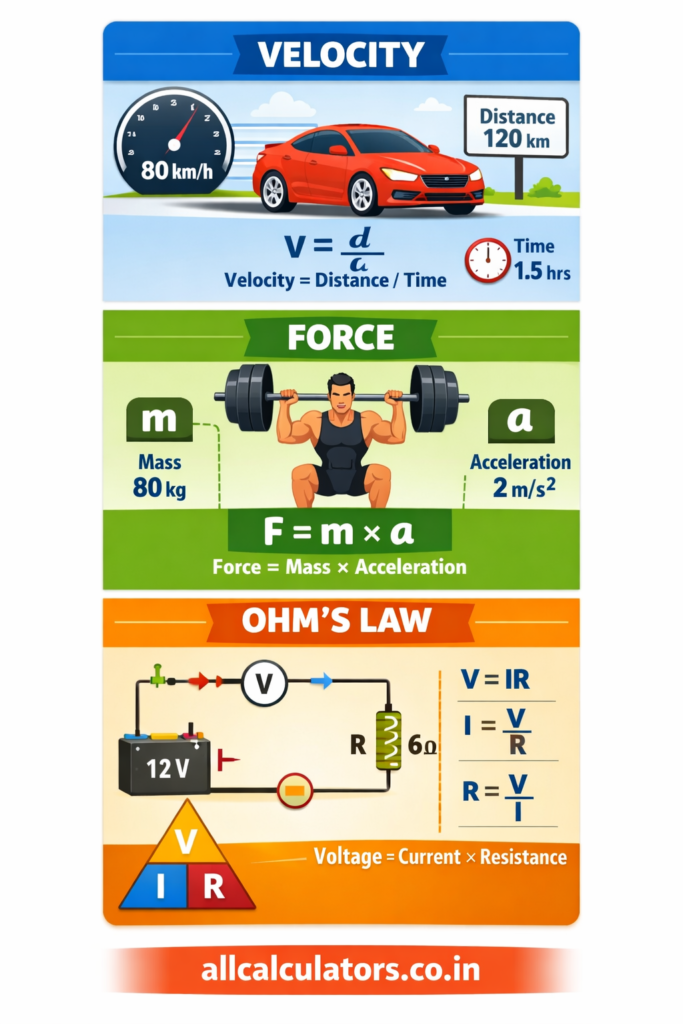
Our Physics Calculators cover the entire spectrum of classical and modern physics, designed to serve students 🎓 from Class 9 to Class 12, undergraduate science and engineering learners, competitive exam aspirants (JEE, NEET, UPSC, SAT, AP Physics) 🏆, and even working professionals who need quick, reliable answers. Whether you need to compute the velocity of a moving object using v = u + at, calculate force using Newton’s iconic second law F = ma, determine kinetic energy with KE = ½mv², or figure out projectile motion step-by-step — our calculators do all the heavy lifting for you in seconds ⏱️.
🧲 What makes our Physics Calculators truly special? Each tool is built on scientifically verified formulas drawn directly from NCERT, CBSE, and international physics curricula. We don’t just give you a number — we walk you through the formula used, the values substituted, and the step-by-step solution 🪜, so you genuinely learn and understand the concept behind every calculation. This approach transforms our calculators from mere answer machines into powerful learning companions that strengthen your conceptual clarity 💡.
Our collection spans all major branches of physics, including:
⚙️ Mechanics & Kinematics: Calculate velocity, acceleration, displacement, free fall, projectile motion, circular motion, and Newton’s Laws of Motion. These are the bedrock concepts every physics student encounters first and must master deeply.
🔋 Work, Energy & Power: Use our calculators to instantly find kinetic energy, potential energy (gravitational and elastic), work done by a force, and power output — all with proper SI unit handling.
💥 Momentum & Collisions: Compute linear momentum (p = mv), impulse, and analyze elastic and inelastic collisions — concepts that appear repeatedly in both board exams and entrance tests.
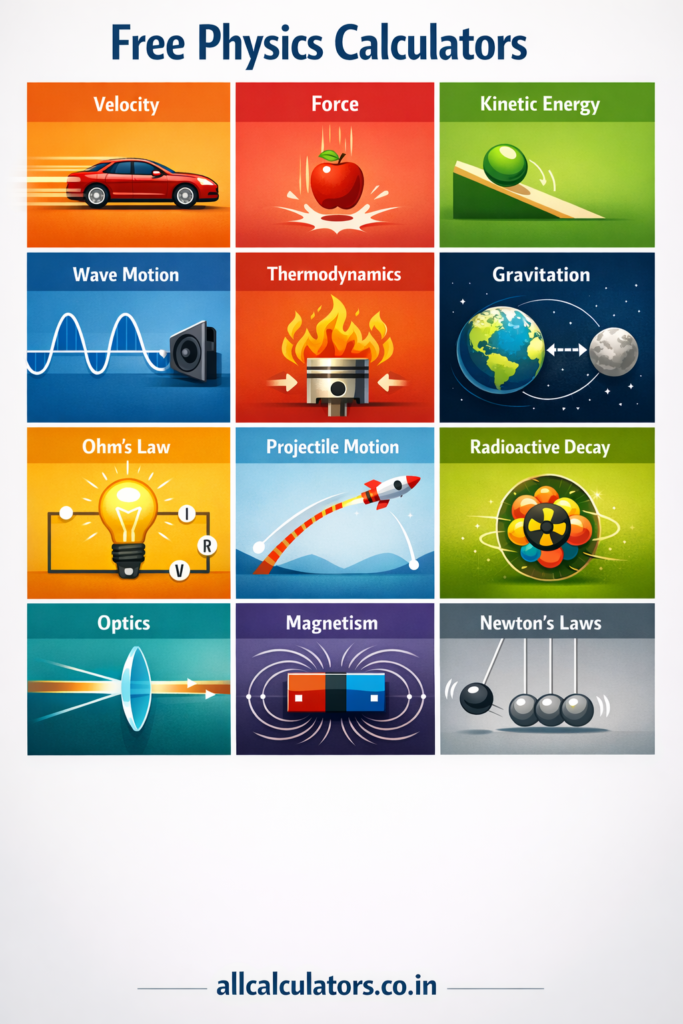
🌊 Waves & Oscillations: Calculate wave speed, frequency, wavelength, time period of a pendulum, and simple harmonic motion parameters — essential for understanding sound, light, and vibration.
🌡️ Thermodynamics: Solve for heat transfer, specific heat capacity, thermal expansion, Carnot efficiency, and ideal gas laws — topics critical in engineering and environmental science.
⚡ Electricity & Magnetism: Our calculators handle Ohm’s Law, electric force (Coulomb’s Law), magnetic force, resistance in circuits, and capacitor energy — perfect for electronics students and hobbyists alike.
☢️ Modern Physics: Explore Einstein’s mass-energy equivalence (E = mc²), the photoelectric effect, radioactive decay half-life, de Broglie wavelength, and more — bridging classical physics with the quantum world.
🪐 Gravitation: Compute gravitational force between masses, orbital velocity, escape velocity, and gravitational potential energy — helping you understand everything from a falling apple 🍎 to a satellite orbiting Earth 🛰️.
Every single calculator in our physics section is 100% free to use 🆓, requires no login or registration, and works seamlessly on mobile 📱, tablet, and desktop 💻 devices. We understand that students in India and across the world need fast, reliable tools that don’t ask for subscriptions or show confusing advertisements every few seconds. That’s our commitment to you.
🌍 Why Online Physics Calculators Are Important
Modern educational tools like this calculator help simplify complex formulas and improve understanding. Instead of spending time on repetitive calculations, students can focus on conceptual learning and problem solving.
Interactive calculators are also extremely valuable for online learning platforms, digital classrooms, and self-study environments.
Using tools like the Ampere Circuital Law Calculator ensures faster problem solving and better accuracy when dealing with electromagnetic field calculations.
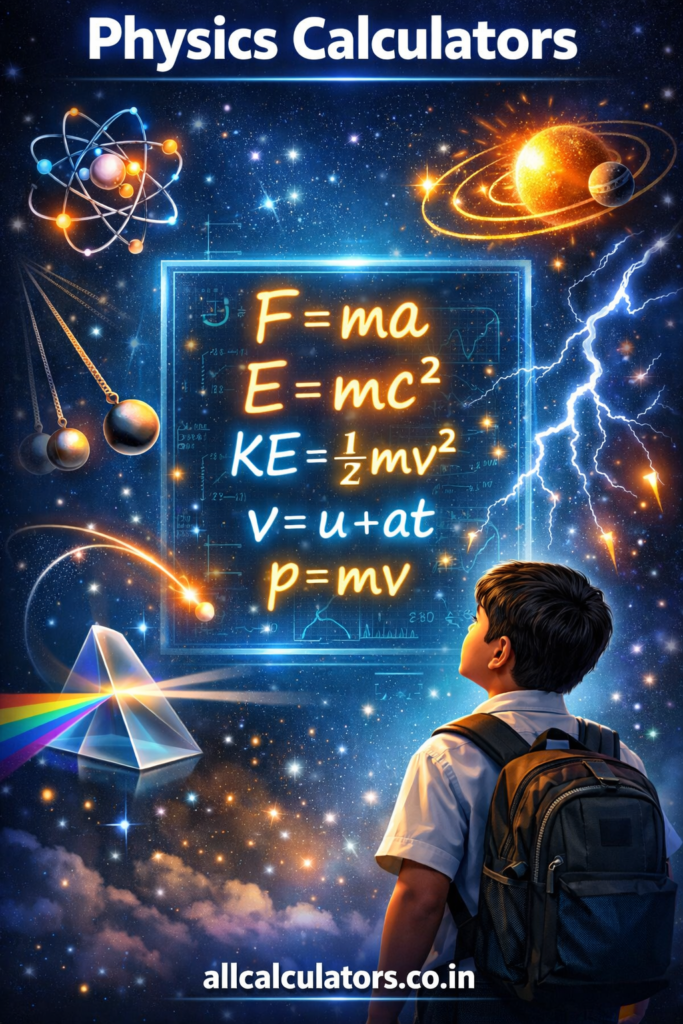
🌍 Applications of Physics Calculators in Daily Life ⚙️📐
Physics calculators are not limited to classrooms—they play a vital role in real-world problem solving:
- 🚗 Motion & Transport – Calculate speed, acceleration, braking distance, and fuel efficiency
- 🏗️ Engineering & Construction – Force analysis, stress-strain, work-energy calculations
- 🔋 Electrical & Electronics – Ohm’s Law, power consumption, circuit optimization
- 🌡️ Thermal Applications – Heat transfer, temperature conversion, efficiency estimation
- 🌊 Waves & Sound – Frequency, wavelength, resonance, acoustics
- 🧪 Scientific Research – Data validation, formula verification, experimental planning
- 🎓 Education & Exams – Fast problem solving, conceptual clarity, practice accuracy
These calculators help bridge theoretical physics with practical implementation, improving decision-making, efficiency, and learning outcomes.
⚠️ Disclaimer
The results provided by these physics calculators online are based on standard formulas and user inputs. While we strive for maximum accuracy, results may vary depending on assumptions, unit inputs, and rounding.
📌 This tool is intended for:
✔️ Educational purposes
✔️ Practice and learning
✔️ Quick estimations
❌ It should not be used as a substitute for professional engineering, scientific, or academic judgment.
Always verify results when accuracy is critical. 🚨
❓ FAQs Section
❓ What is a physics calculator online? 🤔
A physics calculator online is a tool that helps solve physics equations like velocity, force, and energy instantly without manual calculations.
❓ How accurate are physics calculators? 🎯
Most physics equations calculators use standard formulas, making them highly accurate when correct inputs are provided.
❓ Can I use physics calculators for exams? 📚
Yes, they are ideal for practice and learning, but always follow exam rules regarding calculator usage.
❓ Which physics calculator is most useful? ⚡
The most popular ones include velocity calculator, force calculator, and Ohm’s law calculator.
❓ Are these physics calculators free to use? 💰
Yes, all calculators on this platform are completely free and accessible anytime.