
🧮 Pulley Calculator ⚙️
✍️ Author & Academic Authority: Dr. Nitish Kr. Bharadwaj
📘 Qualifications: B.Sc., B.Ed., M.Sc., Ph.D. (Biochemistry), MBA (Financial Management)
🧮 Pulley Calculator – Toll for Mechanical Advantage, Force & Tension ⚙️
A pulley system is one of the most important simple machines in Physics and Mechanical Engineering. 🚀 Whether you are a Class 9, 10, 11 or 12 Physics student, preparing for JEE, NEET, SSC, NDA or engineering entrance exams, or working in mechanical industries, understanding the pulley system is extremely important.
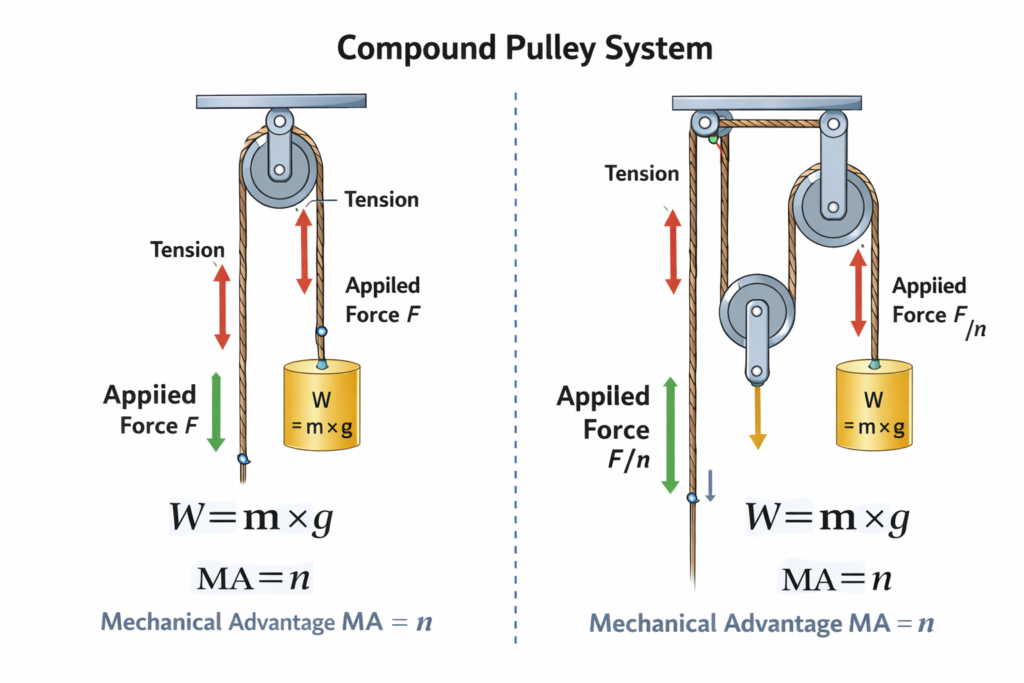
A pulley is a wheel with a groove that holds a rope, belt or chain. It helps lift heavy loads using less effort force. The main concept behind pulleys is Mechanical Advantage (MA) — which tells us how much easier the machine makes the work.
📘 Basic Formula of Pulley System:
Weight (Load Force):
W = m × g
Mechanical Advantage:
MA = Number of supporting ropes
Effort Force:
E = W / MA
Tension in Rope:
T = Effort Force
Where:
m = mass in kg
g = 9.8 m/s²
n = number of rope segments
⚙️ Types of Pulley Systems
🔹 Fixed Pulley – Changes direction of force
🔹 Movable Pulley – Reduces effort force
🔹 Compound Pulley (Block & Tackle) – Increases mechanical advantage
The pulley calculator above instantly computes load force, mechanical advantage, rope tension and effort force in scientific notation format (1.00 × 10²) which is ideal for Physics calculations and board exams.
🎓 Why Scientific Notation Matters?
In Physics, especially in mechanics and engineering problems, values often become very large or very small. For example:
9800 N
can be written as
9.80 × 10³ N
Scientific notation improves clarity, accuracy and professional presentation in exams.
📈 How Mechanical Advantage Works
If there are 4 supporting rope segments:
MA = 4
If Load Force = 400 N
Effort Force = 400 / 4 = 100 N
Thus, the pulley reduces the required effort by 4 times.
This is why cranes, elevators and construction machines use pulley systems.
🏗 Real World Engineering Importance
Pulleys are used in:
- Elevators
- Construction cranes
- Gym equipment
- Flag poles
- Theatre curtain systems
- Sailboats
- Industrial lifting systems
Understanding pulley force calculation is fundamental in civil engineering, mechanical design and robotics.
🔬 Physics Concept Behind It
Pulley system works on principle of:
✔ Conservation of Energy
✔ Work = Force × Distance
✔ Reduction of Force with increase in distance
If force decreases, distance increases proportionally.
🚀 Competitive Exam Relevance
Pulley system questions frequently appear in:
- JEE Main & Advanced
- NEET Physics
- SSC CGL
- NDA
- Railway Exams
- Engineering Entrance Exams
Using this calculator saves time and reduces calculation errors.
🌍 Applications in Human Daily Life
⚙️ Construction Industry – Used to lift cement bags, bricks and steel rods.
🏗 Cranes & Heavy Machinery – Massive pulleys reduce effort required to lift tons of load.
🏠 Home Applications – Window blinds, clotheslines, garage doors use pulley principles.
🏋️ Gym Equipment – Cable machines use compound pulleys to multiply resistance.
🚢 Marine Industry – Sailboats use pulley systems for sail control.
🎭 Entertainment Industry – Theatre stage curtains and lighting systems.
Pulley systems reduce human effort, improve efficiency and ensure safety.
⚠️ Disclaimer
⚠️ This Pulley Calculator is designed for educational and general informational purposes only.
⚠️ Results assume ideal conditions (no friction, massless rope, perfect efficiency).
⚠️ Real industrial systems may involve friction losses and mechanical inefficiencies.
⚠️ Always consult a certified mechanical engineer for industrial design applications.
Use responsibly for academic learning and theoretical calculations.
❓ FAQs
❓ What is Mechanical Advantage in Pulley?
Mechanical Advantage is the ratio of Load Force to Effort Force. In ideal pulley system, MA equals number of supporting rope segments.
❓ How do you calculate tension in a pulley?
Tension equals effort force in ideal systems. T = W / n.
❓ Does pulley reduce work?
No. It reduces effort force but increases distance. Total work remains same (Conservation of Energy).
❓ What is difference between fixed and movable pulley?
Fixed pulley changes direction. Movable pulley reduces effort force.
❓ Is friction considered in this calculator?
No. This calculator assumes ideal frictionless pulley system.