
🌱 Phytoremediation Efficiency Calculator 🌿
Phytoremediation Efficiency (%) =
[(Initial Contaminant Concentration − Final Contaminant Concentration) ÷ Initial Contaminant Concentration] × 100
📊 Result
Table of Contents
✍️ Author & Academic Authority: Dr. Nitish Kr. Bharadwaj
📘 Qualifications: B.Sc., B.Ed., M.Sc., Ph.D. (Biochemistry), MBA (Financial Management)
🌿 Phytoremediation Efficiency Calculator
Calculate Plant-Based Soil Remediation Power Instantly!
🌍 In a world increasingly threatened by industrial pollution, agricultural runoff, and heavy metal contamination in soil and water, nature has gifted us one of the most powerful and sustainable weapons — plants. 🌱 The science of using plants to clean up polluted environments is known as Phytoremediation, and calculating how efficiently a plant performs this biological cleanup is precisely what our Phytoremediation Efficiency Calculator helps you accomplish — for free, instantly, and with unmatched accuracy!
🔬 What is Phytoremediation?
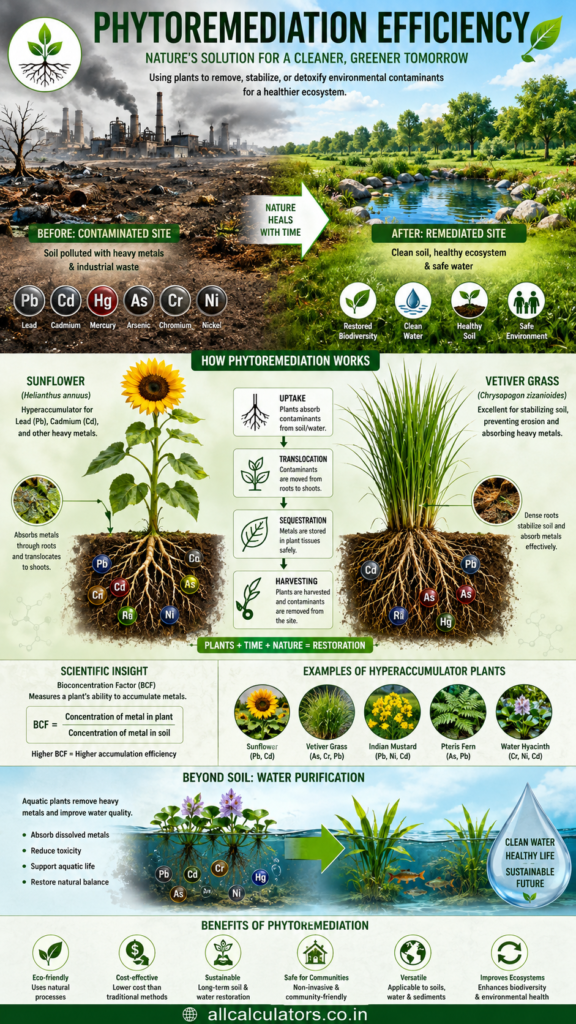
Phytoremediation is a scientifically validated, eco-friendly green technology that leverages the natural metabolic processes of living plants to extract, neutralize, immobilize, or degrade toxic contaminants — including heavy metals like Lead (Pb), Cadmium (Cd), Arsenic (As), Chromium (Cr), Zinc (Zn), and Copper (Cu) — from contaminated soil, groundwater, and wastewater. 🏭💧 Unlike conventional physical or chemical remediation methods that can cost hundreds of thousands of dollars per site, phytoremediation is solar-energy driven, cost-effective, visually appealing, and can reduce cleanup costs by up to 80% while simultaneously restoring biodiversity and improving soil health. 🌞✅

🧪 The Science Behind the Phytoremediation Efficiency Calculator The efficiency of phytoremediation is scientifically measured using two critical parameters that every botany student, agriculture researcher, and environmental scientist must understand:
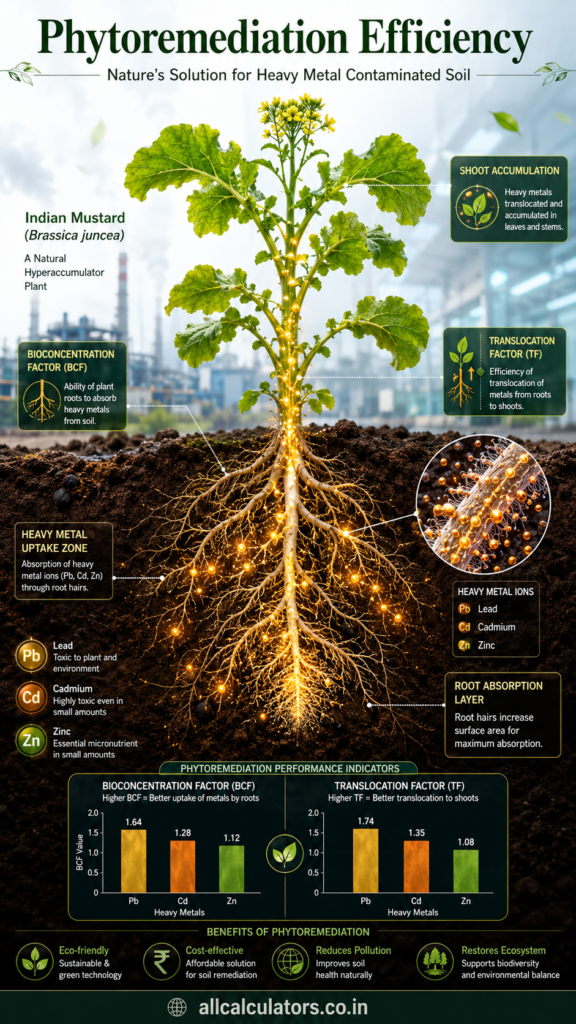
🔹 Bioconcentration Factor (BCF) — Also called the Bioaccumulation Factor (BAF), BCF measures a plant’s ability to accumulate a specific contaminant (like a heavy metal) from the soil into its roots or above-ground biomass. It is calculated as: BCF = Metal Concentration in Plant (mg/kg) ÷ Metal Concentration in Soil (mg/kg) A BCF value greater than 1 is a strong indicator that the plant is a hyperaccumulator — capable of absorbing metal concentrations far exceeding those in its surrounding substrate. 🏆 Plants like Brassica juncea (Indian Mustard), Helianthus annuus (Sunflower), and Pteris vittata (Chinese Brake Fern) are celebrated hyperaccumulators recognized globally for their outstanding BCF values.
🔹 Translocation Factor (TF) — The Translocation Factor evaluates a plant’s internal metal transport efficiency — how effectively it moves accumulated metals from its roots up to the shoots (stems, leaves, and aerial parts). It is calculated as: TF = Metal Concentration in Shoot (mg/kg) ÷ Metal Concentration in Root (mg/kg) When TF > 1, the plant demonstrates highly efficient upward metal translocation, making it ideal for phytoextraction — the most commercially valuable form of phytoremediation where the above-ground plant biomass is harvested and removed, taking the contaminants with it. 🌾🔝 When BCF is high but TF is low, the plant is better suited for phytostabilization, where metals are immobilized in the root zone, preventing their spread.
🧫 Types of Phytoremediation Processes Covered Our calculator supports the efficiency assessment of multiple phytoremediation mechanisms: 🌱 Phytoextraction — Plant roots absorb contaminants, transporting them to harvestable shoots. 💧 Rhizofiltration — Plant roots absorb, adsorb, or precipitate contaminants from water or aqueous waste streams. 🛡️ Phytostabilization — Plants immobilize contaminants in the soil or root zone, reducing bioavailability. 💨 Phytovolatilization — Plants absorb contaminants and release them as less-toxic volatile compounds through transpiration. 🔥 Phytodegradation — Plant enzymes metabolize and break down organic pollutants within plant tissues.

🎓 Who Benefits from the Phytoremediation Efficiency Calculator?
This calculator is a powerhouse tool for a wide audience: 🏫 Biology and Botany students calculating BCF and TF values for their lab assignments and research projects; 🌾 Agricultural scientists and soil ecologists evaluating the remediation potential of native or engineered plant species; 🏗️ Environmental engineers planning cost-effective green remediation strategies for contaminated industrial or mining sites; 🧑🔬 PhD researchers and ecotoxicologists performing meta-analyses of hyperaccumulator performance across soil types; and 🌏 NGOs and Government bodies assessing phytoremediation feasibility for brownfield land restoration projects.
In agriculture, phytoremediation plays a critical role in restoring contaminated farmland. Toxic heavy metals present in soil can reduce crop productivity and enter the human food chain 🍅⚠️. By calculating phytoremediation efficiency, farmers and environmental agencies can estimate how effectively plants detoxify agricultural lands before cultivation resumes 🚜🌿.
Environmental scientists also use phytoremediation efficiency analysis for:
✅ Soil contamination monitoring
✅ Wastewater purification studies
✅ Mining land restoration
✅ Oil spill treatment research
✅ Industrial pollution control
✅ Ecological restoration projects
✅ Sustainable environmental management
Compared to traditional remediation methods, phytoremediation offers several advantages:
🌱 Eco-friendly and sustainable
💰 Cost-effective compared to excavation methods
🌍 Reduces environmental disturbance
🧪 Natural biological detoxification process
🚜 Useful for large agricultural areas
💧 Supports groundwater purification
The growing focus on climate resilience and green technologies has significantly increased global interest in phytoremediation research 📈🌿. Governments, environmental agencies, and sustainability organizations worldwide are investing in plant-based remediation systems to combat pollution naturally.
🌟 Why is Calculating Phytoremediation Efficiency Important?
Not every plant that grows on contaminated land is an effective remediator. The difference between a good green remediator and an ineffective one lies entirely in the numbers — BCF, TF, and removal efficiency percentages. 📊 A plant with a BCF of 0.3 and TF of 0.5 offers little practical remediation value, while one with BCF of 8.5 and TF of 2.1 can clean a heavily contaminated site in just a few growing seasons. By using our free online Phytoremediation Efficiency Calculator, you can instantly quantify and compare plant performance, make data-driven decisions about species selection, and predict how many growing cycles are needed to reduce soil contamination to safe levels. 💡
♻️ As global awareness of soil degradation and environmental pollution intensifies, phytoremediation stands out as the most sustainable, affordable, and biologically rich solution available to humanity. Our calculator transforms complex scientific formulas into instant, easy-to-understand results — empowering students, scientists, and farmers alike to harness the amazing power of plants to heal the earth! 🌍💚
🌍 Applications in Human Daily Life
🌿 Real-World Applications of Phytoremediation Efficiency in Daily Life
🏘️ Contaminated Residential Areas — In neighborhoods near old factories or mining zones, phytoremediation using sunflowers and mustard plants can safely reduce heavy metal levels in garden soils, making them safer for children to play in.
🌾 Agricultural Land Restoration — Farmers use phytoremediation efficiency data to choose the right plants for detoxifying pesticide- or fertilizer-overloaded farmland, restoring productivity without expensive chemical treatments. 🚜
🚰 Drinking Water Safety — Aquatic plants like Water Hyacinth (Eichhornia crassipes) remove iron, lead, and nitrates from contaminated ponds and streams that communities depend on for daily water needs. 💧
⚡ Industrial Wastewater Management — Factories calculate phytoremediation efficiency to design constructed wetlands or green filter beds that naturally treat effluents before releasing water into rivers. 🏭
🏫 School & College Labs — Biology students regularly perform BCF and TF calculations as part of practical experiments on environmental science and green biotechnology. 📚
🌍 Climate & Carbon Benefits — Phytoremediation plants also sequester carbon as they grow, meaning every cleanup site doubles as a mini carbon sink helping fight climate change. 🌡️
🏙️ Urban Green Infrastructure — City planners use phytoremediation in roadside plantations and parks to reduce roadside heavy metal pollution from vehicle exhaust and brake dust. 🌳

⚠️ Disclaimer 🌿📜
The Phytoremediation Efficiency Calculator available on AllCalculators.co.in is intended solely for educational, academic, research, and informational purposes 🧠🔬. While this calculator uses scientifically accepted phytoremediation formulas and environmental remediation principles, actual remediation efficiency may vary depending on plant species, soil composition, pollutant concentration, climate conditions, biological interactions, and laboratory accuracy 🌍⚗️.
Users are strongly advised to verify results independently before applying them in environmental engineering projects, industrial remediation programs, agricultural restoration, or scientific publications 📊. This calculator should not replace professional environmental assessment, laboratory testing, or expert ecological consultation.
AllCalculators.co.in assumes no liability for environmental decisions, research interpretations, agricultural losses, or remediation outcomes resulting from the use of this calculator 🌱⚠️.

📌 Related Calculator
❓ FAQs – Phytoremediation Efficiency Calculator 🌿
❓ What is a Phytoremediation Efficiency Calculator?
A Phytoremediation Efficiency Calculator is an online environmental biology tool used to calculate how effectively plants remove contaminants, toxins, and heavy metals from soil or water 🌱.
❓ What is phytoremediation in environmental science?
Phytoremediation is a biological pollution removal process where plants absorb, stabilize, or degrade environmental contaminants naturally 🌍🌿.
❓ Which pollutants can phytoremediation remove?
Phytoremediation can remove heavy metals, pesticides, petroleum hydrocarbons, industrial chemicals, radioactive contaminants, and wastewater pollutants ☢️💧.
❓ What is the formula for phytoremediation efficiency?
The standard formula is: 🧮 Efficiency (%) = [(Initial Concentration − Final Concentration) ÷ Initial Concentration] × 100
Efficiency(%)=CiCi−Cf×100
❓ Who can use this calculator?
Students, researchers, ecologists, agricultural scientists, environmental engineers, teachers, and sustainability professionals can use this calculator 📚🔬.
❓ Is phytoremediation environmentally friendly?
Yes ✅. Phytoremediation is considered one of the most sustainable and eco-friendly pollution treatment technologies available today 🌱🌎.
❓ Can phytoremediation clean agricultural soil?
Yes 🌾. Many plants can absorb toxic metals and improve soil quality for safer agricultural production.
Phytoremediation is a scientifically validated, eco-friendly green technology that leverages the natural metabolic processes of living plants to extract, neutralize, immobilize, or degrade toxic contaminants. https://t.co/x41q3QspxN pic.twitter.com/ygeSJllE98
— AllCalculators (@allcalcs4u) May 12, 2026