
🌱 Soil pH Nutrient Calculator
pH = –log₁₀[H⁺] ⟹ [H⁺] = 10–pH mol/L
[OH⁻] = 10–pOH | pOH = 14 – pH (at 25°C)
Lime Req. (t/ha) = (Target pH – Current pH) × Buffering Factor
| Nutrient | Symbol | Availability | Remark |
|---|
Table of Contents
✍️ Author & Academic Authority: Dr. Nitish Kr. Bharadwaj
📘 Qualifications: B.Sc., B.Ed., M.Sc., Ph.D. (Biochemistry), MBA (Financial Management)
🌱 Soil pH Nutrient Calculator
Unlock the Secret Language of Your Soil!
🌍 Soil is not just dirt beneath your feet — it is a living, breathing ecosystem that holds the key to every plant’s survival, every farmer’s harvest, and every student’s understanding of life sciences. At the very core of healthy soil science lies one powerful number: soil pH. Whether you are a student studying botany and agriculture, a home gardener trying to grow the perfect tomatoes 🍅, or a professional farmer managing acres of cropland, understanding soil pH and its direct impact on nutrient availability is absolutely non-negotiable. And that’s exactly where our free Soil pH Nutrient Calculator comes in — making this complex science simple, fast, and accessible for everyone! 🎯
🔬 What is Soil pH and Why Does It Matter So Much?
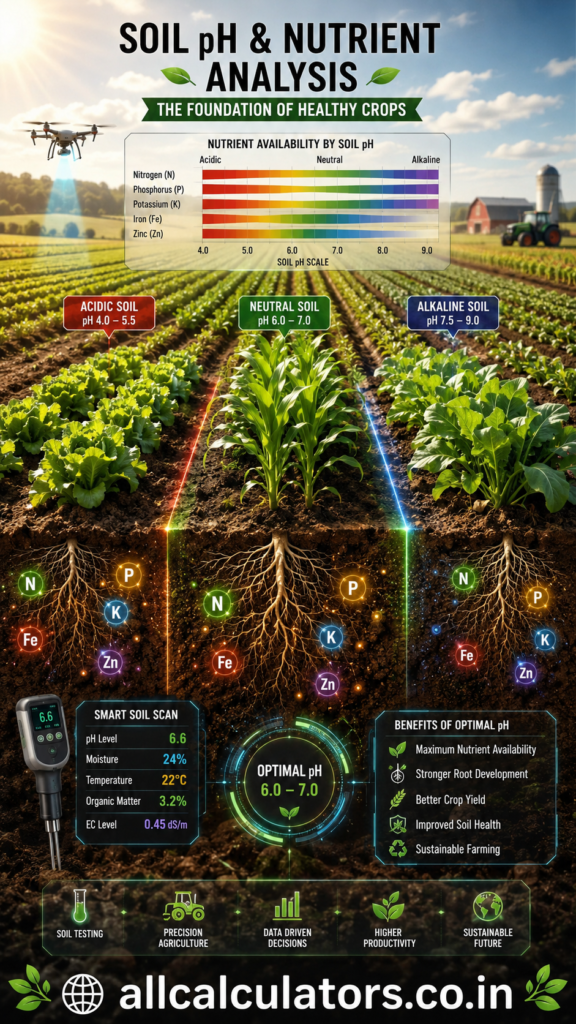
Soil pH is a measure of the hydrogen ion (H⁺) concentration present in the soil solution. It is expressed on a scale from 0 to 14, where:
- 🟥 0–6.9 = Acidic Soil
- 🟩 7.0 = Neutral Soil
- 🟦 7.1–14 = Alkaline (Basic) Soil
The most critical insight every biology student and farmer must know is this: soil pH is the master key 🔑 that unlocks or locks every single nutrient in your soil. Even if you pour expensive fertilizers into your garden, if the pH is wrong, your plants simply cannot absorb those nutrients. This phenomenon — called nutrient lockout — is one of the most common yet misunderstood causes of poor crop yield, yellowing leaves 🍂, stunted growth, and crop failure worldwide.
🧪 How Soil pH Controls Nutrient Availability — The Science Behind the Calculator
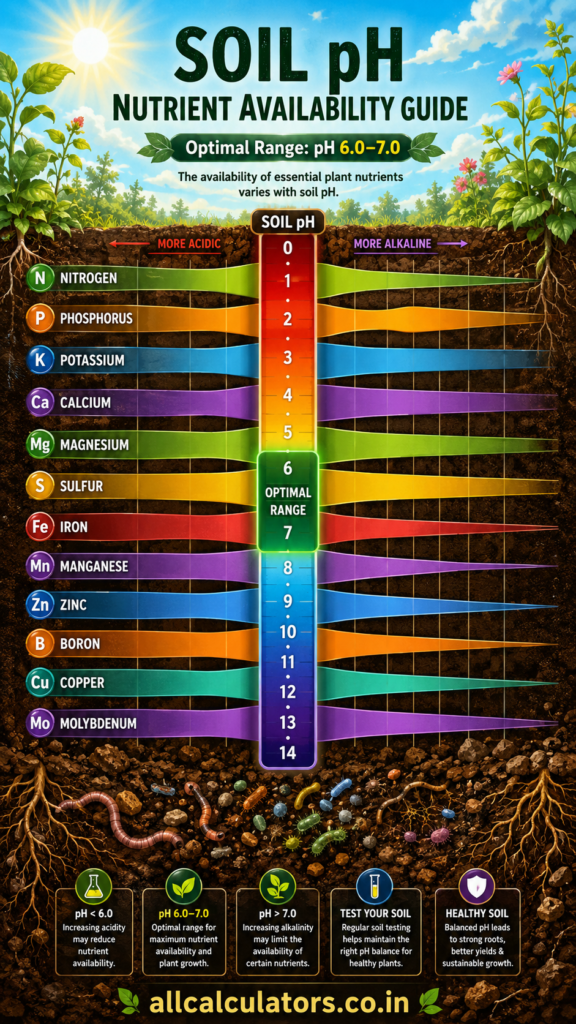
The relationship between soil pH and plant-essential nutrients is both precise and fascinating. Scientists and agronomists have mapped this relationship in a well-known nutrient availability chart (Truog Chart), and our calculator brings this chart to life with real-time calculations. Here’s the big picture:
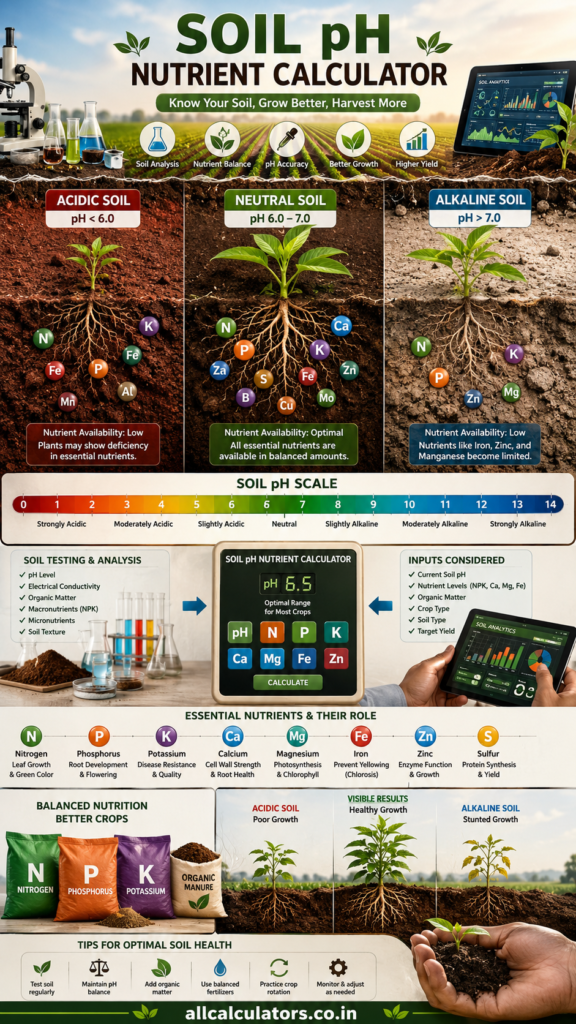
🔴 In Highly Acidic Soils (pH below 5.5):
- Iron (Fe), Manganese (Mn), and Aluminum (Al) become excessively available, often to toxic levels ☠️
- Phosphorus (P), Calcium (Ca), and Magnesium (Mg) become tightly locked and unavailable to plant roots
- Nitrogen-fixing bacteria activity decreases drastically, reducing natural soil fertility 📉
- Legume crops fail to nodulate effectively, eliminating biological nitrogen fixation
🟡 In Slightly Acidic to Neutral Soils (pH 6.0–7.0) — The Sweet Spot! 🎯
- Maximum availability of Nitrogen (N), Phosphorus (P), Potassium (K) — the big three macronutrients
- Optimal uptake of Calcium (Ca), Magnesium (Mg), and Sulfur (S) — secondary nutrients
- Best conditions for essential micronutrients like Zinc (Zn), Copper (Cu), Boron (B), and Molybdenum (Mo)
- Highest beneficial microbial activity 🦠✅ — the engine of natural soil fertility
🔵 In Alkaline Soils (pH above 7.5):
- Iron (Fe), Manganese (Mn), Zinc (Zn), and Copper (Cu) become severely deficient
- Classic chlorosis (yellowing of leaves) appears — a direct symptom of iron unavailability
- Phosphorus begins to precipitate with Calcium, locking it out again
- Boron deficiency impacts flowering and fruiting in many crops 🌸
📐 What Does Our Soil pH Nutrient Calculator Do?
Our online Soil pH Nutrient Calculator is a precision-grade digital tool designed to:
✅ Identify nutrient availability at any soil pH value you enter ✅ Calculate lime requirement to raise acidic soil pH to the optimal range ✅ Calculate sulfur amendment needed to lower alkaline soil pH ✅ Recommend soil amendment quantities based on soil type (sandy, loamy, clay) ✅ Predict macro & micronutrient absorption levels at a given pH ✅ Show which nutrients are deficient, optimal, or toxic at your soil’s current pH ✅ Help students solve textbook problems related to soil chemistry and plant nutrition 📚
🌾 The Science of Soil Amendment — Lime & Sulfur Calculations
When soil is too acidic, the most common remedy is agricultural lime (CaCO₃). The calculator determines exactly how many tons per acre (or kg per square meter) you need based on your current pH, target pH, and soil buffer capacity.
When soil is too alkaline, elemental sulfur (S) is applied. Soil microbes convert sulfur into sulfuric acid through oxidation, gradually lowering pH. Our calculator uses standard agronomic adjustment factors: sandy soil (factor 1.0), loamy soil (factor 1.5), and clay soil (factor 2.0) — the same formulas used by university agricultural extension services worldwide 🏛️.
The underlying formula used: Amendment Required (tons/acre) = (Target pH − Current pH) × Adjustment Factor × Area (sq ft) ÷ 43,560
🎓 Perfect for Students, Farmers & Gardeners Alike!
Whether you are preparing for a NEET, JEE, UPSC, or Agricultural University exam 📝, managing a commercial farm or kitchen garden, or simply curious about why your houseplants are turning yellow 🪴 — this calculator gives you instant, accurate, science-backed answers. No complicated lab visits. No expensive consultants. Just enter your soil pH and get complete nutrient analysis in seconds!
Healthy soil = Healthy plants = Healthy food = Healthy life. 💚 Start your soil health journey today with India’s most trusted free calculator platform — AllCalculators.co.in

🌍 Application in Human Daily Life
🌿 Real-Life Applications of the Soil pH Nutrient Calculator
🏡 Home Gardening: Check if your garden soil is right for tomatoes 🍅, roses 🌹, or herbs 🌿 — and fix it before planting season.
🌾 Farming & Agriculture: Farmers use soil pH data to plan fertilizer schedules, avoid nutrient waste, and maximize crop yields 🌽🌾 — saving thousands in input costs.
🧑🎓 Student Education: Biology, botany & agriculture students use it to solve practical problems on nutrient availability, lime requirement & soil amendment — directly relevant to board and competitive exams 📚.
🌱 Organic Farming: Organic growers check pH to maintain natural nutrient cycles without chemicals — key to sustainable, eco-friendly farming 🌍♻️.
🪴 Houseplant Care: Yellow leaves on your indoor plants? Check soil pH! Iron or magnesium deficiency from wrong pH is a top cause of houseplant decline 🌻.
🌳 Nursery & Horticulture: Nursery owners test soil pH for different crops — blueberries 🫐 love pH 4.5–5.5, while most vegetables prefer 6.0–7.0.
🏗️ Landscaping & Lawn Care: Lawn experts adjust soil pH to 6.5 for lush, green grass 🟩 and healthy turf establishment.
🔬 Research & Lab Work: Agricultural scientists and soil researchers use pH-nutrient calculations for field studies, soil health reports, and irrigation management 🧑🔬.
⚠️ Disclaimer
The Soil pH Nutrient Calculator is developed for educational, informational, and agricultural guidance purposes only 🌱. The calculated nutrient availability and soil fertility results are based on standard scientific soil chemistry principles, generalized nutrient behavior, and commonly accepted agriculture research data.
Actual soil conditions may vary depending on soil texture, organic matter, temperature, moisture, crop type, microbial activity, and environmental factors. 🌾 Users are strongly advised to perform professional laboratory soil testing before making critical farming, fertilizer, or crop management decisions.
This calculator does not replace certified agronomy consultation, agricultural extension services, or laboratory soil analysis. While every effort has been made to provide accurate calculations and SEO-optimized educational content, the website owner shall not be responsible for crop losses, farming decisions, or inaccurate interpretations arising from calculator usage. 🚜✨

📌 Related Calculator
❓ FAQs – Soil pH Nutrient Calculator 🌿
1. 🌱 What is a Soil pH Nutrient Calculator?
A Soil pH Nutrient Calculator is an online agriculture tool that estimates nutrient availability and soil fertility based on soil pH levels.
2. 🌾 Why is soil pH important for plant growth?
Soil pH affects nutrient absorption, fertilizer efficiency, root development, and overall crop productivity.
3. 🧪 What is the ideal soil pH for most crops?
Most crops grow best between soil pH 6.0 and 7.0 because nutrients become highly available in this range.
4. 🚜 How does acidic soil affect nutrients?
Acidic soil can reduce phosphorus availability and increase aluminum toxicity, damaging plant roots.
5. 🌿 How does alkaline soil affect plants?
Alkaline soil reduces micronutrient availability, especially iron, zinc, and manganese, causing nutrient deficiencies.
6. 📚 Who can use the Soil pH Nutrient Calculator?
Farmers, students, gardeners, agriculture researchers, botany learners, and hydroponic growers can all benefit from this calculator.
7. 🌎 Can this calculator improve fertilizer management?
Yes ✅. Proper soil pH analysis helps optimize fertilizer application and nutrient efficiency.
8. 💧 Is soil pH important in hydroponics?
Absolutely ✅. Hydroponic nutrient solutions require proper pH balance for efficient nutrient uptake.
9. 🌱 Can soil pH be corrected?
Yes ✅. Lime is commonly used to raise soil pH, while sulfur lowers soil alkalinity.
10. 🚜 Is this calculator free to use?
Yes ✅. The Soil pH Nutrient Calculator is completely free and accessible online.
Soil is not just dirt beneath your feet — it is a living, breathing ecosystem that holds the key to every plant’s survival, every farmer’s harvest, and every student’s understanding of life sciences. https://t.co/dir4tjrI7w pic.twitter.com/96dFUADtuL
— AllCalculators (@allcalcs4u) May 9, 2026