
🧰 ELISA Sensitivity & Specificity Calculator
Microbiology & Immunology | Biology CalculatorsSensitivity (Se) = TP ÷ (TP + FN) × 100
Specificity (Sp) = TN ÷ (TN + FP) × 100
Positive Predictive Value (PPV) = TP ÷ (TP + FP) × 100
Negative Predictive Value (NPV) = TN ÷ (TN + FN) × 100
Accuracy = (TP + TN) ÷ (TP + TN + FP + FN) × 100
LR+ = Se ÷ (1 − Sp) | LR− = (1 − Se) ÷ Sp
Youden’s Index (J) = Sensitivity + Specificity − 1
| Disease + (Actual Positive) |
Disease − (Actual Negative) |
|
|---|---|---|
| 🟢 Test + | ||
| 🔴 Test − |
Sensitivity = ability to correctly detect true positive cases (high Se = fewer missed cases / lower False Negative rate).
Specificity = ability to correctly identify true negatives (high Sp = fewer false alarms / lower False Positive rate).
PPV & NPV depend on disease prevalence in the tested population.
LR+ > 10 = strong evidence of disease presence. LR− < 0.1 = effectively rules out disease.
Youden’s Index ranges from 0 (no discriminative power) to 1 (perfect test).
Table of Contents
✍️ Author & Academic Authority: Dr. Nitish Kr. Bharadwaj
📘 Qualifications: B.Sc., B.Ed., M.Sc., Ph.D. (Biochemistry), MBA (Financial Management)
🧬 ELISA Sensitivity & Specificity Calculator
Your Ultimate Free Tool for Diagnostic Test Accuracy in Immunology & Microbiology
In the fascinating world of 🔬 Microbiology and Immunology, few techniques hold as much diagnostic power and scientific elegance as the Enzyme-Linked Immunosorbent Assay — the ELISA test. Whether you’re a 🎓 biology student, a medical laboratory scientist, a clinical researcher, or a curious learner diving deep into immunological diagnostics, understanding how to calculate and interpret ELISA sensitivity and specificity is a non-negotiable, foundational skill. Our free, fast, and intuitive ELISA Sensitivity Specificity Calculator at allcalculators.co.in makes this complex calculation effortlessly simple — available anytime, anywhere, at zero cost! 💯
In modern microbiology 🦠 and immunology 🧬, evaluating the reliability of diagnostic tests is critical for both clinical decisions and research outcomes. The ELISA Sensitivity Specificity Calculator is a powerful online tool designed to help students, researchers, and healthcare professionals accurately assess the performance of ELISA-based diagnostic tests. By using key parameters such as True Positives (TP), True Negatives (TN), False Positives (FP), and False Negatives (FN), this calculator provides instant insights into test accuracy, sensitivity, and specificity.
🧪 What is ELISA? The Science Behind the Test
ELISA (Enzyme-Linked Immunosorbent Assay) is a gold-standard immunological technique used to detect and quantify the presence of antigens, antibodies, proteins, hormones, and peptides in biological samples such as blood serum, urine, plasma, and saliva. The principle relies on the exquisitely specific antigen-antibody interaction — where a target molecule (antigen) binds to a complementary antibody that is linked to an enzyme. When a substrate is added, the enzyme catalyzes a colorimetric reaction, producing a measurable signal. 🎨 The intensity of the color is directly proportional to the concentration of the target analyte, making ELISA both qualitative and quantitative in application.
ELISA is routinely used to diagnose diseases like HIV, COVID-19, Hepatitis B & C, Lyme disease, dengue fever, malaria, toxoplasmosis, and many more. It is also a cornerstone technique in food safety testing, pharmaceutical quality control, and vaccine efficacy studies. 💉
ELISA (Enzyme-Linked Immunosorbent Assay) is widely used for detecting antigens or antibodies in biological samples. However, interpreting ELISA results requires understanding how well the test identifies positive and negative cases. This is where sensitivity and specificity come into play. Sensitivity measures the ability of a test to correctly identify individuals who have the disease (true positive rate), while specificity measures the ability to correctly identify those who do not have the disease (true negative rate).
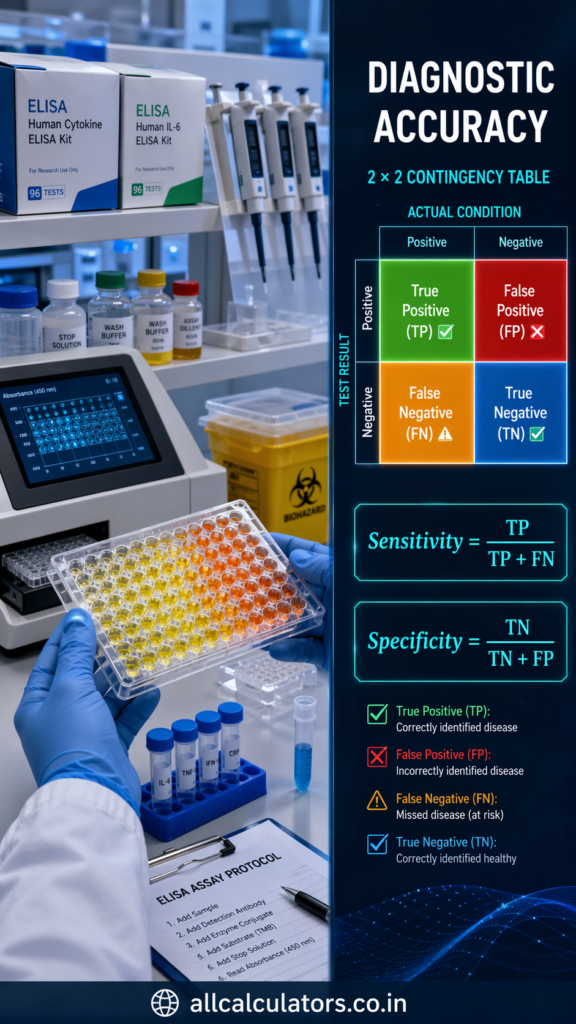
Mathematically, sensitivity is calculated as: Sensitivity = TP / (TP + FN)
and specificity is calculated as: Specificity = TN / (TN + FP)
These formulas are fundamental in evaluating diagnostic tools, especially in fields like infectious disease detection, vaccine research, and clinical diagnostics. The ELISA Sensitivity Specificity Calculator automates these calculations, eliminating manual errors and saving valuable time.
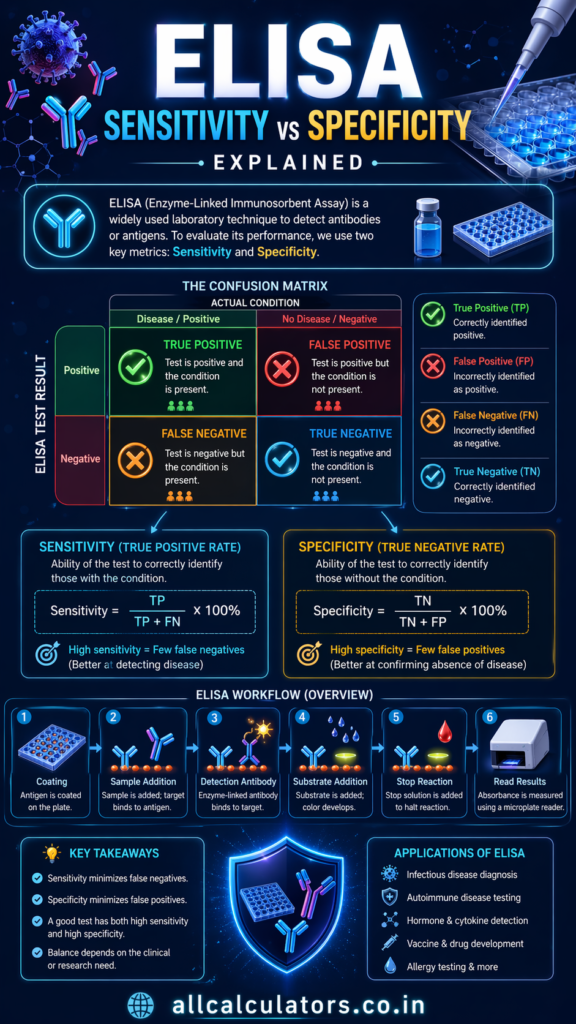
In addition to sensitivity and specificity, advanced interpretations often include accuracy, precision, and predictive values such as Positive Predictive Value (PPV) and Negative Predictive Value (NPV). These metrics provide deeper insights into the reliability of ELISA test results in real-world conditions. By integrating all these calculations into a single tool, users can quickly assess whether a diagnostic test meets required standards.
📊 Why Sensitivity & Specificity Matter in ELISA
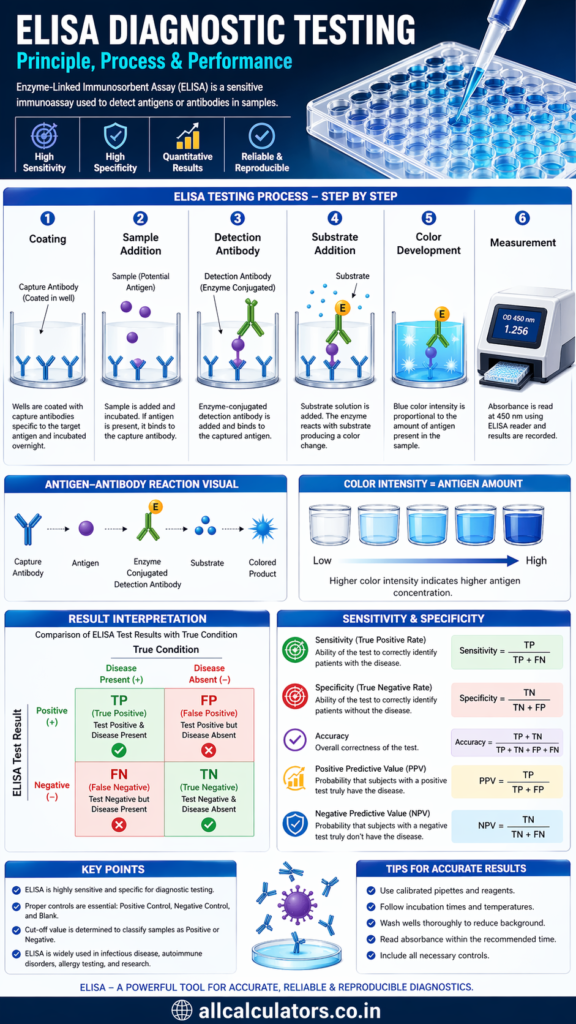
No diagnostic test is perfect. When we use any assay — including ELISA — to detect a disease or condition in a population, the results are categorized into four critical outcomes using a 2×2 contingency table (confusion matrix):
🟢 True Positive (TP) — The test correctly identifies a diseased individual as positive. 🔴 False Positive (FP) — The test incorrectly flags a healthy person as positive (Type I Error). 🟡 False Negative (FN) — The test misses a diseased person and reports them as negative (Type II Error). 🔵 True Negative (TN) — The test correctly identifies a healthy person as negative.
From these four values, a rich set of diagnostic performance metrics is calculated:
🔬 Sensitivity (True Positive Rate) = TP ÷ (TP + FN) × 100% Sensitivity tells you: “Of all the truly diseased individuals, how many did the test correctly detect?” A highly sensitive ELISA test minimizes missed cases (false negatives). High sensitivity is crucial when missing a disease is dangerous — for example, in HIV or cancer screening. Remember the powerful clinical mnemonic: SnNOut — a highly Sensitive test, if Negative, rules Out disease! 💡
🔬 Specificity (True Negative Rate) = TN ÷ (TN + FP) × 100% Specificity answers: “Of all the truly healthy individuals, how many did the test correctly identify as disease-free?” High specificity reduces unnecessary panic, stigma, and costly follow-up testing caused by false positives. The companion mnemonic is SpPin — a highly Specific test, if Positive, rules In disease! 💡
Beyond the basic two, our ELISA Sensitivity Specificity Calculator also computes:
📈 Positive Predictive Value (PPV) — Probability that a person with a positive test result truly has the disease. PPV = TP ÷ (TP + FP) × 100%
📉 Negative Predictive Value (NPV) — Probability that a person with a negative test result is truly disease-free. NPV = TN ÷ (TN + FN) × 100%
⚖️ Diagnostic Accuracy — Overall proportion of correct test results. Accuracy = (TP + TN) ÷ (TP + TN + FP + FN) × 100%
📊 Likelihood Ratios (LR+ and LR−) — Help clinicians update pre-test probability using Bayes’ theorem.
🧠 The Sensitivity-Specificity Trade-Off
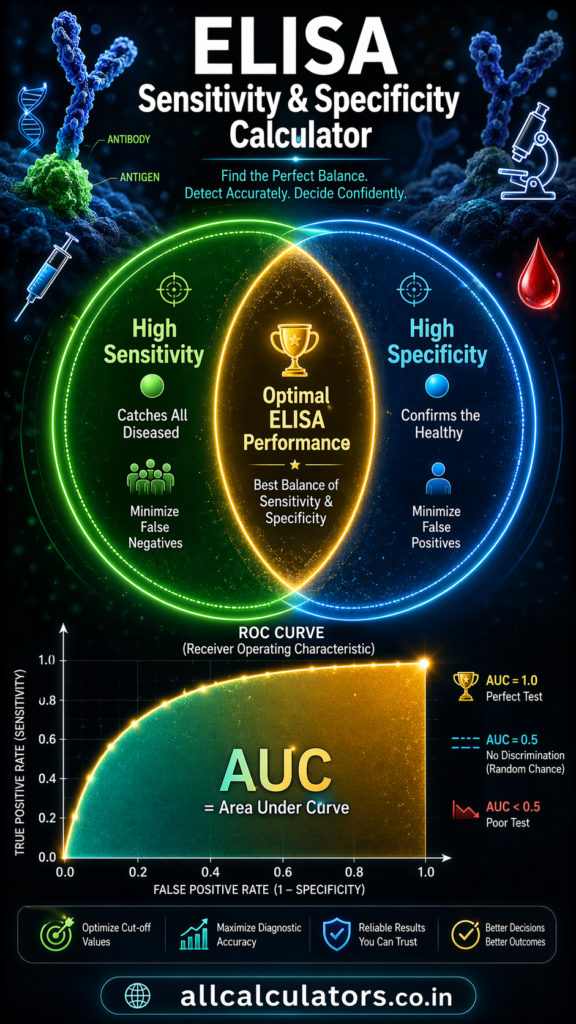
One of the most fascinating and practically important concepts in diagnostic immunology is the inverse relationship between sensitivity and specificity. As you lower the diagnostic cutoff threshold of an ELISA assay, sensitivity rises (you catch more true positives) — but specificity falls (you also pick up more false positives). Raising the threshold does the opposite. This is elegantly visualized using an ROC Curve (Receiver Operating Characteristic curve), and the Area Under the Curve (AUC) serves as a single-number summary of assay performance. An AUC of 1.0 = a perfect test; AUC of 0.5 = no better than random chance. 📐
⚡ How to Use the ELISA Sensitivity Specificity Calculator
Using our calculator is incredibly simple — no complex math required! 🖥️ Just enter your four values: 1️⃣ Number of True Positives (TP) 2️⃣ Number of False Positives (FP) 3️⃣ Number of False Negatives (FN) 4️⃣ Number of True Negatives (TN)
Hit Calculate and instantly get: Sensitivity %, Specificity %, PPV %, NPV %, Accuracy %, Likelihood Ratios — all in one clean, easy-to-read display! 🎯
Whether you’re validating a new ELISA kit in the lab, preparing for your biology or medical exam, writing a research paper, or simply deepening your understanding of diagnostic epidemiology — this tool is your perfect companion. Bookmark it today! 🔖
🌍 Applications in Human Daily Life
🏥 Clinical Diagnostics — ELISA sensitivity and specificity calculations are used daily by pathologists and clinicians to evaluate blood tests for diseases like HIV 🩸, hepatitis, dengue, and thyroid disorders, ensuring patients receive accurate diagnoses.
🎓 Medical & Biology Education — Students studying microbiology, immunology, and public health 📚 use sensitivity-specificity calculators to solve exam problems, complete lab assignments, and understand diagnostic epidemiology.
💉 Vaccine Research & Efficacy Studies — Scientists calculate ELISA sensitivity and specificity to assess whether vaccine-induced antibody tests correctly identify immunized vs. non-immunized individuals, essential in clinical trials. 🔬
🦠 Infectious Disease Control & Epidemiology — Public health officials use these calculations during disease outbreaks (like COVID-19 🦠) to evaluate mass screening tests — determining how many false positives or false negatives a rapid ELISA test produces in a population.
🐾 Veterinary Diagnostics — Animal disease surveillance programs evaluate ELISA test kits for livestock and companion animals to ensure diagnostic accuracy in conditions like foot-and-mouth disease and brucellosis. 🐄
🍔 Food Safety Testing — Food labs use ELISA-based allergen tests (detecting peanut, gluten proteins etc.) and calculate sensitivity & specificity to validate their quality control testing methods. 🌾
🏭 Pharmaceutical Quality Control — Drug manufacturers use ELISA assays to measure biological drug concentrations and run sensitivity-specificity analysis to confirm assay validation before regulatory submissions. 💊
⚠️ Disclaimer 📋
The ELISA Sensitivity Specificity Calculator on allcalculators.co.in is provided strictly for 🎓 educational, research, and informational purposes only. The results generated by this tool are based entirely on the numerical data entered by the user and do not constitute any form of medical advice, clinical diagnosis, or professional laboratory recommendation 🩺. All diagnostic decisions must be validated and interpreted by qualified healthcare professionals, certified laboratory technicians, or licensed medical practitioners in accordance with established clinical protocols. 🏥 While we strive to ensure mathematical accuracy in all computations, allcalculators.co.in accepts no liability for any decisions made based on the output of this calculator. Always consult a qualified professional for medical concerns. 💙 Use this tool to learn, explore, and grow — but never as a substitute for expert clinical judgment! 🔬✅
📌 Related Calculator
❓ FAQs
❓ What is ELISA sensitivity and specificity?
🧬 Sensitivity measures how well a test detects true positives, while specificity measures how accurately it identifies true negatives.
❓ How do you calculate sensitivity and specificity in ELISA?
📊 Sensitivity = TP / (TP + FN) and Specificity = TN / (TN + FP).
❓ Why is sensitivity important in diagnostic tests?
🔍 High sensitivity ensures fewer false negatives, meaning fewer cases are missed.
❓ What does high specificity indicate?
✅ High specificity means fewer false positives, ensuring accurate identification of healthy individuals.
❓ Who can use this ELISA calculator?
🎓 Students, researchers, lab technicians, and healthcare professionals can all benefit from this tool.
In the fascinating world of Microbiology and Immunology, few techniques hold as much diagnostic power and scientific elegance as the Enzyme-Linked Immunosorbent Assay — the ELISA test. https://t.co/xe3W7ErmI1 pic.twitter.com/s5UWEmyAWN
— AllCalculators (@allcalcs4u) April 24, 2026