
🌾 Weed Competition Calculator
This calculator estimates the Weed Competition Index (WCI) from the difference between crop yield under weed-free and weedy conditions. A higher WCI generally indicates greater crop yield loss associated with weed competition.
- 0–10%: 🌿 Very Low Competition
- 10–25%: 🌱 Low Competition
- 25–50%: ⚠️ Moderate Competition
- 50–75%: 🚨 High Competition
- Above 75%: 🔴 Very Severe Competition
Table of Contents
✍️ Author & Academic Authority: Dr. Nitish Kr. Bharadwaj
📘 Qualifications: B.Sc., B.Ed., M.Sc., Ph.D. (Biochemistry), MBA (Financial Management)
🌾 Weed Competition Calculator
Measure, Predict & Prevent Crop Yield Loss Due to Weed Interference
🌿 Weeds are among the most silent yet devastatingly powerful enemies of agricultural productivity worldwide. Every season, millions of farmers and agronomy students wrestle with a fundamental question: How much yield am I losing because of weeds competing with my crops? The answer is not always obvious — but with the right tool, it becomes crystal clear. The Weed Competition Calculator on AllCalculators.co.in is a precision online tool designed specifically for students of botany and agriculture, agronomists, crop scientists, and progressive farmers who want data-driven insights into the financial and biological impact of weed interference on their crops.
🔎 Our Weed Competition Calculator is designed to make this concept easier to understand by helping users evaluate the potential effect of weed pressure on crop performance. It can be useful for 🌾 farmers, 👨🌾 agricultural students, 🌱 botany students, researchers, agronomists, teachers, and anyone studying crop-weed competition and weed-induced yield loss.
🌿 What is Weed Competition?
Weed competition occurs when weeds and crop plants require the same limited resources for growth. The most important competitive resources include 💧 soil moisture, 🧪 mineral nutrients, 🌞 light, and 🌱 physical space. Scientific literature describes crop-weed competition as an important biological factor affecting agricultural productivity because weeds can capture resources that would otherwise be available to the crop.
The effect is not necessarily proportional to the number of weeds. A small number of early-emerging weeds can sometimes have a greater impact than a much larger population that emerges later. Weed emergence timing relative to the crop is therefore an important part of understanding weed competition and crop yield loss.
🌾 How Does Weed Competition Reduce Crop Yield?
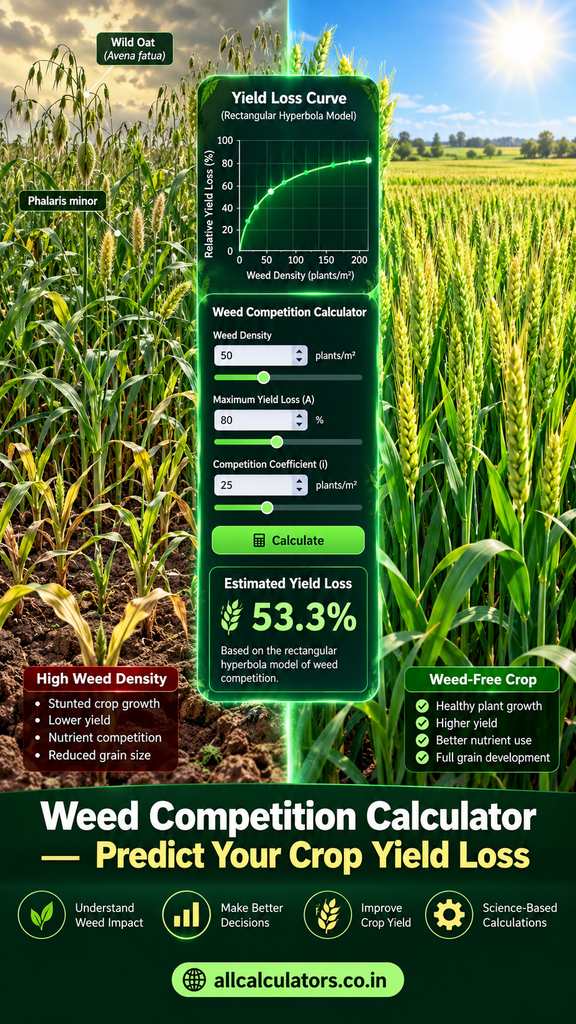
When weeds emerge alongside a crop, they can intercept sunlight, consume soil water and nutrients, and occupy growing space. 🌞☀️💧🧪 As weed pressure increases, crop plants may experience reduced growth, smaller biomass accumulation, lower reproductive development, and ultimately reduced yield.
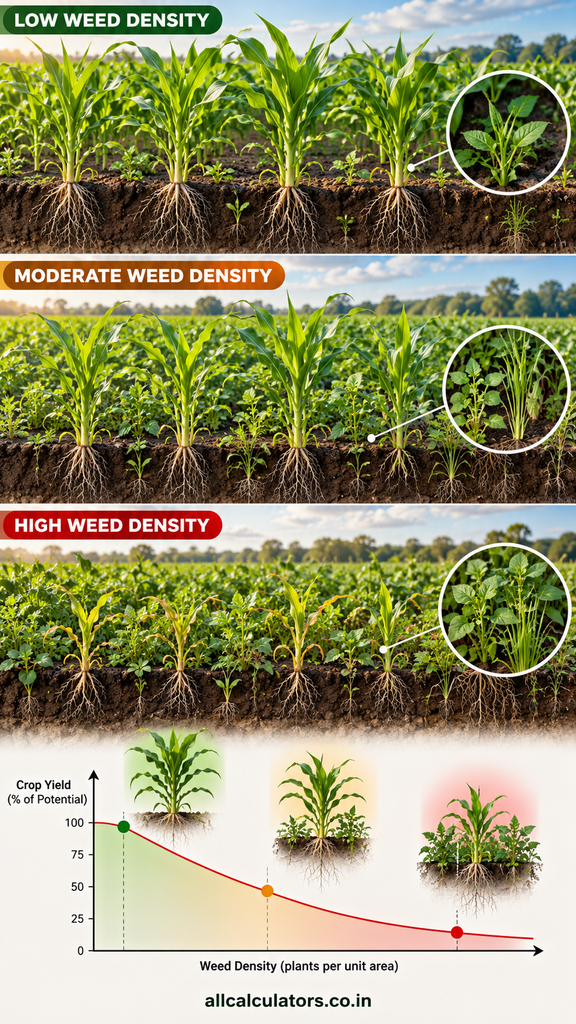
However, the relationship between weed density and crop yield loss is usually not a simple straight-line relationship. Weed-science research commonly uses nonlinear or rectangular-hyperbola models to describe yield loss as weed density increases. These models recognize that the first weeds can have a relatively large marginal effect, while the additional effect of each additional weed may diminish as weeds increasingly compete among themselves.
This is why a weed yield loss calculator can be useful as an educational and decision-support tool: it helps users think about weed pressure in terms of crop response rather than simply counting weeds.
📊 Why is Weed Density Important?
Weed density generally refers to the number of weeds present within a defined area, such as plants per square metre. It is one of the commonly studied variables for describing crop-weed interference.
For example, two fields may have the same crop but very different weed densities. The field with a higher density of competitive weeds may face greater potential interference. Nevertheless, density alone does not tell the entire story. Weed species, weed size, crop growth stage, emergence timing, environmental conditions, and crop competitiveness can substantially change the outcome.
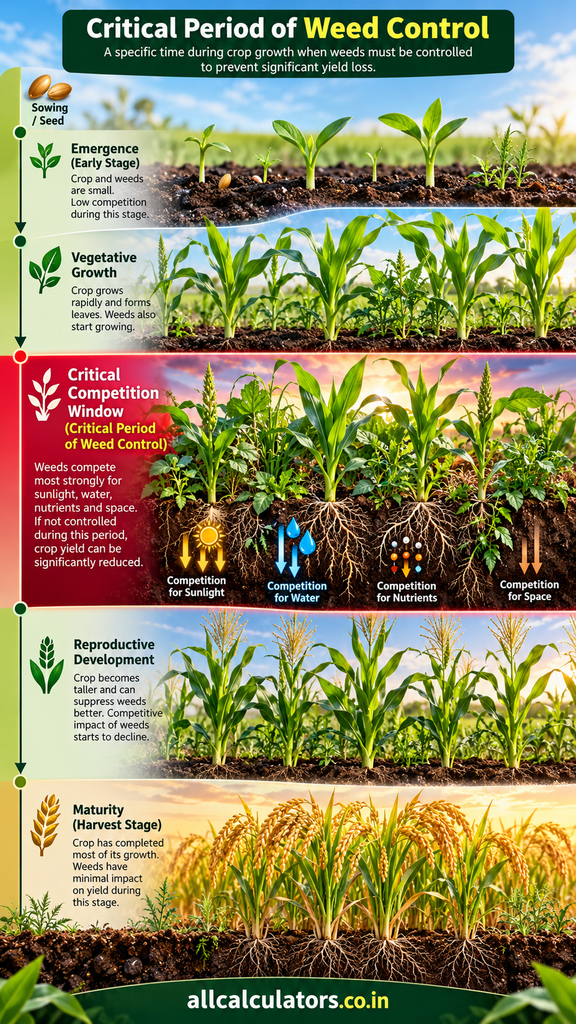
⏱️ What is the Critical Period of Weed Control?
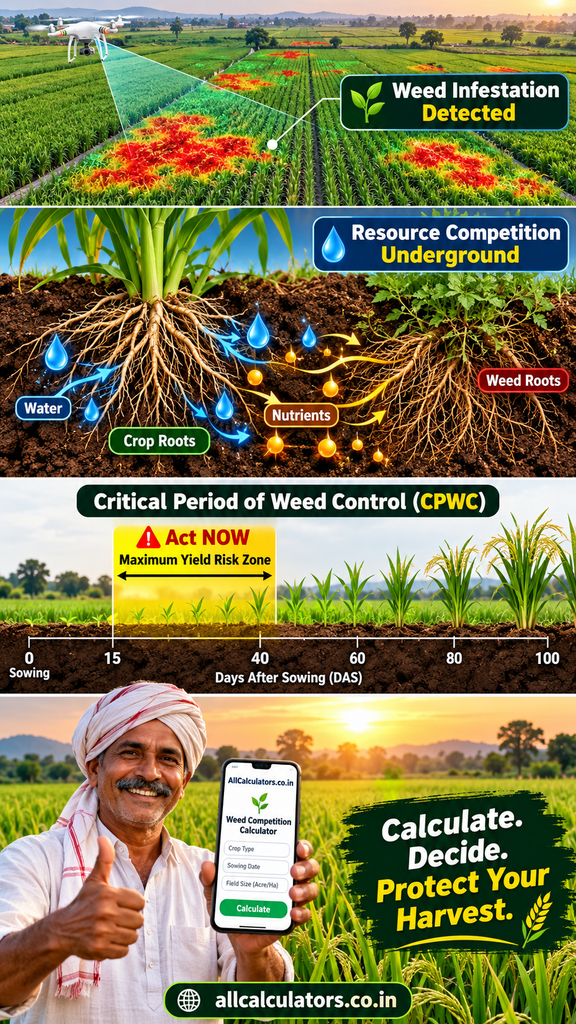
One of the most important concepts in weed science is the critical period of weed control (CPWC). This is the period during crop development when weeds need to be controlled to prevent an unacceptable reduction in crop yield.
The critical period is influenced by both the time weeds can remain in the field before causing significant damage and the time by which weeds need to be removed to protect crop yield. A commonly used approach defines the period around an acceptable yield-loss threshold, such as 5%, although the appropriate threshold depends on the crop and management objective.
Importantly, there is no single critical period that applies to every crop. Research has reported different critical windows for rice, wheat, chickpea, cowpea, cotton, soybean, sesame, and other crops. For example, studies have identified particularly important weed-competition windows in rice and chickpea, demonstrating why crop-specific conditions matter.
🧮 How Can a Weed Competition Calculator Help?
A crop weed competition calculator can help organize the variables involved in estimating potential weed interference. Depending on the model used, relevant inputs may include 🌱 crop information, 🌿 weed density, 📅 weed emergence or competition duration, expected weed-free yield, and other crop-weed parameters.
A widely studied approach is the rectangular hyperbola yield-loss model, which relates relative crop yield loss to weed density using parameters describing weed competitiveness and maximum potential loss. FAO material on weed-crop competition describes this approach and notes that model parameters can vary according to the crop-weed combination, crop density, weed emergence timing, and soil fertility.
Therefore, calculator results should be interpreted as an estimate or educational decision-support output, not as a guaranteed field measurement.
🚜 Why Early Weed Management Matters
Early-season weed competition can be particularly important because weeds that emerge close to crop emergence often have more opportunity to capture resources and influence crop development. Research and extension guidance emphasize that the competitive effect depends strongly on weed emergence timing, density, species, environmental conditions, and crop management.
Effective weed management may involve 🌾 crop rotation, 🌱 competitive crop establishment, appropriate planting density, mechanical control, cultural practices, herbicide programs where appropriate, and integrated weed management. The objective is not necessarily to eliminate every weed at every moment, but to prevent economically important competition during vulnerable crop-development stages.
📈 Understanding Your Calculator Result
When using a Weed Competition Calculator, remember that the estimated result represents a model-based interpretation of the information entered. Actual field outcomes can differ because agricultural systems are influenced by weather 🌦️, soil characteristics 🪨, crop variety 🌾, weed species 🌿, weed emergence pattern ⏱️, nutrient availability 🧪, irrigation 💧, planting density, and management practices.
For students, the calculator can be particularly useful for understanding the relationship between weed density, crop competition, critical weed-control periods, and potential yield loss. For agricultural users, it can provide a convenient first-level estimate that can be combined with field scouting, local agronomic recommendations, and professional advice.
🌱 Use the Weed Competition Calculator to explore crop-weed competition, understand potential yield effects, and learn why timely weed management is an important part of successful crop production.

🚜 APPLICATIONS IN HUMAN DAILY LIFE 🌱
🌾 Real-World Applications of Weed Competition Concepts in Daily Life
🚜 1. On the Farm — Farmers use weed competition data to decide when to weed or apply herbicide, saving money by targeting only the critical growth window instead of spraying all season. This reduces input costs and environmental pollution. 🌿
🎓 2. Agriculture & Botany Education — Students studying agronomy, horticulture, and crop science use critical period concepts daily in practicals, assignments, field experiments, and entrance exam preparation (ICAR-JRF, CUET, etc.). 📚
🏡 3. Home & Kitchen Gardening — Even home gardeners growing vegetables 🥦🍅 benefit from understanding that weeds emerging in the first 2–4 weeks post-sowing cause the maximum damage — a timely weed removal saves the entire harvest!
💊 4. Herbicide-Use Optimization — Knowing the exact CPWC window means farmers apply herbicides only when most effective, reducing chemical overuse, cutting costs 💰, and protecting soil microbiota and nearby water bodies.
📊 5. Farm Income Forecasting — Agri-businesses, cooperative societies, and agricultural banks use yield-loss models to predict crop income, assess loan risk 🏦, and plan post-harvest procurement strategies.
🌿 6. Organic Farming Decisions — Organic farmers who cannot use chemical herbicides use weed competition calculations to precisely time mechanical weeding operations — maximizing weed control efficiency without synthetic inputs. ♻️
🔬 7. Agricultural Research & Field Trials — Researchers at ICAR, SAUs, and international institutes use weed competition models to design experiments, compare varieties for competitive ability, and publish agronomy papers. 🧑🔬
🌍 8. Food Security Policy Planning — Government bodies and NGOs use aggregate yield-loss estimates from weed competition to design national food security programs and targeted crop protection subsidy schemes. 🏛️
⚠️ Disclaimer & Important Notice
🌿 The Weed Competition Calculator on AllCalculators.co.in is designed purely for educational, academic, and general informational purposes. The yield-loss estimates and weed interference predictions provided are based on widely accepted agronomic models (including the Cousens rectangular hyperbola model) and are approximations only — actual field results may vary significantly depending on your specific crop variety 🌾, soil type 🌍, local climate ☁️, weed species composition, irrigation regimen 💧, and farm management practices.
📌 This tool does not replace the expert advice of a certified agronomist, a licensed agricultural extension officer, or professional crop protection consultant. For critical field-level crop management decisions — especially herbicide selection and application — always consult a qualified agricultural professional or your nearest KVK (Krishi Vigyan Kendra) 🏢. We are not responsible for any agricultural decisions, financial losses, or crop failures arising from the use of results generated by this calculator. Always validate outputs with local field data and expert guidance before taking action. 🙏
❓ FAQs
🌱 Frequently Asked Questions About Weed Competition Calculator
❓ 1. What is a Weed Competition Calculator?
A Weed Competition Calculator is an online agricultural tool designed to help estimate or understand the potential effect of weeds on crop growth and yield. Depending on the model, it may consider factors such as weed density, competition duration, emergence timing, and crop yield potential.
❓ 2. What is crop-weed competition?
🌾 Crop-weed competition occurs when crop plants and weeds use the same limited resources, including sunlight, water, nutrients, and growing space. The resulting interference can reduce crop growth and yield.
❓ 3. How does weed density affect crop yield?
🌿 Higher weed density can increase competitive pressure, but yield loss is generally not a simple one-to-one relationship with weed numbers. Weed species, emergence timing, crop density and environmental conditions can significantly influence the result. Density-based nonlinear models are widely used in weed science to describe this relationship.
❓ 4. What is the critical period of weed control?
⏱️ The critical period of weed control (CPWC) is the portion of the crop growth cycle when weeds must be managed to prevent an unacceptable reduction in crop yield. The period varies among crops and growing conditions.
❓ 5. Can weed competition cause crop yield loss?
🌾 Yes. Weed competition can reduce crop growth and yield by interfering with resource acquisition and through other crop responses to weed presence. The magnitude of yield loss varies according to weed density, weed species, emergence timing, crop characteristics, and environmental conditions.
❓ 6. Why is the timing of weed emergence important?
⏰ Weeds that emerge early relative to the crop can have a greater competitive effect because they have more time to establish and interact with the crop. Later-emerging weeds may have a smaller effect, although the actual response depends on crop and weed conditions. ScienceDirect
❓ 7. What is weed-induced yield loss?
📉 Weed-induced yield loss is the reduction in crop yield associated with weed interference compared with a suitable weed-free or low-competition condition. Researchers commonly estimate relative yield loss using experimental data and mathematical models.
❓ 8. Can this calculator be used for every crop?
🌱 The underlying concept applies broadly to crop production, but the exact competitive response is crop- and weed-specific. Critical periods and model parameters can differ substantially among crops and environments. Research demonstrates different competition windows for crops such as rice, wheat, chickpea, cowpea, cotton, sesame and others. Indian Journal of Agronomy
❓ 9. Is weed competition the same as weed density?
🔎 No. Weed density describes how many weeds occur in a defined area, while weed competition describes the biological interference between weeds and crops. Density is an important input in many competition models, but species, size, emergence timing and crop conditions also matter.
❓ 10. Is the Weed Competition Calculator a substitute for an agronomist?
👨🌾 No. It is best treated as an educational and preliminary decision-support tool. Real-world weed-management decisions should consider field scouting, crop-specific research, local conditions, product labels and qualified agricultural advice.
❓ 11. What is a weed yield loss calculator used for?
📊 A weed yield loss calculator can be used to explore how weed pressure may translate into potential crop yield reduction. It is especially useful for understanding weed density, competition timing and crop sensitivity.
❓ 12. Why should farmers monitor weeds early?
🌱 Early weed competition can be particularly important because weeds that establish near crop emergence may strongly influence crop development. The economically important competition window varies by crop and growing conditions.
📌 Related Calculator
📷 Weeds are among the most silent yet devastatingly powerful enemies of agricultural productivity worldwide. Every season, millions of farmers and agronomy students wrestle with a fundamental question: How much yield am I losing because of weeds competing with my crops? https://t.co/g63UkuXXaf
— AllCalculators (@allcalcs4u) October 4, 2026