
💧 Water Density Calculator
ρ = ρ0 + A·S + B·T + C·P
Where:
ρ = Density of water (kg m-3)
ρ0 = 999.84 kg m-3 (density of pure water)
S = Salinity (ppt)
T = Temperature (°C)
P = Pressure (bar)
Constants used:
A = 0.78
B = −0.28
C = 0.0045
Table of Contents
✍️ Author & Academic Authority: Dr. Nitish Kr. Bharadwaj
📘 Qualifications: B.Sc., B.Ed., M.Sc., Ph.D. (Biochemistry), MBA (Financial Management)
🌊 Water Density Calculator (Temperature, Salinity & Pressure)
Understanding water density is essential in physics, oceanography, environmental science, engineering, and many everyday scientific applications. The Water Density Calculator helps you determine the density of water based on temperature, salinity, and pressure, which are the three primary variables that influence how compact water molecules are in a given volume. Whether you’re a student solving a physics problem, a marine researcher analyzing seawater properties, or simply someone exploring science concepts, this calculator provides fast and accurate results. 🚀
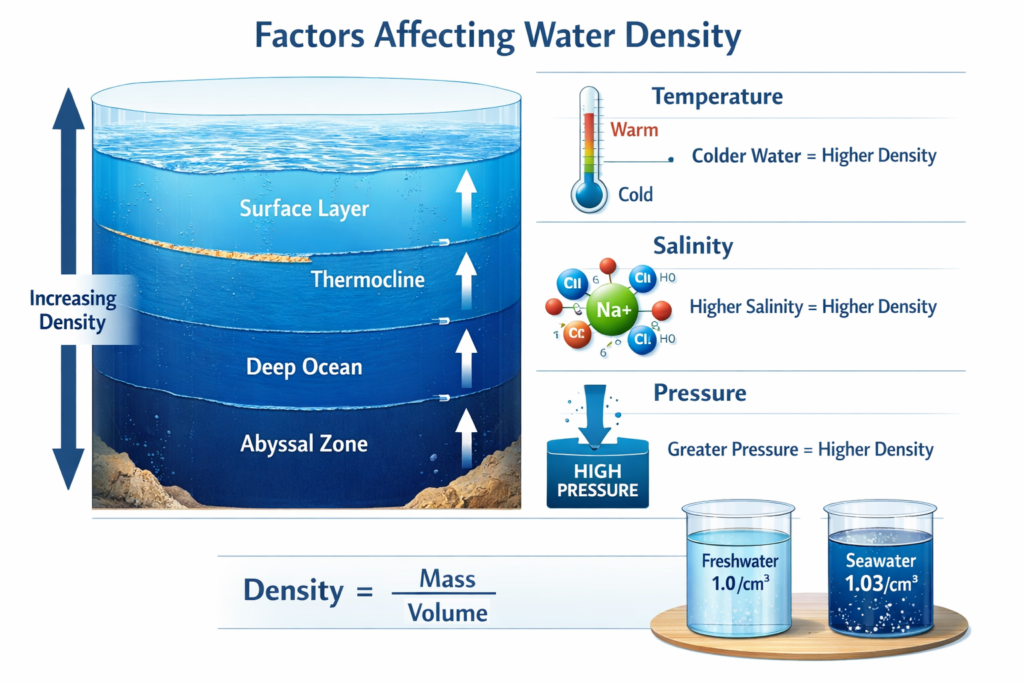
💧 What is Water Density?
Density is defined as mass per unit volume of a substance. In physics, the formula for density is: Density = Mass ÷ Volume
For pure water, density is approximately: 1000 kg/m³ at 4°C
However, the density of water is not constant. It changes depending on:
🌡️ Temperature
🧂 Salinity (amount of dissolved salt)
ضغط Pressure (depth or compression)
This is why oceanographers and scientists use advanced formulas like the UNESCO equation of state for seawater to determine accurate density values. The Water Density Calculator simplifies these calculations automatically.
🌡️ Effect of Temperature on Water Density
Temperature has the strongest effect on water density. As water warms up, its molecules move faster and spread apart, causing density to decrease. Conversely, when water cools, molecules move closer together and density increases.
Interestingly, water reaches its maximum density at 4°C, which is why ice floats on water. When water freezes, it expands and becomes less dense than liquid water.
Examples:
💧 Water at 4°C → ~1000 kg/m³
💧 Water at 25°C → ~997 kg/m³
💧 Water at 100°C → ~958 kg/m³
This phenomenon explains many natural processes such as:
🐟 Aquatic life survival in winter
🌍 Thermal stratification in lakes
❄️ Ice formation on the surface of water bodies
🧂 Effect of Salinity on Water Density
Salinity refers to the amount of dissolved salts in water. Seawater contains minerals like sodium chloride, magnesium, and calcium. These dissolved substances increase the mass of the water without significantly increasing its volume, which results in higher density.
Typical salinity levels:
🌊 Freshwater → ~0 PSU
🌊 Brackish water → 0.5 – 30 PSU
🌊 Ocean seawater → ~35 PSU
Average densities:
💧 Freshwater density → ~1000 kg/m³
🌊 Seawater density → ~1025 kg/m³
This difference explains why it is easier to float in the ocean than in a swimming pool. The higher density of seawater produces stronger buoyant force.
🧭 Effect of Pressure on Water Density
Pressure increases with depth in oceans and deep water bodies. As pressure increases, water molecules compress slightly, causing density to increase.
For example:
🌊 Surface ocean pressure → 1 atmosphere
🌊 1000 meters depth → ~100 atmospheres
While water is relatively incompressible, high pressure at great depths still slightly increases density. This factor is crucial in deep-sea physics and oceanographic modeling.
🧮 How the Water Density Calculator Works
The Water Density Calculator estimates water density by combining the effects of:
✔ Temperature
✔ Salinity
✔ Pressure
Using scientific equations derived from oceanographic research, the calculator quickly computes density values in units such as:
📏 kg/m³
📏 g/cm³
📏 lb/ft³
Instead of manually applying complex formulas, the tool gives instant results with high precision.
📊 Why Water Density Matters
Water density plays a major role in many scientific and engineering fields. Understanding density differences helps explain natural phenomena and technological applications.
Examples include:
🌊 Ocean circulation patterns
🐟 Marine ecosystem stability
🚢 Ship buoyancy and naval engineering
🌦 Climate and weather modeling
💧 Hydrology and groundwater movement
For students and researchers, accurately calculating density helps in solving physics problems, fluid mechanics equations, and oceanography models.
🌍 Applications in Daily Life
Water density plays a surprising role in many real-world applications and natural phenomena. Here are some practical uses:
🚢 Ship and Boat Design: Naval engineers use seawater density calculations to ensure ships float safely. Denser water creates stronger buoyant force, affecting ship stability.
🐟 Marine Ecosystems: Ocean density differences create water layers (thermoclines and haloclines) that influence marine life habitats and nutrient circulation.
🌊 Ocean Currents & Climate: Density differences drive thermohaline circulation, a global ocean current system that influences Earth’s climate.
🏊 Swimming & Floating: People float more easily in saltwater because higher salinity increases water density.
💧 Water Treatment Plants: Engineers use density calculations when designing desalination and filtration systems.
🌡️ Environmental Monitoring: Scientists track temperature and salinity changes to monitor climate change and ocean health.
📚 Education & Physics Experiments: Students use water density equations in fluid mechanics, buoyancy experiments, and thermodynamics studies.
⚠️ Disclaimer
The Water Density Calculator available on this website is designed for educational, research, and informational purposes only. While we strive to provide scientifically accurate calculations using widely accepted formulas, results should not replace professional engineering, oceanographic, or scientific analysis. Users should verify results when applying them in critical engineering, marine navigation, environmental modeling, or industrial applications.
By using this tool, you acknowledge that allcalculators.co.in is not responsible for any decisions made based on the calculated results. Always consult a qualified expert for high-precision scientific requirements. 🌍
📌Related Calculator
❓ FAQs
🌊 What is the density of water at room temperature?
At around 25°C, the density of pure water is approximately 997 kg/m³. Temperature changes slightly affect the density value.
🌡️ Why does water have maximum density at 4°C?
Water molecules arrange themselves most compactly at 4°C, making water reach its highest density of about 1000 kg/m³.
🧂 Why is seawater denser than freshwater?
Seawater contains dissolved salts and minerals, increasing mass per volume and resulting in higher density (about 1025 kg/m³).
📊 How do temperature, salinity, and pressure affect water density?
Temperature decreases density, while salinity and pressure increase density.
🧮 How accurate is an online water density calculator?
Most calculators use scientific equations derived from oceanographic research, providing highly accurate estimates for educational and research purposes.