
⚡ Volt to Electron Volt Calculator
Energy (eV) = Charge of Electron × Voltage
E = e × V
Where:
e = 1.602 × 10⁻¹⁹ Coulomb
✍️ Author & Academic Authority: Dr. Nitish Kr. Bharadwaj
📘 Qualifications: B.Sc., B.Ed., M.Sc., Ph.D. (Biochemistry), MBA (Financial Management)
⚡ Volt to Electron Volt Calculator – Instantly Convert Voltage to Energy (eV) 🔬
In modern physics, electronics, and quantum science, energy is often expressed in a special unit known as the electron volt (eV). Scientists, engineers, and students frequently need to convert electrical potential measured in volts (V) into electron volts (eV) when studying atomic particles, semiconductor devices, radiation physics, and particle accelerators.
The Volt to Electron Volt Calculator is a powerful online physics tool designed to instantly convert voltage into the corresponding energy in electron volts. This calculator simplifies calculations used in quantum mechanics, electrical engineering, semiconductor physics, and particle physics, allowing students and professionals to obtain accurate results instantly.
⚡ Instead of manually performing calculations using the electron volt formula, this calculator automates the process and eliminates calculation errors.
🔬 What is an Electron Volt?
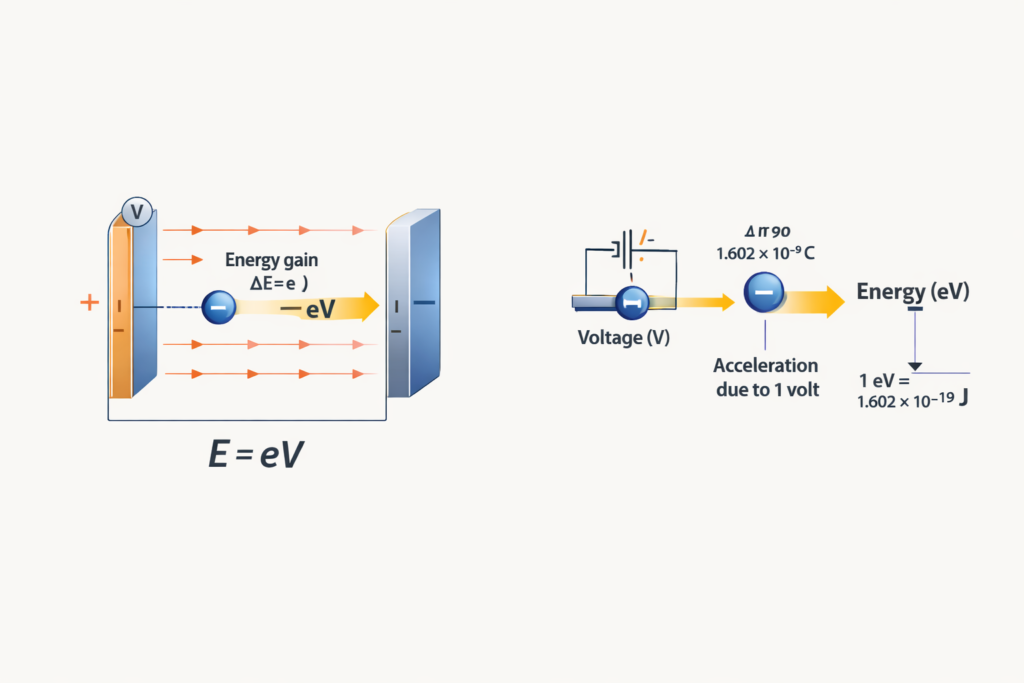
An electron volt (eV) is a unit of energy used primarily in atomic and particle physics. It represents the amount of energy gained by an electron when it moves through an electric potential difference of one volt.
Mathematically: Energy (in electron volts) equals the charge of the electron multiplied by the potential difference.
The elementary charge of an electron is: 1.602 × 10⁻¹⁹ coulombs
When an electron moves across a potential difference of 1 volt, the energy gained is 1 electron volt (1 eV).
This unit is extremely useful because atomic-scale energies are very small in joules, and using electron volts makes values easier to interpret.
For example:
• Energy levels of atoms
• Semiconductor band gaps
• X-ray photon energy
• Particle collision energy
are all commonly expressed in electron volts (eV).
⚡ Volt to Electron Volt Conversion Formula
The conversion between voltage and electron volts follows a simple principle.
When one elementary charge moves through one volt, it gains one electron volt of energy.
Therefore: Energy (eV) = Voltage (V)
This means:
1 Volt = 1 Electron Volt (for a single electron)
However, when calculating energy in joules, the relationship becomes: Energy (J) = e × V
Where:
e = 1.602 × 10⁻¹⁹ C
V = Voltage in volts
This is why scientists frequently convert voltage values into electron volts for atomic and subatomic energy measurements.
🔎 Where Electron Volt Units Are Used
The electron volt is widely used in multiple scientific fields.
🧪 Atomic Physics: Energy levels of electrons in atoms are measured in electron volts. For example, the hydrogen atom has an ionization energy of 13.6 eV.
⚛ Particle Physics: High-energy particle collisions are measured in larger electron volt units such as:
• keV (kiloelectron volt = 103 eV)
• MeV (megaelectron volt = 106 eV)
• GeV (gigaelectron volt = 109 eV)
• TeV (teraelectron volt = 1012eV)
Particle accelerators like those used in high-energy physics experiments often operate at these massive energy scales.
💻 Semiconductor Physics: The band gap energy of semiconductor materials is measured in electron volts.
Examples: Silicon band gap ≈ 1.1 eV, Gallium arsenide band gap ≈ 1.42 eV
These values determine how electronic devices such as transistors, LEDs, and solar cells function.
🌞 Photonics and Light Energy: Photon energy is commonly expressed in electron volts.
For example: Visible light photons typically have energies between 1.8 eV and 3.1 eV.
📊 Example Calculation
Suppose an electron moves across a potential difference of: 5 volts
Using the conversion relationship: Energy = Voltage
Energy = 5 eV
So the electron gains 5 electron volts of energy.
If the same energy is expressed in joules: Energy (J) = 5 × 1.602 × 10-19
Energy = 8.01 × 10⁻¹⁹ J
This demonstrates why physicists prefer electron volts — the numbers become much easier to understand and compare.
🌐 Why Online Physics Calculators Are Important
Online tools such as the Volt to Electron Volt Calculator help students and professionals quickly solve physics problems without needing complex formulas every time.
Benefits include:
✔ Faster learning
✔ Accurate results
✔ Reduced calculation mistakes
✔ Better conceptual understanding
✔ Accessibility on mobile and desktop devices
Educational websites that provide tools like these play an important role in digital learning and STEM education.
Applications in Daily Life ⚡
Although electron volts are mainly used in scientific fields, they indirectly impact many technologies we use every day.
💡 Semiconductor Electronics: Modern electronics such as smartphones, computers, and microchips rely on semiconductor materials whose energy band gaps are measured in electron volts.
🔋 Solar Panels: Solar cells convert photon energy (measured in eV) into electrical power. Understanding electron volt energy helps optimize solar panel efficiency.
📱 LED Lighting: LEDs emit light when electrons move between energy levels in a semiconductor. The emitted light energy is measured in electron volts, determining the color of the LED.
🧬 Medical Imaging: Technologies like X-ray machines and radiation detectors operate using photon energies measured in electron volts.
⚛ Nuclear Energy: Nuclear reactions release energy in MeV (million electron volts), which helps scientists understand nuclear power generation.
⚠️ Disclaimer
The Volt to Electron Volt Calculator available on this website is designed for educational and informational purposes only. While we strive to provide highly accurate calculations using standard physics formulas, results should not be used as a substitute for professional scientific analysis, laboratory measurements, or engineering design calculations.
📚 Users such as students, teachers, researchers, and engineers are encouraged to verify results independently when performing critical experiments or academic research.
This tool aims to simplify physics learning, voltage to electron volt conversion, and energy calculations, but the website owners are not responsible for any decisions made based on calculator results.
📌 Related Calculator
❓ FAQs
❓ What is a Volt to Electron Volt Calculator?
A Volt to Electron Volt Calculator is an online physics tool used to convert electrical potential (volts) into particle energy measured in electron volts (eV). It helps students and engineers perform quick energy calculations in physics.
❓ How do you convert volts to electron volts?
The conversion is very simple: Energy (eV) = Voltage (V). This means when an electron moves across 1 volt, it gains 1 electron volt of energy.
❓ What is the formula for electron volt energy?
The formula used in physics is: Energy (J) = e × V
Where: e = 1.602 × 10⁻¹⁹ C, V = Voltage in volts
❓ Why do physicists use electron volts instead of joules?
Electron volts are used because atomic and particle energies are extremely small in joules. Using electron volts makes these values easier to understand and compare.
❓ Where are electron volts commonly used?
Electron volts are widely used in:
⚛ Particle physics
🔬 Atomic physics
💻 Semiconductor technology
🌞 Solar energy research
📡 Radiation physics
🧠 Final Thoughts
The Volt to Electron Volt Calculator is an essential physics conversion tool that bridges the gap between electrical potential and particle energy.
By converting voltage into electron volts, the calculator allows users to understand how particles behave under electric fields — a concept that lies at the heart of modern physics, electronics, and quantum technology.
Whether you are studying atomic energy levels, semiconductor devices, or particle accelerators, this calculator makes your calculations fast, accurate, and effortless.
⚡ Try the calculator now and simplify your physics energy conversions instantly!