
💉 Vaccine Efficacy Calculator
🧬 Microbiology & Immunology Calculator
📊 Calculate Vaccine Effectiveness
🔬 Formula Used
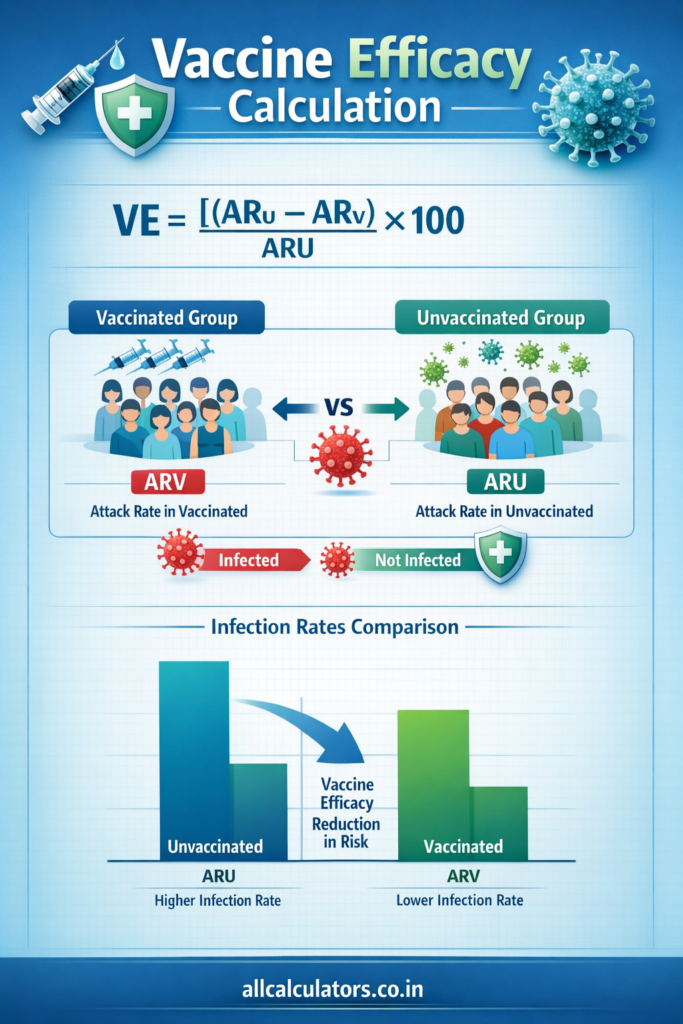
VE = (ARunvaccinated – ARvaccinated) / ARunvaccinated × 100
Where: AR = (Cases / Total) × 100
Number of infected individuals
Total individuals in group
Number of infected individuals
Total individuals in group
📈 Results
Vaccine Efficacy
🎯 Interpretation
📋 Step-by-Step Solution
Vaccine efficacy of 95% means that vaccinated individuals have a 95% lower risk of developing disease compared to unvaccinated individuals. This was famously observed in the Pfizer-BioNTech COVID-19 vaccine trials!
Table of Contents
✍️ Author & Academic Authority: Dr. Nitish Kr. Bharadwaj
📘 Qualifications: B.Sc., B.Ed., M.Sc., Ph.D. (Biochemistry), MBA (Financial Management)
🧮 Vaccine Efficacy Calculator
Calculate VE Percentage & Protection Rate in Immunology
In the fascinating world of microbiology and immunology, understanding how well a vaccine works to protect you from dangerous
diseases is one of the most critical pieces of knowledge you can have. Whether you’re a student studying for exams, a healthcare
professional making evidence-based decisions, or simply a curious individual who wants to understand the science behind vaccine
protection, the Vaccine Efficacy Calculator is your go-to free online tool. This powerful immunology calculator is designed to help
you instantly calculate the vaccine efficacy (VE) percentage using the exact same scientific formula that researchers and
epidemiologists use in clinical trials and real-world studies. Gone are the days of struggling with complex spreadsheets or
manually crunching numbers — now you can get accurate results in seconds with just a few inputs. 🔬
🤔 What Exactly is Vaccine Efficacy?
Vaccine efficacy is a precise scientific measure that tells you what percentage reduction in disease occurs in a vaccinated group
compared to an unvaccinated group during controlled clinical trials. It’s one of the most important metrics in immunology because
it directly answers the question: “How well does this vaccine actually work under ideal conditions?” The vaccine efficacy formula
was first developed by Greenwood and Yule in 1915 for cholera and typhoid vaccines, and it has since become the gold standard in
vaccine research worldwide. The formula is elegantly simple yet powerfully informative: VE = (ARU – ARV) / ARU × 100%, where ARU
stands for the Attack Rate in the Unvaccinated group, and ARV represents the Attack Rate in the Vaccinated group. Alternatively,
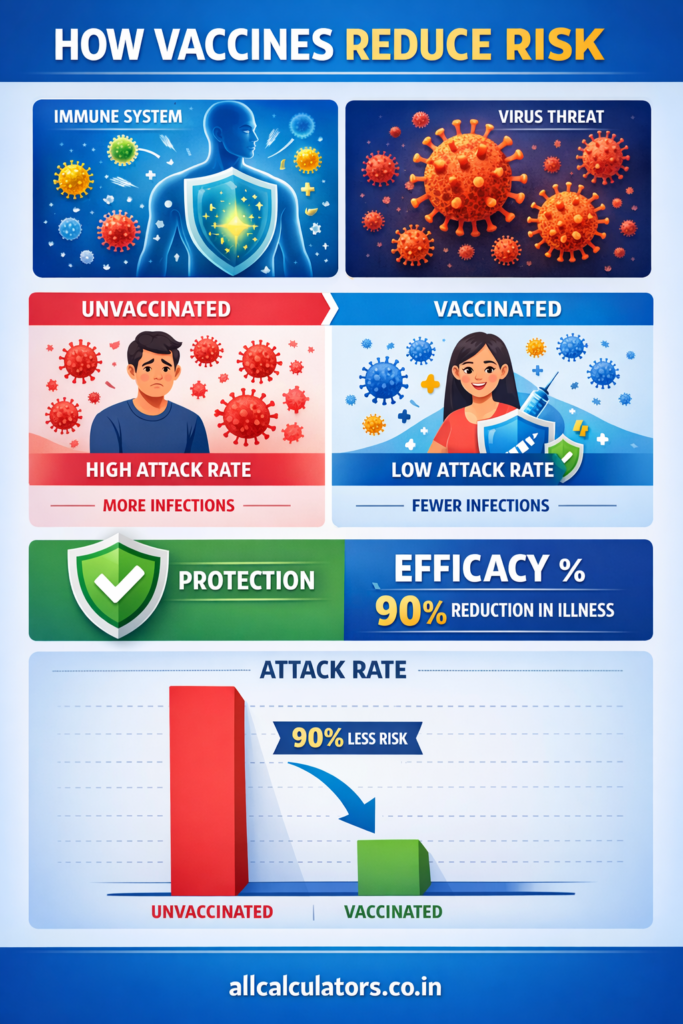
you can use VE = (1 – RR) × 100%, where RR is the Relative Risk. For example, if 100 unvaccinated people got sick (10% attack rate)
and only 10 vaccinated people got sick (1% attack rate), the vaccine efficacy would be a remarkable 90%! This means the vaccine
reduced the risk of disease by 90% in the vaccinated group. 📊
💡 Why is Understanding VE Important for Everyone?
Understanding vaccine efficacy isn’t just for scientists — it’s increasingly becoming essential knowledge for everyday
decision-making. In a world where vaccine-preventable diseases still cause millions of deaths annually, knowing how to interpret VE
percentages helps you make informed choices about your health and your family’s health. When public health officials announce that a new vaccine has “90% efficacy,” understanding what that truly means can alleviate unnecessary fears and combat misinformation. For students pursuing careers in microbiology, immunology, medicine, or public health, mastering the vaccine efficacy calculation is fundamental to your education. This free online calculator serves as both a learning tool and a practical resource, bridging the gap between complex epidemiological concepts and public understanding. 📚
⚙️ How Does the Vaccine Efficacy Calculator Work?
Using our Vaccine Efficacy Calculator is incredibly straightforward, even if you have no background in mathematics or science.
Simply input the number of individuals who fell ill (the attack rate) in both the vaccinated group and the unvaccinated group from
your clinical trial or study data. The calculator handles all the complex calculations automatically, using the standard VE formula
universally recognized by the World Health Organization (WHO), the Centers for Disease Control and Prevention (CDC), and other
leading health organizations. You’ll instantly receive your vaccine efficacy percentage, along with a clear interpretation of what
that number means in practical terms. The tool also helps you understand concepts like relative risk reduction and absolute risk
reduction, giving you a comprehensive picture of vaccine performance. No more confusion about what those percentage numbers
actually mean for real-world protection! 🛡️
⚖️ The Critical Difference Between Efficacy and Effectiveness
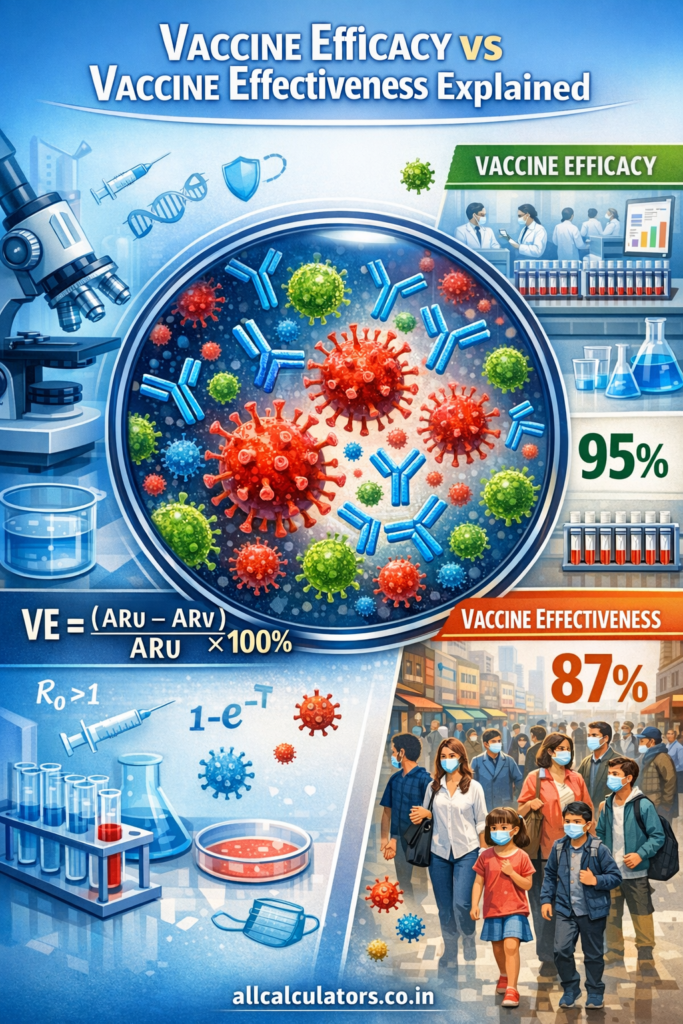
One of the most common sources of confusion in vaccine science is the difference between vaccine efficacy and vaccine effectiveness — and our calculator helps clarify this important distinction. Efficacy is measured during controlled randomized clinical trials with ideal conditions, specific populations, and careful monitoring. Effectiveness, on the other hand, measures how well vaccines perform in messy, real-world conditions with diverse populations, varying health statuses, and numerous external factors.
Generally, effectiveness numbers tend to be slightly lower than efficacy numbers because real life introduces variables that
controlled trials eliminate. Both metrics are valuable, but efficacy is typically reported first (during trial phases), while
effectiveness data accumulates after widespread vaccine rollout. Understanding this difference is crucial for interpreting news
about vaccines accurately and avoiding misunderstandings. 🌍
🎓 Applications in Research, Public Health, and Education
The Vaccine Efficacy Calculator has wide-ranging applications across multiple fields. Researchers use similar calculations to
evaluate new vaccine candidates during development. Public health officials rely on VE data to formulate vaccination policies and
identify high-risk populations needing targeted interventions. Educators find this tool invaluable for teaching epidemiology
concepts to students in an engaging, practical way. Healthcare providers use vaccine efficacy information to address vaccine
hesitancy with concrete, evidence-based data rather than emotional arguments. Even journalists and content creators covering health
topics can use this tool to better understand and communicate vaccine science to the public. The beauty of this calculator lies in
its versatility — it serves everyone from PhD researchers to elementary students learning about germs and immunity for the first
time. 🌟
🦠 Real-World Example: COVID-19 Vaccines
To make this concept crystal clear, let’s look at real-world application using COVID-19 vaccines as an example. When studies showed
that Pfizer-BioNTech’s vaccine had approximately 95% efficacy, it didn’t mean 5% of vaccinated people would get COVID-19. Instead,
it meant that among vaccinated individuals, there was a 95% reduction in the risk of developing COVID-19 compared to unvaccinated
individuals. So if 1,000 unvaccinated people got COVID-19 during the study period, only about 50 vaccinated people would be
expected to get it — representing that dramatic 95% risk reduction. This is why vaccine efficacy calculators became so important
during the pandemic — they helped people understand that these vaccines were extraordinarily effective at preventing severe illness
and death, even if they weren’t “perfect.” Understanding the difference between a 50% effective vaccine and a 95% effective
vaccine can be the difference between life and death for vulnerable populations. 💉
🔢 The Mathematical Formula Explained Step by Step
Let’s break down the vaccine efficacy formula into its simplest components so you fully understand what our calculator is doing.
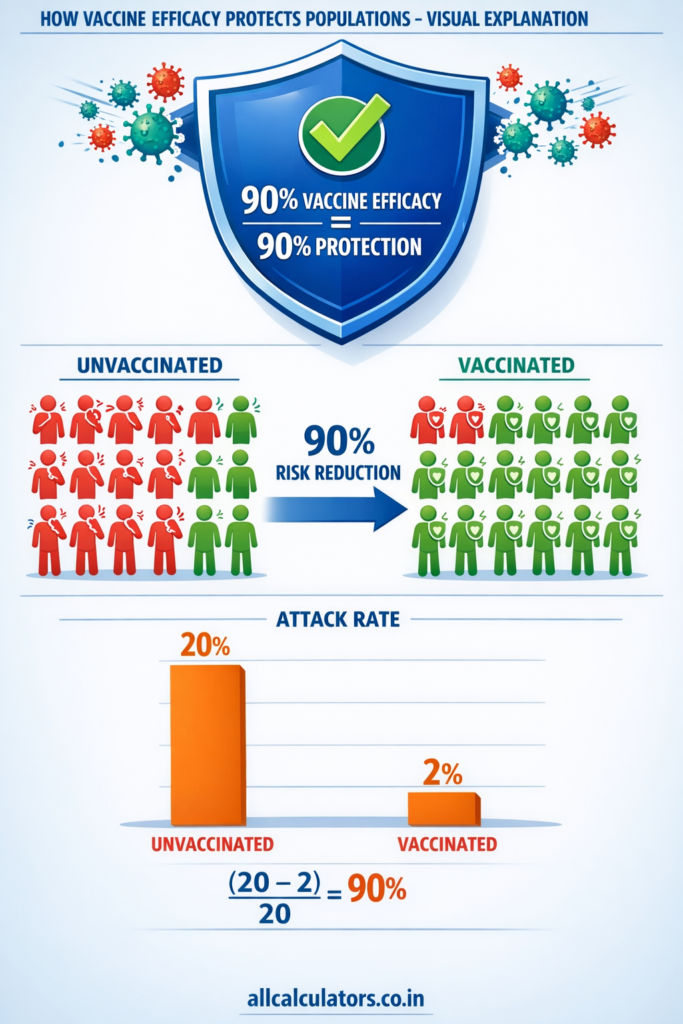
The classic formula is VE = (ARU – ARV) / ARU × 100%. Let’s say you have a clinical trial with 1,000 participants in each group. In
the unvaccinated group, 200 people developed the disease, giving an Attack Rate Unvaccinated (ARU) of 200/1,000 = 0.20 or 20%. In
the vaccinated group, only 20 people developed the disease, giving an Attack Rate Vaccinated (ARV) of 20/1,000 = 0.02 or 2%.
Plugging these into the formula: VE = (0.20 – 0.02) / 0.20 × 100% = 0.18 / 0.20 × 100% = 0.90 × 100% = 90% vaccine efficacy. This
90% efficacy means the vaccine provided a 90% reduction in disease risk — an incredibly powerful protective effect! Our calculator
handles all these steps automatically, so you never have to worry about making calculation errors. ✅
🌍 The Broader Significance for Global Health
Understanding vaccine efficacy calculations isn’t just academic — it has profound implications for global health outcomes. When
organizations like WHO and CDC evaluate vaccines for approval, they rely on these efficacy calculations to determine whether a
vaccine is good enough to recommend for mass vaccination campaigns. High-efficacy vaccines can achieve herd immunity with lower
vaccination rates, while vaccines with moderate efficacy may require higher coverage rates to protect populations effectively. This
mathematical framework helps policymakers allocate limited resources efficiently, targeting vaccines to populations where they’ll
have the greatest impact. For instance, a vaccine with 90% efficacy might be prioritized for healthcare workers and elderly
populations, while a 70% efficacy vaccine might be deployed more broadly in younger, healthier populations. Every percentage point
of efficacy translates to thousands — sometimes millions — of lives saved when applied to global vaccination programs. 🎯
🧬 Practical Applications of Vaccine Efficacy in Everyday Life 🌍
Understanding vaccine efficacy through our immunology calculator has numerous practical applications in your daily life. Here are
key areas where this knowledge becomes invaluable:
🤰 Pregnancy and Infant Health — Expecting mothers often face decisions about vaccines like Tdap (whooping cough) and influenza
shots. Knowing that the Tdap vaccine provides approximately 78-84% efficacy against pertussis in infants helps parents make
informed decisions about timing and necessity of vaccination during pregnancy for protecting their newborns. The vaccine protection rate directly impacts the health outcomes of vulnerable newborns who are too young for certain immunizations.
👴 Elderly Care and Senior Health — As we age, our immune systems become less robust, making flu vaccines less effective in older
adults (typically 30-50% effective vs. 50-70% in younger adults). Understanding these VE percentages helps families and caregivers
make decisions about additional protective measures like high-dose flu vaccines or pneumococcal vaccines for grandparents. This
knowledge empowers families to have informed conversations with healthcare providers about optimal protection strategies.
✈️ International Travel Planning — When traveling to countries with endemic diseases, travelers need vaccines for typhoid, yellow
fever, or Japanese encephalitis. Knowing the vaccine efficacy of these travel vaccines helps you understand your actual level of
protection and whether additional precautions (like mosquito nets or prophylactic medications) are necessary. A vaccine efficacy
calculator can help you research and understand the expected protection from travel immunizations before your trip.
🏫 School Enrollment Requirements — Many schools require vaccination records for enrollment, and understanding vaccine
effectiveness versus vaccine efficacy helps parents navigate exemption processes intelligently. Rather than blindly following or
rejecting requirements, informed parents can understand the genuine risks and benefits. Some vaccines like MMR
(measles-mumps-rubella) provide 97% efficacy against measles after two doses, which is why high vaccination rates are so critical
in school settings.
💼 Workplace Health Decisions — Healthcare workers, teachers, food service employees, and others in public-facing roles often face workplace vaccine mandates. Understanding vaccine efficacy percentages helps employees understand their personal protection levels and make informed decisions about workplace health and safety. Employees can also understand why boosters might be recommended when initial vaccine VE wanes over time.
🏠 Family Health Planning — When a new baby arrives, parents make countless health decisions. Understanding which vaccines provide high VE (like the 99% effective hepatitis B series) versus those with moderate efficacy helps prioritize vaccination schedules and understand why some diseases still occur occasionally even in fully vaccinated populations. This knowledge reduces unnecessary worry when breakthrough infections occur.
📰 Navigating Health News and Social Media — Perhaps one of the most valuable daily applications is the ability to critically
evaluate health news. When headlines scream “Vaccine Only 70% Effective,” understanding what that VE percentage actually means
helps prevent unnecessary fear. You can distinguish between “70% effective” meaning the vaccine is worthless (wrong interpretation) versus “70% reduction in risk with 30% still protected if exposed” (correct interpretation). This immunology literacy is essential for modern information consumption.
🧪 Making Evidence-Based Health Decisions — Whether deciding about annual flu shots, COVID-19 boosters, or childhood immunization schedules, understanding vaccine efficacy calculations empowers you to have meaningful conversations with healthcare providers. Instead of passively accepting recommendations, you can ask informed questions like “How does this vaccine’s efficacy compare to alternatives?” or “Given my health conditions, should I wait for a higher-efficacy option?”
⚠️Disclaimer 🔍
🔬 Vaccine Efficacy Calculator — Scientific Accuracy Notice 🧪
⚠️ DISCLAIMER: While our Vaccine Efficacy Calculator uses the scientifically accepted VE formula (VE = (ARU – ARV) / ARU × 100%)
widely recognized by WHO, CDC, and leading immunology research institutions worldwide, allcalculators.co.in provides this tool for
educational and informational purposes only. 📚 The calculated vaccine efficacy percentages are based on mathematical formulas
applied to user-provided data and do not constitute medical, clinical, or public health advice. 🏥 Results from this immunology
calculator should never replace consultation with qualified healthcare professionals for diagnosis, treatment, vaccination
schedules, or health-related decisions. ⚕️ Vaccine efficacy measured in controlled clinical trials differs from real-world vaccine
effectiveness, which may vary based on population demographics, emerging variants, waning immunity, and individual health factors.
🌎 Always consult official sources like WHO, CDC, or your national health authority for authoritative vaccine guidance. 💉 Our free
online calculator is a learning aid only — use it responsibly and always prioritize professional medical advice for personal
health decisions. ✅
📌 Related Calculator
❓ Frequently Asked Questions About Vaccine Efficacy Calculator 💡
Q1: What is vaccine efficacy and how does the calculator work? 🤔
A: Vaccine efficacy is the percentage reduction in disease risk among vaccinated individuals compared to unvaccinated individuals
in controlled clinical trials. Our free Vaccine Efficacy Calculator uses the standard formula: VE = (ARU – ARV) / ARU × 100%, where
ARU is the Attack Rate in Unvaccinated group and ARV is the Attack Rate in Vaccinated group. Simply input your trial data numbers,
and the calculator instantly computes the VE percentage — it’s that easy! No complex math required! 🧮✨
Q2: What is the difference between vaccine efficacy and vaccine effectiveness? ⚖️
A: This is one of the most common questions in immunology! Vaccine efficacy is measured in controlled clinical trials under ideal
conditions with specific populations. Vaccine effectiveness measures how well vaccines work in real-world conditions with diverse
populations, varying health statuses, and external environmental factors. Effectiveness numbers are typically slightly lower than
efficacy numbers because real life introduces variables that clinical trials eliminate. Both metrics are valuable, but
effectiveness is generally preferred for understanding actual population protection. 🌍💉
Q3: How do I calculate vaccine efficacy percentage manually? 🔢
A: To manually calculate vaccine efficacy percentage, follow these steps: First, determine the attack rate in your unvaccinated
group (number sick ÷ total unvaccinated). Second, determine the attack rate in your vaccinated group (number sick ÷ total
vaccinated). Third, apply the formula: VE = (ARU – ARV) / ARU × 100%. For example, if ARU = 20% and ARV = 2%, then VE = (0.20 –
0.02) / 0.20 × 100% = 90% vaccine efficacy. You can also use the alternative formula: VE = (1 – Relative Risk) × 100%. Our
immunology calculator handles all these calculations automatically! ✅🧠
Q4: Does 90% vaccine efficacy mean 10% of people will get sick? ❌
A: Absolutely not! This is a critical misconception that our Vaccine Efficacy Calculator helps clarify. A 90% efficacy means the
vaccinated group had a 90% lower risk of developing disease compared to the unvaccinated group — NOT that 10% of vaccinated people
will get sick. For example, if 1,000 unvaccinated people got COVID-19 during a study period, only about 100 vaccinated people would
be expected to get it (not 100 out of 100 vaccinated). This distinction is crucial for understanding true vaccine protection
rates. 🛡️🔬
Q5: Why is vaccine efficacy important for public health? 🌍
A: Vaccine efficacy is fundamental to public health decision-making! Health organizations like WHO and CDC use VE percentages to
evaluate whether vaccines should be approved and recommended for mass vaccination programs. High-efficacy vaccines can achieve herd
immunity with lower vaccination coverage rates. Understanding efficacy helps policymakers allocate limited healthcare resources
efficiently and identify which populations need targeted vaccination campaigns most urgently. It also helps combat vaccine
hesitancy by providing concrete, evidence-based data about vaccine performance. 📊💪
Q6: Can I use this calculator for any vaccine? 💉
A: Our Vaccine Efficacy Calculator can be used to calculate VE percentages for virtually any vaccine, including COVID-19, influenza
(flu), measles, polio, typhoid, yellow fever, and more! The underlying immunology formula is universal — it applies to all
vaccines that have been studied using clinical trial designs with vaccinated and unvaccinated comparison groups. Whether you’re a
student researching for exams, a healthcare professional analyzing data, or a curious individual wanting to understand vaccine
performance, this free online calculator serves all needs! 🌟🎓