
🔥 Thermal Energy Calculator
Q = Thermal Energy (J)
m = Mass (kg)
c = Specific Heat Capacity (J/kg°C)
ΔT = Change in Temperature (°C)
Table of Contents
✍️ Author & Academic Authority: Dr. Nitish Kr. Bharadwaj
📘 Qualifications: B.Sc., B.Ed., M.Sc., Ph.D. (Biochemistry), MBA (Financial Management)
🔥 Thermal Energy Calculator – Introduction
Instantly Calculate Heat Energy in Physics ⚡
Understanding thermal energy is a fundamental concept in physics and thermodynamics. Whether you are a student solving physics problems, an engineer analyzing heat transfer, or someone curious about energy changes, the Thermal Energy Calculator helps you instantly compute the amount of heat energy involved in a system.
🌡️ Thermal energy refers to the internal energy contained in a substance due to the random motion of its molecules. As temperature increases, molecular motion becomes more vigorous, and the substance possesses greater thermal energy. In physics, thermal energy is commonly calculated using the formula: Q = m × c × ΔT
Where:
• Q = Thermal Energy (Joules)
• m = Mass of the substance (kg)
• c = Specific Heat Capacity (J/kg·°C)
• ΔT = Change in Temperature (Final − Initial)
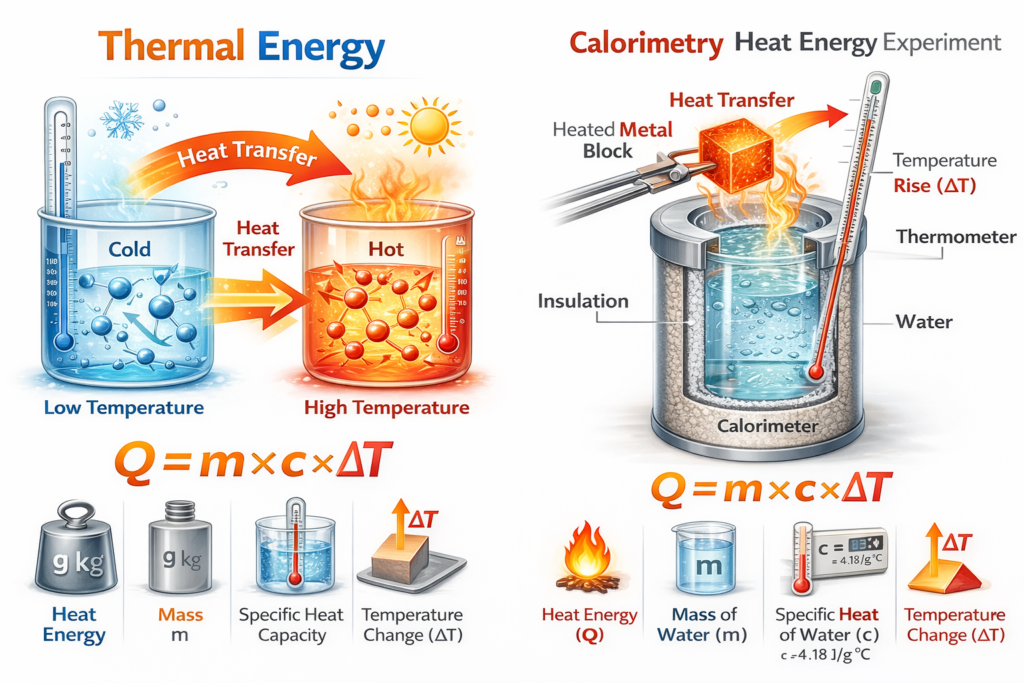
Our online Thermal Energy Calculator allows you to quickly compute heat energy by simply entering mass, specific heat capacity, and temperature change. This eliminates the need for manual calculations and reduces the chances of errors in solving thermodynamics problems.
🚀 This physics heat energy calculator is particularly useful for students studying thermodynamics, calorimetry, heat transfer, and energy conversion. It simplifies complex calculations and provides quick results for homework, exam preparation, or scientific experiments.
🌍 What is Thermal Energy?
Thermal energy is the total kinetic energy of microscopic particles in matter. Every atom and molecule vibrates or moves, and this movement contributes to the thermal energy of the object.
For example:
🔥 A hot cup of coffee contains more thermal energy than a cold cup because its molecules move faster.
❄️ Ice has lower thermal energy because molecular movement is slower.
The amount of thermal energy depends on three main factors:
✔ Mass of the substance
✔ Temperature change
✔ Specific heat capacity
Because of these factors, a large object may contain more thermal energy than a smaller object even if both have the same temperature.
📚 Why Thermal Energy is Important in Physics
Thermal energy plays a major role in many scientific and engineering fields.
⚡ Thermodynamics – understanding energy transfer between systems
🔥 Heat transfer engineering – designing heating and cooling systems
🌎 Climate science – studying temperature changes in Earth’s systems
⚙️ Mechanical engineering – analyzing energy efficiency
The ability to calculate thermal energy quickly helps in analyzing how heat flows from one object to another.
🧪 Example of Thermal Energy Calculation
Suppose we have:
Mass = 2 kg
Specific Heat Capacity = 4200 J/kg°C (water)
Temperature Change = 10°C
Using the thermal energy formula: Q = m × c × ΔT
Q = 2 × 4200 × 10
Q = 84,000 Joules
Using our thermal energy calculator, you can get this result instantly without manual calculation.
🔬 Thermal Energy in Thermodynamics
In thermodynamics, thermal energy is closely related to heat transfer and temperature changes. Heat flows naturally from hotter objects to colder ones until thermal equilibrium is reached.
There are three main methods of heat transfer:
🔥 Conduction – Heat transfer through direct contact
🌬 Convection – Heat transfer through fluid movement
☀️ Radiation – Heat transfer through electromagnetic waves
Understanding these processes is essential when studying energy conservation and heat flow in physics.
🌍 Applications in Daily Life
Thermal energy plays an essential role in everyday life. Understanding how to calculate thermal energy helps in many real-world applications.
🍳 Cooking and Food Preparation: When cooking food, heat energy is transferred from the stove to the food. A thermal energy calculator can estimate how much heat is required to raise the temperature of water, oil, or food.
🚗 Automobile Engines: Car engines generate enormous heat during fuel combustion. Engineers calculate heat energy and temperature changes to design efficient cooling systems.
🏠 Home Heating Systems: Heating systems such as radiators, heaters, and boilers rely on thermal energy calculations to maintain comfortable indoor temperatures.
🧊 Refrigerators and Air Conditioners: Cooling systems remove thermal energy from the air. Engineers calculate heat transfer using thermodynamics formulas similar to those used in a heat energy calculator.
🌞 Solar Energy Systems: Solar panels convert sunlight into usable energy. Understanding thermal energy calculations helps design efficient solar heating systems.
🧪 Scientific Experiments: In laboratories, scientists perform calorimetry experiments to measure heat energy released or absorbed in chemical reactions.
⚠️ Disclaimer 📢
The Thermal Energy Calculator on AllCalculators.co.in is designed for educational and informational purposes only. While the calculator uses standard physics formulas for thermal energy calculation, results may vary depending on measurement accuracy and input values.
🔬 This tool should be used as a learning aid for students, teachers, and physics enthusiasts. For professional engineering analysis, scientific research, or industrial applications, consult qualified experts and verified technical resources.
By using this online heat energy calculator, users acknowledge that the website is not responsible for decisions or outcomes based solely on calculator results.
📌 Related Calculator
❓FAQs
❓ What is a Thermal Energy Calculator?
A thermal energy calculator is an online physics tool used to calculate heat energy using the formula Q = m × c × ΔT. It helps students and professionals quickly determine energy changes caused by temperature differences.
❓ What is the formula for thermal energy?
The formula used in thermodynamics is: Q = m × c × ΔT; Where Q is heat energy, m is mass, c is specific heat capacity, and ΔT is temperature change.
❓ What unit is thermal energy measured in?
Thermal energy is measured in Joules (J) according to the International System of Units (SI).
❓ Why is thermal energy important in physics?
Thermal energy explains how heat flows between objects, how temperature changes occur, and how energy is conserved in thermodynamic systems.
❓ Who can use a heat energy calculator?
A heat energy calculator is useful for students, teachers, engineers, and researchers studying thermodynamics, calorimetry, and heat transfer.