
🔥 Specific Heat Calculator
Where:
c = Specific Heat Capacity
Q = Heat Energy (J)
m = Mass (kg)
ΔT = Temperature Change (°C or K)
Table of Contents
✍️ Author & Academic Authority: Dr. Nitish Kr. Bharadwaj
📘 Qualifications: B.Sc., B.Ed., M.Sc., Ph.D. (Biochemistry), MBA (Financial Management)
🔥 Specific Heat Calculator – Introduction
Easily Calculate Specific Heat Capacity Online ⚛️
Understanding specific heat capacity is one of the most important concepts in physics and thermodynamics. Whether you are a student solving physics problems, a teacher explaining calorimetry, or someone working with temperature and heat transfer calculations, our Specific Heat Calculator helps you quickly determine the specific heat capacity of a substance using the standard thermodynamics formula.
This online specific heat calculator is designed to simplify calculations involving heat energy (Q), mass (m), and temperature change (ΔT). Instead of manually solving equations, you can instantly compute results using this physics calculator tool, saving time and avoiding mistakes.
⚛️ What is Specific Heat Capacity?
Specific heat capacity is the amount of heat energy required to raise the temperature of 1 unit mass of a substance by 1°C (or 1 Kelvin). In physics, this property tells us how different materials respond to heat energy.
For example: 🔥 Water has a very high specific heat capacity, which means it takes a lot of energy to change its temperature.
🪨 Metals usually have lower specific heat capacity, meaning they heat up quickly. This property plays a major role in climate systems, cooking, engineering, and industrial heat transfer processes.
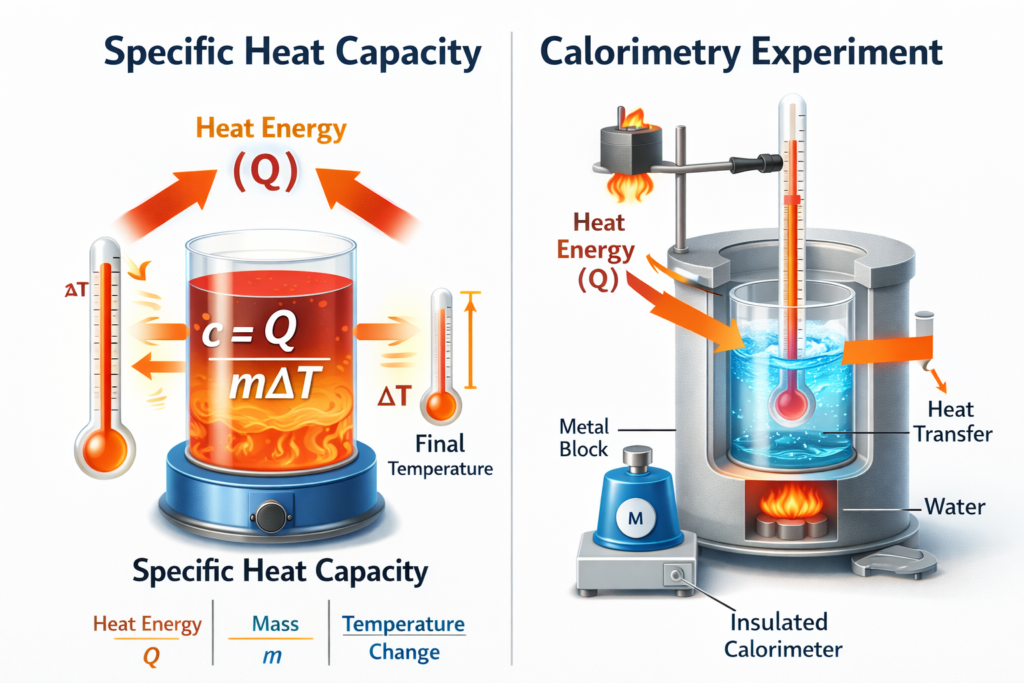
📐 Specific Heat Formula
The specific heat capacity formula used in thermodynamics is: c = Q / (m × ΔT)
Where:
⚡ c = Specific Heat Capacity
🔥 Q = Heat energy supplied (Joules)
⚖️ m = Mass of the substance (kg or g)
🌡️ ΔT = Change in temperature (Final Temperature – Initial Temperature)
This formula is widely used in calorimetry experiments, physics labs, engineering heat calculations, and energy transfer studies.
Our Specific Heat Calculator online automatically solves this equation and gives an instant result.
🚀 Why Use an Online Specific Heat Calculator?
Manually calculating specific heat capacity can be time-consuming and error-prone, especially when dealing with multiple units and values.
Using our specific heat formula calculator offers several advantages:
✅ Instant calculations
✅ Accurate physics results
✅ Perfect for students and teachers
✅ Works for homework, assignments, and experiments
✅ Saves time during calorimetry calculations
This physics heat capacity calculator is ideal for high school students, college learners, and professionals dealing with thermal energy calculations.
🧪 Example Calculation
Suppose you have the following values:
Heat Energy (Q) = 500 Joules
Mass (m) = 2 kg
Temperature Change (ΔT) = 5°C
Using the formula:
c = Q / (m × ΔT)
c = 500 / (2 × 5)
c = 50 J/kg°C
Instead of doing this manually every time, our specific heat capacity calculator online solves it instantly.
🌍 Why Specific Heat Matters in Real Life
Specific heat capacity plays a major role in many natural and technological processes.
For example: 🌊 Oceans regulate Earth’s temperature because water stores large amounts of heat.
🔥 Cooking works efficiently because different materials transfer heat differently.
🏗️ Engineers design buildings and machines by considering thermal energy properties of materials.
Understanding this concept helps explain weather patterns, heating systems, and industrial processes.
📊 Units Commonly Used in Specific Heat
The most common units used in specific heat calculations include:
🔥 J/kg°C (Joules per kilogram per degree Celsius)
🔥 J/g°C (Joules per gram per degree Celsius)
🔥 cal/g°C (Calories per gram per degree Celsius)
Our specific heat calculator works with these values easily, making it ideal for physics homework and thermodynamics calculations.
🌍 Applications in Daily Life
Specific heat capacity is not just a physics concept — it influences many real-world processes and technologies.
🌊 Climate Regulation: Water has a high specific heat capacity, which helps oceans absorb heat and regulate Earth’s climate.
🍳 Cooking and Kitchen Science: Different cookware materials have different heat capacities, affecting how food heats and cooks.
🏗️ Building Construction: Engineers choose materials with suitable thermal properties and heat capacity to improve energy efficiency.
🚗 Automotive Industry: Car engines and cooling systems rely on heat transfer calculations and specific heat capacity of fluids.
🔋 Energy Storage Systems: Thermal storage systems use materials with high specific heat capacity to store energy.
🧊 Refrigeration and Cooling: Cooling systems depend on heat energy calculations and calorimetry principles.
⚠️Disclaimer 📢
The Specific Heat Calculator provided on allcalculators.co.in is designed for educational and informational purposes only.
While this tool aims to provide accurate physics calculations, results should always be verified when used for academic exams, laboratory experiments, engineering work, or scientific research. Users are responsible for ensuring that the input values, units, and measurements are correct before interpreting results.
📚 This calculator is intended to assist students, educators, and researchers in understanding specific heat capacity calculations and thermodynamics concepts.
📌 Related Calculator
❓FAQs
❓ What is specific heat capacity in physics?
Specific heat capacity is the amount of heat energy required to raise the temperature of one unit mass of a substance by one degree Celsius or Kelvin. It is a key concept in thermodynamics and calorimetry calculations.
❓ What is the formula used in the specific heat calculator?
The calculator uses the formula: c = Q / (m × ΔT); Where Q is heat energy, m is mass, and ΔT is temperature change.
❓ What units are used for specific heat capacity?
Common units include:
🔥 Joules per kilogram per degree Celsius (J/kg°C)
🔥 Joules per gram per degree Celsius (J/g°C)
🔥 Calories per gram per degree Celsius (cal/g°C)
❓ Why does water have a high specific heat capacity?
Water molecules form strong hydrogen bonds, allowing them to store large amounts of heat energy without a large temperature change.
❓ Who can use this specific heat calculator?
This online specific heat calculator is ideal for physics students, teachers, engineers, and researchers solving heat transfer or calorimetry problems.