
🌊 Reynolds Number Calculator
Table of Contents
✍️ Author & Academic Authority: Dr. Nitish Kr. Bharadwaj
📘 Qualifications: B.Sc., B.Ed., M.Sc., Ph.D. (Biochemistry), MBA (Financial Management)
🌊 Reynolds Number Calculator – Introduction
Instantly Determine Laminar or Turbulent Flow🔎
Fluid flow is one of the most important concepts in physics, mechanical engineering, civil engineering, and fluid mechanics. Whether you are studying pipe flow in engineering systems, blood circulation in biology, airflow over aircraft wings, or water flow in pipelines, understanding how fluids move is essential.
One of the most powerful tools used to analyze fluid motion is the Reynolds Number. Our Reynolds Number Calculator helps students, engineers, and researchers quickly determine whether a flow is laminar, transitional, or turbulent by using the Reynolds number formula. This online Reynolds Number Calculator is designed to make complex calculations simple and fast. Instead of manually solving equations or risking calculation errors, users can simply enter the required parameters such as fluid velocity, characteristic length (or pipe diameter), fluid density, and dynamic viscosity, and instantly calculate the Reynolds number.
📘 What is Reynolds Number?
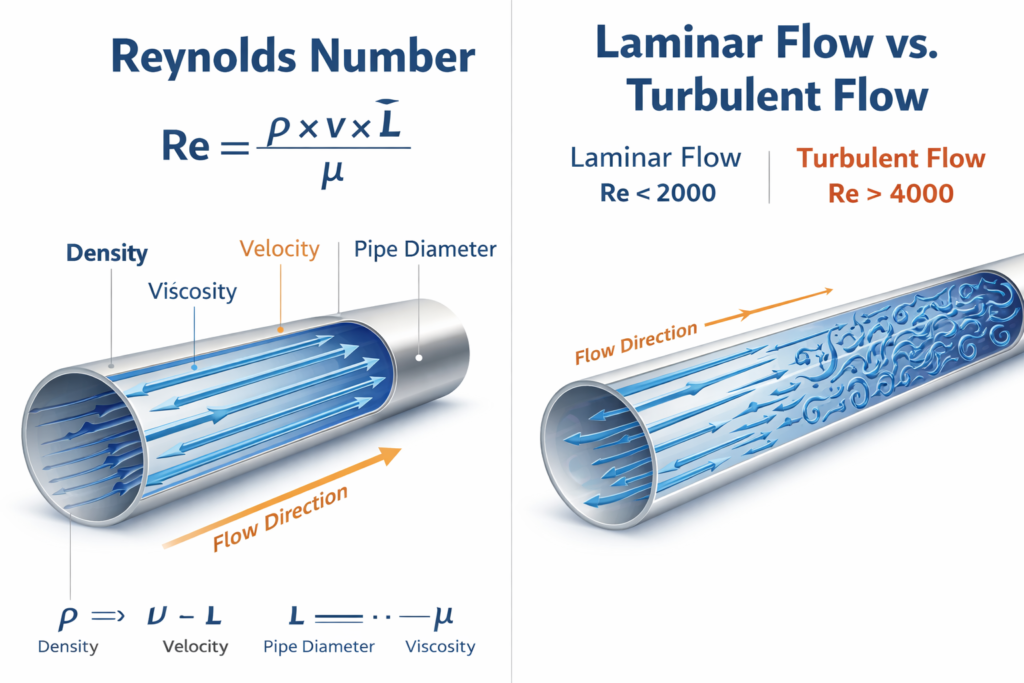
The Reynolds number (Re) is a dimensionless quantity used in fluid mechanics to predict flow patterns in different fluid flow situations. It compares the inertial forces of the fluid to the viscous forces acting within the fluid.
The formula for Reynolds Number is: Re = (ρ × v × L) / μ
Where:
ρ = Fluid density
v = Fluid velocity
L = Characteristic length (pipe diameter in pipe flow)
μ = Dynamic viscosity of the fluid
This equation helps determine how a fluid behaves when flowing through pipes, channels, or around objects.
🔬 Flow Regimes Based on Reynolds Number
One of the main reasons engineers calculate Reynolds number is to identify the flow regime. The value of Reynolds number determines whether the flow is smooth or chaotic.
1️⃣ Laminar Flow (Re < 2000): In laminar flow, fluid moves in parallel layers without mixing. This type of flow is smooth and predictable. Laminar flow commonly occurs in slow-moving fluids or highly viscous liquids such as oil.
2️⃣ Transitional Flow (Re between 2000 and 4000): In this range, the flow begins transitioning from laminar to turbulent. Small disturbances can cause fluctuations in the flow.
3️⃣ Turbulent Flow (Re > 4000): Turbulent flow is chaotic and characterized by eddies, swirls, and irregular motion. This type of flow occurs at high velocities or low viscosity and is common in large pipelines, rivers, and atmospheric flows.
🧠 Why Reynolds Number is Important
The Reynolds number equation is one of the most fundamental principles in fluid mechanics. It allows engineers and scientists to predict flow behavior before building physical systems, saving time, cost, and resources.
Some major reasons why Reynolds number is important include:
✔ Predicting flow type in pipes and channels
✔ Designing efficient fluid transport systems
✔ Understanding aerodynamic behavior
✔ Improving hydraulic system performance
✔ Optimizing industrial fluid processes
Using a Reynolds Number Calculator online simplifies these calculations and allows users to analyze fluid systems instantly.
⚙️ Reynolds Number in Fluid Mechanics
The Reynolds number was introduced by the famous scientist Osborne Reynolds, who studied fluid flow patterns in the late 19th century. His experiments demonstrated that fluid flow transitions from smooth to chaotic depending on velocity and viscosity.
Today, the Reynolds number formula is used extensively in fields such as:
• Mechanical engineering
• Civil engineering
• Chemical engineering
• Aerospace engineering
• Biomedical engineering
From pipeline design to aircraft aerodynamics, Reynolds number plays a critical role in predicting fluid behavior.
🚀 Why Use Our Reynolds Number Calculator?
Our Reynolds Number Calculator online tool is designed to provide accurate results instantly while being extremely user-friendly.
Key benefits include:
✔ Instant Reynolds number calculation
✔ Accurate physics-based formula implementation
✔ Mobile-friendly and responsive calculator
✔ Perfect for students and engineers
✔ Helps understand laminar vs turbulent flow quickly
By using this fluid flow Reynolds number calculator, users can simplify complex physics calculations and gain a deeper understanding of fluid behavior.
🌍 Applications in Daily Life
Even though Reynolds number is often discussed in engineering textbooks, it has many real-world applications that affect everyday life.
🚰 Water Flow in Household Pipes: Engineers use the Reynolds number calculator for pipe flow to ensure water moves efficiently through plumbing systems without excessive turbulence or pressure loss.
🚗 Vehicle Aerodynamics: Automotive engineers calculate Reynolds number for airflow around cars to reduce drag and improve fuel efficiency.
✈️ Aircraft Design: Aerospace engineers analyze Reynolds number in airfoil flow to optimize aircraft wing performance.
🏥 Blood Flow in the Human Body: Biomedical engineers study Reynolds number in blood flow to understand cardiovascular health and design medical devices.
🏭 Industrial Fluid Transport: Factories transporting oil, chemicals, or gases through pipelines rely on Reynolds number calculations to ensure efficient flow.
🌊 River and Ocean Flow: Environmental scientists use Reynolds number to analyze water currents, ocean circulation, and river flow patterns.
⚠️ Disclaimer (Educational Use Only)
This Reynolds Number Calculator is designed for educational and informational purposes. While the calculator uses standard fluid mechanics formulas, results should be considered approximate.
📚 For academic assignments, engineering design, or professional research, always verify results with authoritative references or engineering software.
🧪 The tool assumes ideal conditions and may not account for all real-world variables such as temperature variation, compressibility, or complex flow geometry. By using this calculator, users agree that allcalculators.co.in is not responsible for decisions made based on these calculations.
📌 Related Calculator
❓ FAQs
❓ What is Reynolds Number in fluid mechanics?
The Reynolds number is a dimensionless quantity used to determine whether fluid flow is laminar, transitional, or turbulent. It compares inertial forces to viscous forces in a fluid.
❓ What is the formula for Reynolds Number?
The Reynolds number formula is: Re = (ρ × v × L) / μ; Where density, velocity, characteristic length, and viscosity determine the flow regime.
❓ What does a high Reynolds number mean?
A high Reynolds number (greater than 4000) indicates turbulent flow, where the fluid motion becomes chaotic with eddies and vortices.
❓ What does a low Reynolds number mean?
A low Reynolds number (less than 2000) indicates laminar flow, where the fluid flows smoothly in parallel layers.
❓ Why is Reynolds Number important?
The Reynolds number helps engineers predict fluid behavior, design pipelines, improve aerodynamics, and analyze fluid transport systems.
.