
🎨 Resistor Color Code Calculator
Formula Used: Resistance = (First Band Digit × 10 + Second Band Digit) × 10Multiplier ± Tolerance
✍️ Author & Academic Authority: Dr. Nitish Kr. Bharadwaj
📘 Qualifications: B.Sc., B.Ed., M.Sc., Ph.D. (Biochemistry), MBA (Financial Management)
🎨🔌 Resistor Color Code Calculator – Instantly Decode Resistor Values
Electronics is the backbone of modern technology, powering everything from smartphones and computers to home appliances and scientific instruments. At the core of nearly every electronic circuit lies a small but essential component known as a resistor. Resistors regulate electrical current, protect circuit components, and help maintain proper voltage levels. However, resistors are extremely small, which makes printing numerical resistance values directly on them impractical. To solve this problem, manufacturers developed the resistor color code system.
The Resistor Color Code Calculator is a powerful online tool designed to quickly decode the colored bands printed on resistors and convert them into their corresponding resistance values in ohms (Ω). Instead of manually interpreting resistor bands using charts or tables, users can simply select the colors displayed on the resistor and instantly obtain the resistance value, tolerance, and sometimes temperature coefficient.
🎓 This tool is particularly useful for electronics students, electrical engineers, hobbyists, technicians, and DIY enthusiasts who frequently work with electronic circuits and components.
📚 Understanding the Resistor Color Code System
Resistors use a series of colored bands printed around their cylindrical body to represent their electrical resistance value. Each color corresponds to a specific number according to an internationally standardized system defined by the Electronic Industries Alliance (EIA).
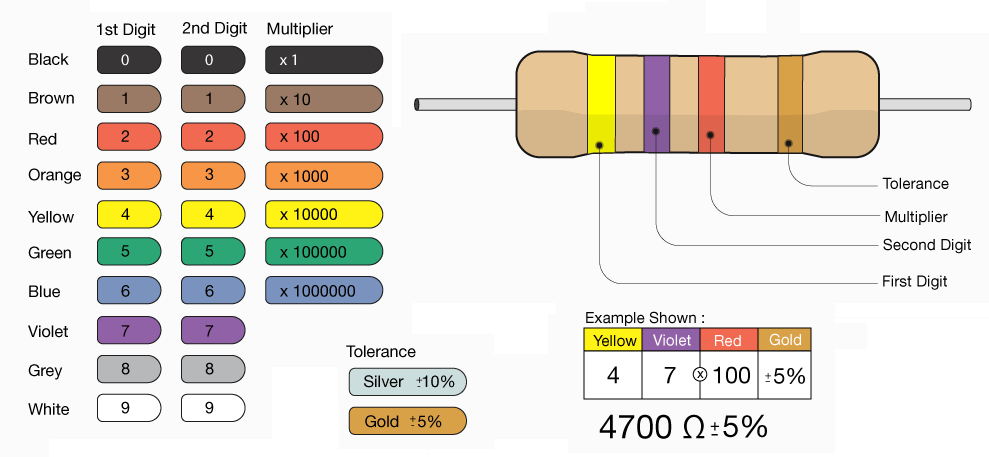
The most common resistor types use either:
• 4-band color code
• 5-band color code
• 6-band color code
Each band represents a specific parameter such as the first digit, second digit, multiplier, tolerance, and temperature coefficient.
For example, a 4-band resistor typically contains:
Band 1 → First significant digit
Band 2 → Second significant digit
Band 3 → Multiplier
Band 4 → Tolerance
A 5-band resistor adds an additional significant digit, allowing for more precise resistance values commonly used in precision electronics.
🎨 Standard Resistor Color Code Values
Each resistor color corresponds to a number from 0 to 9. The colors also represent multiplier values and tolerance percentages.
Here is a simplified concept of the color mapping:
Black → 0
Brown → 1
Red → 2
Orange → 3
Yellow → 4
Green → 5
Blue → 6
Violet → 7
Gray → 8
White → 9
Multipliers increase resistance values by powers of ten. For example:
Red multiplier → ×100
Orange multiplier → ×1000
Yellow multiplier → ×10,000
Tolerance bands indicate the allowable deviation from the resistor’s rated value. Common tolerance values include:
Gold → ±5%
Silver → ±10%
Brown → ±1%
Red → ±2%
Understanding these color codes is essential for interpreting resistor values accurately when assembling circuits.
⚡ Why Use a Resistor Color Code Calculator?
Although charts exist, manually decoding resistor color bands can be slow and error-prone. This is especially true for beginners or when working with multiple resistors in a circuit.
A Resistor Color Code Calculator eliminates guesswork and significantly speeds up the process.
Benefits include:
✔ Instant resistor value calculation
✔ Accurate decoding of 4-band, 5-band, and 6-band resistors
✔ Helps prevent circuit design mistakes
✔ Saves time during electronics projects
✔ Useful learning tool for students
Instead of memorizing color charts, users can rely on the calculator to quickly determine the correct resistance value.
🧠 How the Resistor Color Code Calculator Works
The calculator works by converting the selected color bands into numerical values using the standardized resistor color code system.
The basic formula used is:
Resistance = (Significant Digits) × Multiplier
For example:
Band 1: Red = 2
Band 2: Violet = 7
Band 3: Orange = ×1000
Resistance = 27 × 1000 = 27,000 Ω (27kΩ)
If the tolerance band is gold, the resistor has a tolerance of ±5%, meaning the actual resistance may vary slightly from the nominal value.
This automated calculation ensures accurate and fast results for electronics work.
🔬 Importance of Resistors in Electronics
Resistors play a crucial role in almost every electrical and electronic device. Without them, circuits could experience excessive current flow, which could damage sensitive components like microchips, LEDs, and sensors.
Some key functions of resistors include:
• Limiting current flow
• Dividing voltage in circuits
• Setting biasing conditions in amplifiers
• Protecting circuit components
• Controlling signal levels
Because resistors are so common in electronics, knowing how to interpret resistor color codes is a fundamental skill for engineers and students alike.
🎓 Educational Benefits for Students
Students studying physics, electrical engineering, electronics, and robotics frequently encounter resistor color codes in laboratories and exams.
This calculator helps students:
📘 Learn resistor color coding faster
📘 Understand resistance calculations
📘 Verify lab measurements
📘 Practice electronics circuit design
By interacting with the calculator, learners gain hands-on understanding of how resistor values are determined.
🔧 Ideal for DIY Electronics Projects
DIY electronics enthusiasts often build projects such as:
• Arduino circuits
• LED lighting systems
• Amplifiers
• Sensors and IoT devices
• Robotics projects
These projects frequently require identifying resistors from component kits. The Resistor Color Code Calculator makes this process fast and accurate.
Instead of searching through printed charts, users can simply select colors and instantly obtain the resistance value.
🔧 Applications in Daily Life ⚡
📱 Electronics Repair: Technicians repairing smartphones, laptops, TVs, and gaming consoles frequently use resistor color code calculators to identify damaged components and replace them correctly.
🧑🎓 Education & Engineering Labs: Physics and electronics students use resistor color code charts and calculators during lab experiments to determine resistor values quickly.
🤖 DIY Electronics Projects: Makers building Arduino, Raspberry Pi, and robotics projects rely on resistor value calculators to select correct resistors for sensors, LEDs, and microcontrollers.
🏭 Industrial Electronics: Engineers designing industrial control systems and circuit boards frequently decode resistor values to ensure circuit accuracy.
🔌 Electrical Circuit Design: Resistor values determine how much current flows through a circuit. Designers must calculate correct resistance values for safe and efficient operation.
🌐 Why This Online Calculator is Useful
This free online tool simplifies resistor decoding and improves learning efficiency.
Key features include:
⚡ Instant resistor value calculation
⚡ Support for multiple band resistors
⚡ Beginner-friendly interface
⚡ Accurate resistance results
⚡ Accessible on mobile and desktop
Whether you are an electronics beginner or an experienced engineer, this tool can streamline resistor identification and circuit design.
⚠️ Disclaimer 📢
The Resistor Color Code Calculator provided on this website is designed for educational and informational purposes only. While every effort has been made to ensure the accuracy of resistor calculations, the results generated by this calculator should be used as a reference and not as a substitute for professional engineering analysis.
Users should verify resistor values using proper testing equipment such as digital multimeters or professional circuit measurement tools before implementing them in critical electronic systems.
This tool does not guarantee error-free results for all resistor types, including damaged, faded, or non-standard resistors.
By using this calculator, you acknowledge that the website owners are not responsible for any technical errors, circuit failures, or damages resulting from reliance on the calculator results.
Always follow proper electronics safety procedures when working with electrical circuits.
📌 Related Calculator
❓FAQs ⚡
❓ What is a resistor color code calculator?
A resistor color code calculator is an online electronics tool that converts the colored bands on a resistor into its resistance value in ohms. It helps users quickly determine resistor values without manually using a resistor color code chart.
❓ How do you read resistor color codes?
To read a resistor color code, identify the color bands from left to right. The first bands represent digits, the next band represents the multiplier, and the final band represents tolerance. Using a resistor color code calculator simplifies this process.
❓ What is the difference between 4 band and 5 band resistors?
A 4-band resistor contains two significant digits, a multiplier, and a tolerance band.
A 5-band resistor contains three significant digits, a multiplier, and a tolerance band, allowing more precise resistance values.
❓ Why do resistors use color codes instead of numbers?
Resistors are very small electronic components, making printed numbers difficult to read. Color bands provide a compact and standardized way to represent resistance values.
❓ What does the gold band mean on a resistor?
A gold band on a resistor indicates a tolerance of ±5%, meaning the actual resistance may vary within 5% of the labeled value.