
🦠 R0 Basic Reproduction Number Calculator
| Disease | R0 Range | Status |
|---|---|---|
| Measles | 12 – 18 | 🔴 Highly Epidemic |
| Chickenpox (Varicella) | 8 – 10 | 🔴 Highly Epidemic |
| Mumps | 4 – 7 | 🔴 Epidemic |
| Rubella | 5 – 7 | 🔴 Epidemic |
| Smallpox | 5 – 7 | 🔴 Epidemic |
| COVID-19 (original) | 2 – 3 | 🟡 Moderate Epidemic |
| SARS | 2 – 5 | 🟡 Moderate Epidemic |
| Influenza (seasonal) | 0.9 – 2.1 | 🟡 Borderline |
| Ebola | 1.5 – 2.5 | 🟡 Moderate Epidemic |
| Polio | 5 – 7 | 🔴 Epidemic |
💡 Herd Immunity Threshold (HIT) = 1 − (1 ÷ R0). Expressed as a percentage of the population that must be immune to prevent epidemic spread.
Table of Contents
✍️ Author & Academic Authority: Dr. Nitish Kr. Bharadwaj
📘 Qualifications: B.Sc., B.Ed., M.Sc., Ph.D. (Biochemistry), MBA (Financial Management)
🦠 R₀ Basic Reproduction Number Calculator
Decode the Power of Disease Spread Instantly!
The R₀ Basic Reproduction Number Calculator is a powerful epidemiology tool designed to estimate how contagious an infectious disease is within a population. In microbiology and immunology, the basic reproduction number (R₀) represents the average number of secondary infections produced by a single infected individual in a fully susceptible population. Understanding and calculating R₀ is critical in predicting disease outbreaks, planning vaccination strategies, and controlling epidemics effectively. 🚀
Understanding how infectious diseases spread through a population is one of the most critical challenges in modern public health, microbiology, and immunology. At the very core of this understanding lies a single, powerful number — the Basic Reproduction Number, scientifically denoted as R0 (pronounced “R-naught”). Whether you are a biology student, a medical professional, a public health researcher, or simply a curious mind trying to make sense of the pandemic news, our free online R0 Basic Reproduction Number Calculator gives you the power to instantly calculate, interpret, and apply this fundamental epidemiological metric. 🔬

🔍 What is R0 — The Basic Reproduction Number?
The Basic Reproduction Number (R0) is defined as the average number of secondary infections produced by a single infected individual when introduced into a completely susceptible population — meaning no one has been vaccinated or previously exposed to the disease. It is a dimensionless number that acts as a universal measuring stick 📏 for the transmissibility or contagiousness of any infectious disease.
In the simplest terms:
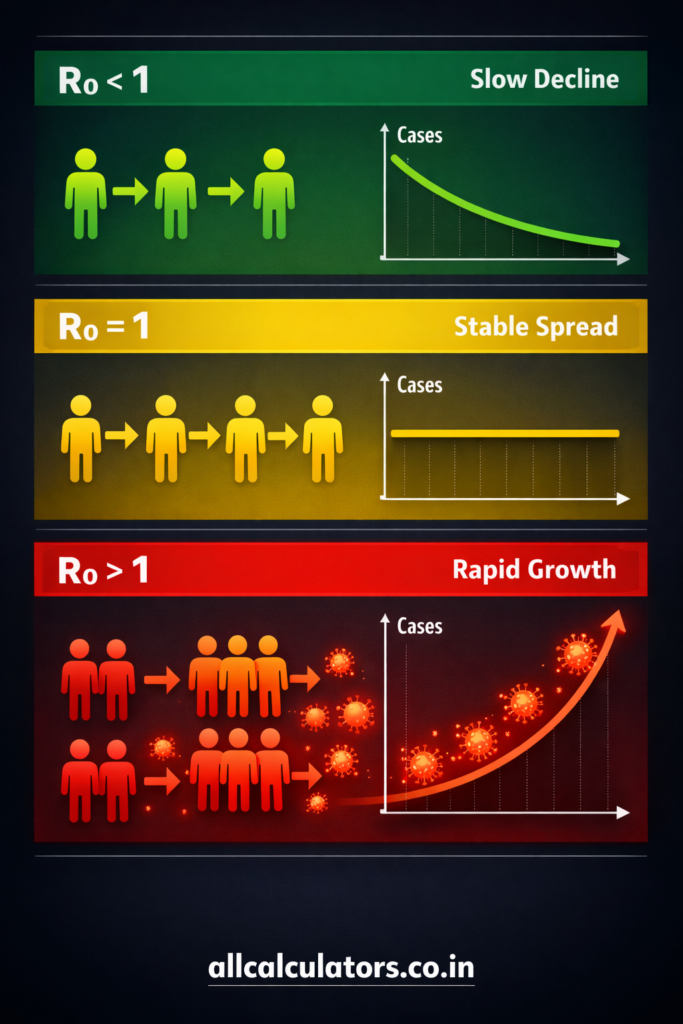
- 🔴 R0 > 1 → Each infected person spreads the disease to MORE than one other person. The infection will grow and potentially cause an outbreak or epidemic.
- 🟡 R0 = 1 → Each infected person spreads the disease to exactly ONE other person. The infection remains stable and endemic in the population.
- 🟢 R0 < 1 → Each infected person spreads the disease to LESS than one other person. The infection will eventually die out naturally.
This threshold behavior makes R0 one of the most important numbers in all of epidemiology and public health decision-making. 💡
🧮 The R0 Formula — How is It Calculated?
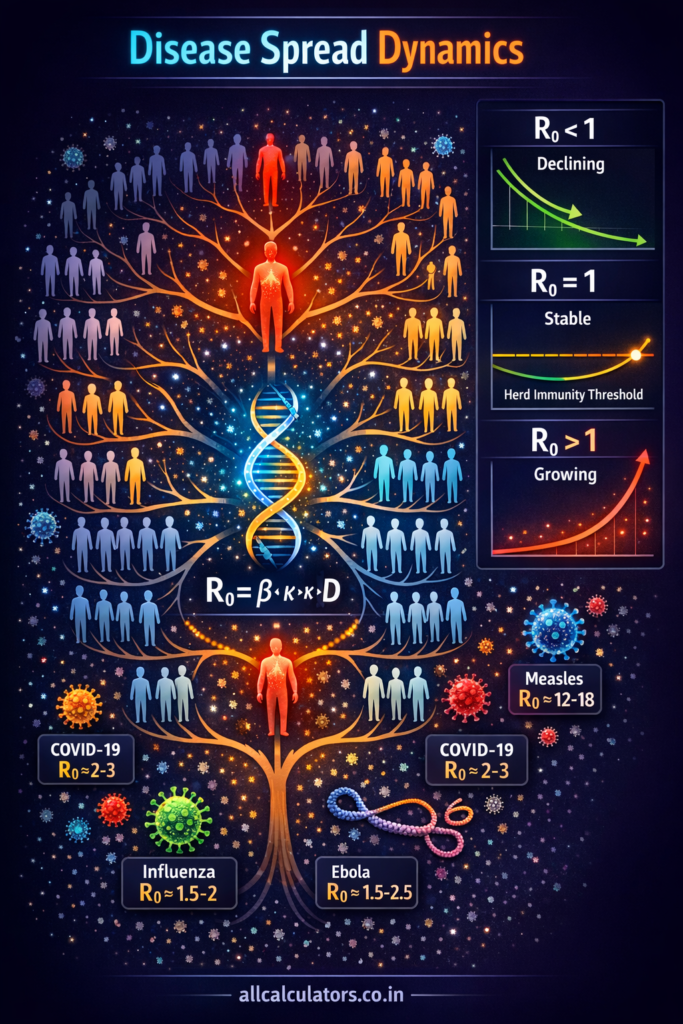
The basic formula to calculate R0 is elegantly simple: R0 = β × κ × D
Where:
- β (Beta) = Probability of disease transmission per contact between a susceptible and an infected person
- κ (Kappa) = Average rate of contact between susceptible and infected individuals (contact rate)
- D = Average duration of infectiousness (in days or the same unit as κ)
This formula encapsulates three fundamental biological and social factors — how easily the pathogen spreads per contact, how often people interact, and how long an infected person can pass on the disease. Our R0 calculator online uses these exact parameters to give you a precise, science-backed result in seconds. ⚡
🌍 R0 Values of Common Diseases — A Global Perspective
One of the most fascinating aspects of studying R0 is comparing it across diseases. Here are well-known R0 values that scientists have documented through decades of epidemiological research:
| 🦠 Disease | 📊 R0 Value | 🔁 Transmission Mode |
|---|---|---|
| Measles | 12–18 | Airborne |
| Pertussis (Whooping Cough) | 12–17 | Airborne droplet |
| Chickenpox (Varicella) | 10–12 | Airborne |
| Mumps | 4–7 | Airborne droplet |
| Polio | 5–7 | Fecal-oral |
| Rubella | 5–7 | Airborne droplet |
| COVID-19 (Original strain) | 2–3 | Airborne droplet |
| COVID-19 (Omicron variant) | 8–15 | Airborne droplet |
| Influenza (Seasonal) | 0.9–2.1 | Airborne droplet |
| SARS | 2–5 | Airborne droplet |
| HIV/AIDS | 2–5 | Sexual/Blood contact |
| Ebola | 1.5–2.5 | Direct contact |
| Smallpox | 5–7 | Social contact |
| Malaria | ≈100 (vector-based) | Mosquito vector |
These numbers are not just academic facts — they directly drive vaccination strategies, quarantine policies, school closure decisions, and pandemic preparedness plans at the global level. 🌐

🛡️ R0 and Herd Immunity — The Critical Connection
One of the most powerful applications of R0 is calculating the Herd Immunity Threshold (HIT) — the percentage of a population that must be immune (through vaccination or natural infection) to prevent an epidemic from spreading.
The formula is: Herd Immunity Threshold (HIT) = 1 − (1 / R0)
For example:
- Measles (R0 = 15): HIT = 1 − (1/15) = 93.3% of the population must be immune 💉
- COVID-19 (R0 = 3): HIT = 1 − (1/3) = 66.7% of the population must be immune
- Influenza (R0 = 2): HIT = 1 − (1/2) = 50% of the population must be immune
This direct mathematical relationship between R0 and herd immunity is why epidemiologists, WHO officials, and government health bodies rely so heavily on the Basic Reproduction Number during outbreak planning and vaccine rollout campaigns. 📋
🔬 R0 vs. Rt (Effective Reproduction Number) — Know the Difference
While R0 measures the theoretical transmission potential of a disease in a fully susceptible population, the Effective Reproduction Number (Rt or Re) tracks the REAL-TIME spread of a disease in a real population — one that has partial immunity from vaccines or prior infections. Think of R0 as the disease’s maximum potential 🏃, while Rt is what’s actually happening on the ground day by day.
- R0 = Fixed baseline value (assumes 100% susceptibility, no interventions)
- Rt = Dynamic, changing value (reflects current immunity levels, control measures, and variant behavior)
Both numbers work together to paint a complete picture of an epidemic’s trajectory. Our calculator helps you compute R0 from first principles, which can then be compared with real-time Rt estimates from health agencies.
📚 R0 in Microbiology & Immunology Education
For students studying microbiology, immunology, epidemiology, public health, or biology, R0 is a foundational concept that appears across textbooks, competitive exams (NEET, USMLE, NCLEX, GATE Biotechnology), and university coursework. Understanding how to calculate and interpret R0 strengthens your grasp of:
✅ Disease ecology and host-pathogen dynamics ✅ SIR (Susceptible-Infected-Recovered) mathematical models ✅ Vaccination program design and evaluation ✅ Outbreak investigation and response strategies ✅ The mathematics of exponential vs. linear disease growth ✅ Evolutionary pressures on pathogen virulence and transmissibility
Our free R0 Basic Reproduction Number Calculator makes this learning interactive, visual, and instantly applicable — whether you’re solving a textbook problem, conducting independent research, or simply satisfying your intellectual curiosity about how the invisible world of microbes shapes our human world. 🌏🔭
🌍 Applications in Daily Life
🦠 Pandemic Awareness & Safety
Understand how fast diseases like COVID-19 spread using the R0 value calculator, helping individuals make informed safety decisions.
💉 Vaccination Planning
Helps estimate herd immunity thresholds using the herd immunity calculator, guiding vaccination strategies.
🏫 Education & Exam Preparation
Students use the epidemiology calculator online to solve biology and medical entrance problems efficiently.
🏥 Healthcare Decision Making
Doctors and public health officials rely on infection spread calculators to assess outbreak risks.
📊 Policy & Government Planning
Governments use disease transmission rate calculators to plan lockdowns and control measures.
🌐 Research & Data Analysis
Researchers use the R naught formula calculator to model disease spread scenarios.
⚠️ Disclaimer
⚠️ This R₀ Basic Reproduction Number Calculator is intended for educational and informational purposes only. While it provides accurate results based on standard epidemiological formulas, it should not be used as a substitute for professional medical advice, public health decisions, or scientific research conclusions. 🧪
📉 Real-world disease spread depends on multiple dynamic factors such as population immunity, behavioral changes, and environmental conditions, which may not be fully captured in this tool.
👨⚕️ Always consult qualified healthcare professionals or epidemiologists for critical decisions related to infectious diseases.
📌 Related Calculator
❓ FAQs Section
🤔 What is R₀ in epidemiology?
R₀ (basic reproduction number) measures how many people one infected person can spread a disease to in a fully susceptible population.
📊 How to calculate R₀ easily?
You can use our R0 calculator online by entering transmission rate, contact rate, and infectious duration to get instant results.
🦠 What does R₀ > 1 mean?
If R₀ is greater than 1, the infection will spread rapidly in the population.
🛑 What happens if R₀ < 1?
If R₀ is less than 1, the disease will gradually die out.
R₀ helps determine the percentage of people who need vaccination to stop disease spread.