
🧪 Poiseuille’s Law Calculator
Q = (π ΔP r4) / (8 η L)
Table of Contents
✍️ Author & Academic Authority: Dr. Nitish Kr. Bharadwaj
📘 Qualifications: B.Sc., B.Ed., M.Sc., Ph.D. (Biochemistry), MBA (Financial Management)
🧪 Poiseuille’s Law Calculator – Introduction
Instantly Calculate Fluid Flow in Pipes 📏
Fluid mechanics plays a fundamental role in physics, engineering, medicine, and daily life technologies. One of the most important principles governing laminar flow of liquids through cylindrical pipes is Poiseuille’s Law. To make solving these physics problems faster and easier, our Poiseuille’s Law Calculator helps students, engineers, and researchers instantly compute volumetric flow rate, pressure difference, viscosity effects, and pipe radius influence without complicated manual calculations.
This Poiseuille equation calculator is specifically designed for students studying fluid mechanics, physics learners preparing for exams, mechanical engineers analyzing pipe flow systems, and researchers studying laminar fluid motion. Instead of solving lengthy equations manually, users can input values such as viscosity, pipe radius, pressure difference, and pipe length, and the calculator instantly determines the fluid flow rate.
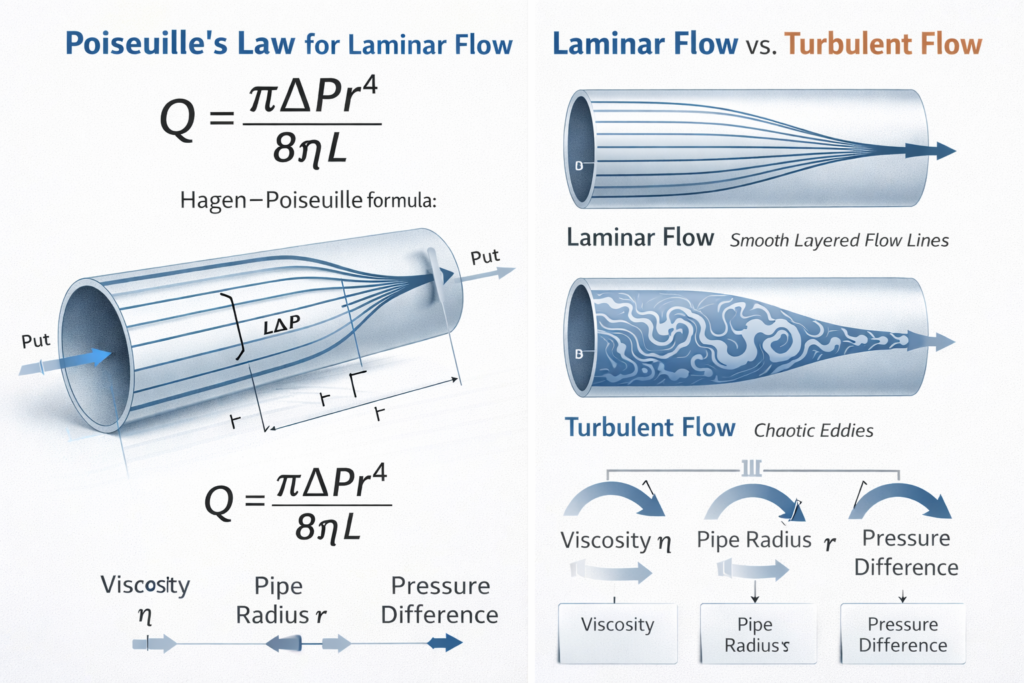
📘 What is Poiseuille’s Law?
Poiseuille’s Law, also known as the Hagen–Poiseuille equation, describes the laminar flow of a viscous fluid through a cylindrical pipe. The law states that the flow rate of a liquid is directly proportional to the fourth power of the pipe radius and the pressure difference, and inversely proportional to the fluid viscosity and pipe length.
The mathematical formula of Poiseuille’s Law is: Q = (π × ΔP × r⁴) / (8 × η × L)
Where:
- Q = Volumetric flow rate
- ΔP = Pressure difference between pipe ends
- r = Radius of the pipe
- η (eta) = Dynamic viscosity of the fluid
- L = Length of the pipe
This formula highlights one of the most fascinating aspects of fluid mechanics: the pipe radius has the strongest influence on flow rate because it is raised to the fourth power. Even a small increase in radius dramatically increases fluid flow.
Because the equation involves multiple parameters and exponents, manual calculation often becomes tedious. That is why a Poiseuille’s law calculator becomes extremely useful for solving physics problems quickly.
⚙️ How the Poiseuille’s Law Calculator Works
Our online Poiseuille equation calculator simplifies the entire calculation process. Users only need to enter the required parameters, and the tool computes the result instantly using the Hagen–Poiseuille equation.
Typical inputs include:
✔ Pressure difference (ΔP)
✔ Pipe radius (r)
✔ Fluid viscosity (η)
✔ Pipe length (L)
After entering the values, the calculator instantly determines:
➡ Volumetric Flow Rate (Q): This tool eliminates the possibility of calculation errors, making it especially helpful for students solving homework, physics assignments, competitive exams, or engineering projects.
🌊 Why Poiseuille’s Law is Important in Fluid Mechanics
Understanding Poiseuille’s law is essential for analyzing laminar flow conditions in pipes and tubes. Laminar flow occurs when fluid particles move in smooth layers without turbulence.
This concept is widely used in hydraulics, biological systems, industrial pipelines, and microfluidics.
Key insights provided by the law include:
🔬 Effect of Pipe Radius: Flow rate increases dramatically with pipe radius because it is proportional to r⁴.
💧 Effect of Viscosity: Higher viscosity fluids like oil or honey flow slower compared to low-viscosity fluids such as water or alcohol.
📉 Effect of Pipe Length: Longer pipes create more resistance, reducing the flow rate.
⚡ Effect of Pressure Difference: Higher pressure difference increases the driving force for fluid movement.
These principles are essential for designing pipelines, understanding blood flow in arteries, and optimizing fluid transport systems.
📊 Why Pipe Radius Matters the Most
One of the most important takeaways from Poiseuille’s law is the power of the pipe radius.
Since the radius appears as r⁴ in the equation, even a small change can produce a huge difference in flow.
Example: If the pipe radius doubles, the flow rate increases by: 2⁴ = 16 times
This principle explains many natural and engineering systems, including blood circulation in arteries and industrial pipeline design.
🌍 Applications in Daily Life
Poiseuille’s Law is not only important in physics textbooks—it also plays a major role in many real-life systems and technologies.
🫀 Blood Flow in Human Arteries: Doctors and biomedical engineers use Poiseuille’s principle to understand blood circulation and arterial resistance.
🚰 Water Supply Systems: Municipal engineers analyze pipe radius, pressure differences, and pipe length to maintain efficient water distribution.
🏭 Industrial Pipeline Design: Factories transporting oil, chemicals, and gases rely on fluid flow equations to design efficient pipeline systems.
🧪 Medical IV Drips: The flow of medicine through intravenous tubes follows the same laminar flow principles.
🚗 Lubrication Systems in Machines: Engines rely on oil flow through small passages, which is governed by viscosity and pressure differences.
🔬 Microfluidics & Lab Devices: Modern biomedical devices use tiny channels where fluid flow follows Poiseuille’s law precisely.
These examples show why understanding Poiseuille’s law and laminar pipe flow is crucial in both engineering systems and biological processes.
⚠️ Disclaimer
The Poiseuille’s Law Calculator provided on this website is intended for educational, learning, and general informational purposes only.
📚 While every effort has been made to ensure accuracy and reliability, the results generated by this calculator should not be used as a substitute for professional engineering analysis, medical advice, or industrial design calculations.
🔬 Fluid mechanics calculations may vary depending on real-world factors such as turbulence, pipe roughness, temperature variations, and non-Newtonian fluid behavior. Users are encouraged to verify results independently before applying them in research, engineering projects, medical analysis, or industrial applications. By using this tool, you acknowledge that allcalculators.co.in is not responsible for any decisions or outcomes based on the results produced by this calculator.
📌 Related Calculator
❓FAQs
❓ What is Poiseuille’s Law in simple terms?
Poiseuille’s Law explains how a viscous fluid flows through a cylindrical pipe under laminar conditions. It shows that the flow rate depends on pressure difference, pipe radius, viscosity, and pipe length.
❓ What does the Poiseuille’s Law Calculator calculate?
The calculator determines the volumetric flow rate of a fluid moving through a pipe using the Hagen–Poiseuille equation based on input values like pressure difference, pipe radius, viscosity, and pipe length.
❓ Why is pipe radius so important in Poiseuille’s law?
Because the flow rate is proportional to r⁴ (radius to the fourth power). This means even a small increase in pipe radius can dramatically increase fluid flow.
❓ Where is Poiseuille’s law used in real life?
It is used in blood circulation analysis, hydraulic engineering, pipeline design, medical IV flow systems, lubrication systems, and microfluidic devices.
❓ What is laminar flow in fluid mechanics?
Laminar flow is a smooth and orderly fluid motion where layers of fluid slide past each other without mixing or turbulence.