
🧪 Poise-Stokes Converter
Dynamic viscosity and kinematic viscosity relation:
η = ρν
Where:
η = Dynamic viscosity (Poise)
ν = Kinematic viscosity (Stokes)
ρ = Density of fluid (g/cm3)
Table of Contents
✍️ Author & Academic Authority: Dr. Nitish Kr. Bharadwaj
📘 Qualifications: B.Sc., B.Ed., M.Sc., Ph.D. (Biochemistry), MBA (Financial Management)
🧪 Poise-Stokes Converter – Introduction
Instantly Convert Dynamic Viscosity to Kinematic Viscosity ⚙️
Understanding viscosity is essential in physics, fluid mechanics, engineering, chemistry, and real-world industrial applications. The Poise-Stokes Converter is a specialized physics calculator designed to convert dynamic viscosity (Poise) into kinematic viscosity (Stokes) quickly and accurately. This tool helps students, engineers, researchers, and professionals perform viscosity conversions without complex manual calculations.
Viscosity refers to the resistance of a fluid to flow. In simple terms, it measures how thick or thin a fluid is. Fluids like honey have high viscosity, while water has low viscosity. In fluid mechanics and physics, viscosity is measured using two major units: Poise (P) and Stokes (St).
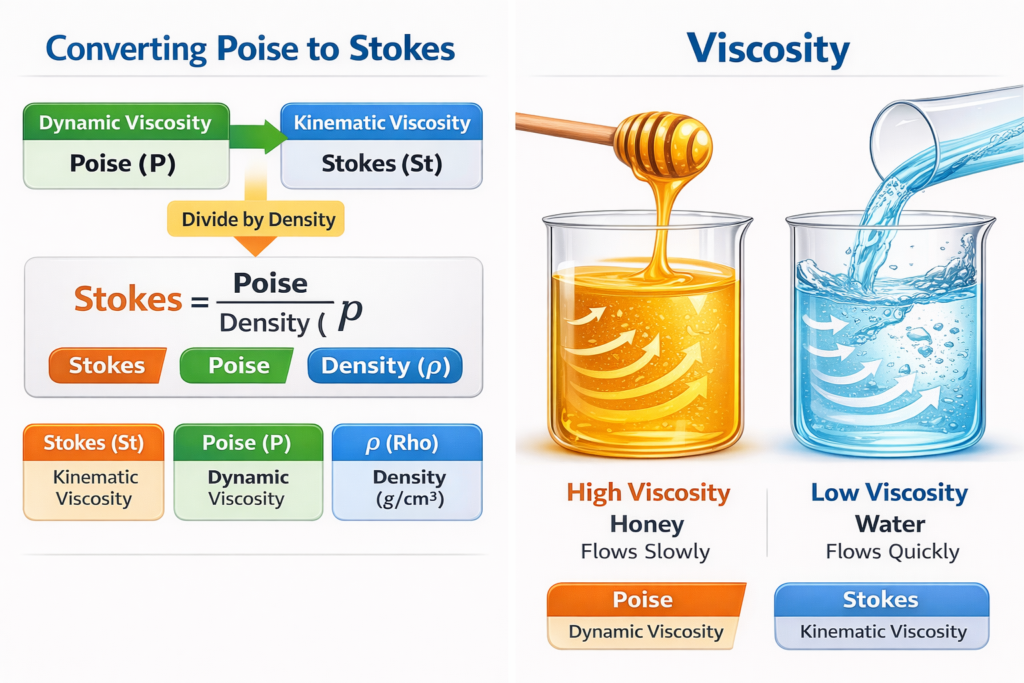
Dynamic viscosity is measured in Poise, whereas kinematic viscosity is measured in Stokes. The relationship between these two quantities depends on the density of the fluid. Because of this dependency, converting between Poise and Stokes requires a specific formula.
The mathematical relationship is: Kinematic Viscosity (Stokes) = Dynamic Viscosity (Poise) ÷ Density of Fluid
This equation forms the core working principle of the Poise-Stokes Converter calculator. By entering the dynamic viscosity value (in Poise) and the density of the fluid, the calculator automatically determines the kinematic viscosity in Stokes.
📘 Understanding Poise (P)
Poise is the CGS unit used to measure dynamic viscosity. It describes how much internal resistance exists when one layer of fluid moves over another. In scientific and engineering calculations, Poise is often converted to centipoise (cP) because most common liquids fall into smaller viscosity ranges.
For example:
Water at 20°C ≈ 1 centipoise (0.01 Poise)
Honey ≈ 2000–10000 centipoise
Dynamic viscosity is extremely important in lubrication engineering, chemical processing, and pipeline fluid transport systems.
📗 Understanding Stokes (St)
Stokes is the CGS unit used to measure kinematic viscosity. Unlike dynamic viscosity, kinematic viscosity takes fluid density into account, making it useful in flow analysis where gravity or inertial forces are involved.
The unit Stokes is named after the famous physicist George Gabriel Stokes, who contributed significantly to the field of fluid dynamics.
The formula for kinematic viscosity is: Kinematic Viscosity = Dynamic Viscosity ÷ Density
This relationship is fundamental in hydrodynamics, lubrication systems, meteorology, and aerodynamics.
📊 Why a Poise-Stokes Converter Is Important
Performing viscosity conversions manually can be time-consuming and prone to calculation errors. Students often struggle with unit conversions when solving physics problems involving fluid flow, laminar motion, Reynolds number, or Stoke’s Law.
The Poise-Stokes Converter calculator eliminates these issues by providing:
⚡ Instant conversion results
📐 Accurate physics-based calculations
📚 Easy learning support for students
🔬 Reliable results for laboratory analysis
This calculator is especially helpful when studying topics such as:
- Fluid mechanics
- Viscosity measurement
- Laminar flow equations
- Stokes’ law problems
- Engineering fluid analysis
🎓 Educational Importance
Physics students frequently encounter viscosity problems in high school physics, undergraduate engineering courses, and competitive exams. Understanding the difference between dynamic viscosity and kinematic viscosity is essential for solving problems involving:
Fluid motion
Drag forces
Particle settling velocity
Pipe flow calculations
Lubrication systems
By using a Poise-Stokes conversion calculator, students can focus on understanding concepts instead of getting stuck on complex arithmetic calculations.
⚙️ Engineering and Industrial Relevance: Viscosity measurements are essential in industries such as:
Petroleum engineering
Automotive lubrication systems
Chemical manufacturing
Food processing
Pharmaceutical formulation
Engineers often need to convert viscosity units when analyzing oil performance, fluid transport efficiency, and industrial fluid dynamics systems.
For example, lubricant manufacturers measure viscosity in Poise or centipoise, but mechanical engineers analyzing flow systems may require Stokes or centistokes values.
A Poise-to-Stokes converter helps professionals switch between these units efficiently.
🌍 Why Use an Online Poise-Stokes Calculator
Online calculators dramatically simplify physics calculations. Instead of manually applying formulas and worrying about unit mistakes, users can simply enter values and get results instantly.
Benefits include:
🚀 Faster calculations
🎯 Improved accuracy
📱 Mobile-friendly usability
📊 Perfect for students, teachers, and engineers
📚 Helpful for physics assignments and research
The Poise-Stokes Converter on AllCalculators.co.in is built to provide fast, accurate, and user-friendly physics calculations, helping learners and professionals solve viscosity conversion problems effortlessly.
🌍 Applications in Daily Life
Although viscosity calculations sound technical, they play a huge role in daily life and industrial systems.
🚗 Automobile Engine Oils: Engine oil viscosity determines how smoothly an engine operates. Engineers use viscosity calculations to ensure the oil flows correctly at different temperatures.
🍯 Food Industry: Food products like honey, syrups, sauces, and dairy products rely on viscosity measurements to maintain texture and quality.
💊 Pharmaceutical Formulations: Medicine syrups, gels, and suspensions require precise viscosity control to ensure proper dosage and stability.
🛢️ Petroleum Industry: Crude oil and lubricants must be tested for viscosity to determine how easily they can flow through pipelines.
🧪 Chemical Engineering: Viscosity calculations help determine reaction rates and fluid transport behavior in chemical reactors.
🌧️ Meteorology & Environmental Science: Viscosity plays a role in atmospheric fluid dynamics and environmental modeling.
⚠️ Disclaimer
The Poise-Stokes Converter calculator available on AllCalculators.co.in is designed for educational, informational, and general calculation purposes only. While the calculator uses scientifically accepted formulas from fluid mechanics and physics, the results should be considered approximate estimates. Users are encouraged to verify results when performing critical engineering, industrial, laboratory, or research calculations.
AllCalculators.co.in does not guarantee absolute accuracy for professional or safety-critical applications. Always consult qualified engineers, physicists, or technical experts when precise measurements are required.
📌 Related Calculator
❓FAQs
❓ What is a Poise-Stokes Converter?
A Poise-Stokes Converter is an online physics calculator that converts dynamic viscosity measured in Poise into kinematic viscosity measured in Stokes using the density of the fluid.
❓ What is the formula to convert Poise to Stokes?
The formula used in the Poise to Stokes conversion calculator is: Kinematic Viscosity (Stokes) = Dynamic Viscosity (Poise) ÷ Density of Fluid.
❓ What is the difference between Poise and Stokes?
Poise measures dynamic viscosity, which represents internal resistance to fluid motion.
Stokes measures kinematic viscosity, which considers both viscosity and fluid density.
❓ Why is viscosity conversion important in physics?
Viscosity conversion is important for solving problems related to fluid flow, Reynolds number, laminar motion, and Stoke’s Law in fluid mechanics.
❓ Who uses Poise-Stokes conversion calculators?
Students, engineers, researchers, chemists, petroleum engineers, and physics educators frequently use viscosity conversion calculators.