
🔌 Wire Resistance Calculator
R = ρL / A
Table of Contents
✍️ Author & Academic Authority: Dr. Nitish Kr. Bharadwaj
📘 Qualifications: B.Sc., B.Ed., M.Sc., Ph.D. (Biochemistry), MBA (Financial Management)
⚡ Wire Resistance Calculator – Introduction
Instantly Calculate Electrical Resistance of Any Wire
Electricity powers nearly every aspect of modern life — from smartphones and computers to industrial machines and home appliances. But behind every electrical system lies a fundamental property called electrical resistance. Understanding resistance is crucial for engineers, students, electricians, and anyone working with electrical circuits.
The Wire Resistance Calculator is a powerful physics tool that helps you quickly calculate the resistance of a wire using its length, cross-sectional area, and resistivity. Instead of manually solving formulas, this calculator performs the calculation instantly and accurately. Whether you’re studying physics, designing an electrical circuit, or troubleshooting wiring systems, this tool simplifies the process.
⚙️ What is Wire Resistance?
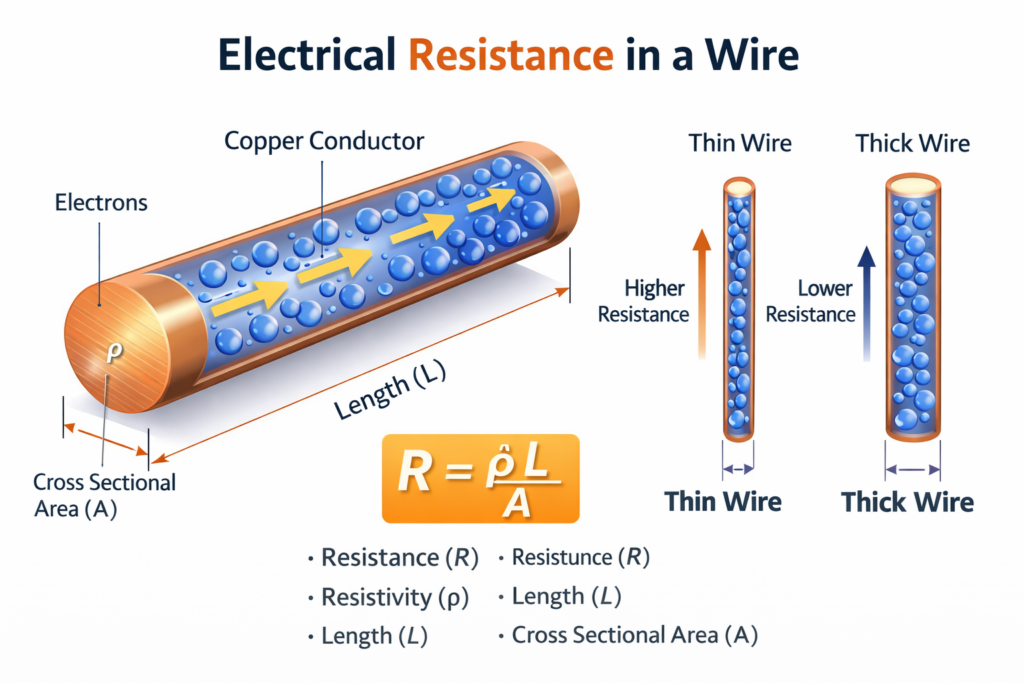
Electrical resistance is the opposition offered by a material to the flow of electric current. When current flows through a wire, electrons collide with atoms inside the conductor. These collisions slow down the electron movement, producing resistance.
The resistance of a wire depends on three main factors:
📏 Length of the wire (L) – Longer wires create more resistance because electrons must travel farther.
📐 Cross-sectional area (A) – Thicker wires allow more electrons to flow, reducing resistance.
🧪 Material resistivity (ρ) – Different materials resist current differently.
For example:
- Copper has very low resistance and is widely used in electrical wiring.
- Aluminum has slightly higher resistance but is lighter and cheaper.
- Nichrome has very high resistance and is used in heating elements.
🧮 Wire Resistance Formula
The resistance of a wire is calculated using the standard physics resistance formula: R = ρL / A
Where:
- R = Resistance (Ohms, Ω)
- ρ = Resistivity of material (Ω·m)
- L = Length of wire (meters)
- A = Cross-sectional area (square meters)
This formula is a fundamental concept taught in electromagnetism and electrical engineering courses worldwide.
Using a wire resistance calculator online eliminates calculation mistakes and instantly provides results.
⚡ Why Use a Wire Resistance Calculator?
Manual calculations often involve unit conversions and complex numbers. The resistance calculator for wire simplifies everything.
Benefits include:
✔ Instant calculation of resistance
✔ Accurate results without manual errors
✔ Helpful for students solving physics problems
✔ Useful for electrical engineers designing circuits
✔ Ideal for quick verification of resistance values
With the growing demand for online physics calculators, tools like this make technical calculations faster and more accessible.
📚 Importance of Wire Resistance in Physics
Resistance plays a major role in many electrical phenomena.
For example: ⚡ Ohm’s Law states that voltage equals current multiplied by resistance: V = IR
This relationship helps engineers determine voltage drops in circuits.
Wire resistance also affects:
- Power loss in transmission lines
- Heat generation in conductors
- Efficiency of electrical devices
Understanding resistance is therefore essential for electrical system design, power distribution, and electronic circuits.
🔬 Resistivity of Common Materials
Different materials have different resistivities.
Typical values include:
Copper → 1.68 × 10⁻⁸ Ω·m
Aluminum → 2.82 × 10⁻⁸ Ω·m
Iron → 1.0 × 10⁻⁷ Ω·m
Nichrome → 1.10 × 10⁻⁶ Ω·m
Materials with low resistivity are good conductors, while materials with high resistivity are used as resistors or heating elements.
The resistivity calculator for wire helps determine resistance based on these material properties.
🧠 Factors Affecting Wire Resistance
Several physical factors influence resistance:
1️⃣ Length of Wire: Longer wires increase resistance because electrons travel a greater distance.
2️⃣ Cross-Sectional Area: Thicker wires reduce resistance because they provide more space for electron flow.
3️⃣ Material Type: Conductors like copper offer low resistance compared to metals like iron.
4️⃣ Temperature: Resistance usually increases as temperature rises due to increased atomic vibrations.
These factors are essential when designing electrical circuits and selecting appropriate wire gauges.
⚡ Real-World Importance of Wire Resistance
Wire resistance is not just a theoretical physics concept. It directly impacts many real-world systems.
For instance:
- Electrical power grids must minimize resistance to reduce energy loss.
- Electronic circuits rely on precise resistance values to function correctly.
- Heating devices use high-resistance wires to generate heat.
This is why professionals often rely on resistance of wire calculators to ensure accurate designs.
🚀 Why Online Calculators Are Essential Today
Modern education and engineering increasingly rely on digital tools. Online calculators provide:
✔ Fast calculations
✔ Easy accessibility from any device
✔ Accurate physics computations
✔ Interactive learning experience
The wire resistance calculator is one of the most practical tools for quickly solving resistance problems in physics and engineering.
Whether you’re designing circuits, studying electricity, or simply curious about how wires behave electrically, this calculator provides instant answers.
🌍 Applications in Daily Life ⚡
Electrical resistance may seem like a theoretical concept, but it plays a major role in everyday technology.
🔌 Household Electrical Wiring: Electricians use resistance calculations to select the correct wire gauge for safe wiring.
💡 Electronic Devices: Smartphones, laptops, and televisions rely on carefully designed circuits where resistance controls current flow.
🔥 Heating Appliances: Devices like electric heaters, toasters, and kettles use high-resistance wires to convert electrical energy into heat.
⚡ Power Transmission Lines: Engineers calculate wire resistance to reduce energy loss during electricity transmission.
🚗 Automotive Electrical Systems: Cars use resistance calculations in sensors, lighting systems, and battery circuits.
🔬 Laboratory Experiments: Students performing physics experiments use resistance formulas to analyze current flow.
Using a wire resistance calculator online makes these calculations simple and accurate.
⚠️ Disclaimer
The Wire Resistance Calculator provided on this website is designed for educational, academic, and general informational purposes.
While this tool uses standard physics formulas to calculate electrical resistance, the results should be considered approximate estimates. Real-world electrical systems may vary due to factors such as temperature, impurities in materials, manufacturing tolerances, and environmental conditions.
⚡ This calculator should not replace professional electrical design calculations for critical engineering projects.
Users are advised to consult qualified electrical engineers or technical experts before applying these results to real electrical installations.
By using this tool, you agree that the website allcalculators.co.in is not responsible for any decisions made based on the calculated values.
📌 Related Calculator
❓ FAQs
❓ What is the formula used in the wire resistance calculator?
❓ Which material has the lowest resistance?
Copper and silver have extremely low resistivity, making them excellent conductors for electrical wiring.
❓ Does temperature affect wire resistance?
Yes. As temperature increases, atomic vibrations increase, which causes resistance to rise in most conductive materials.