
🔌 Series Parallel Resistance Calculator ⚡
Series Circuit:
Rtotal = R1 + R2 + R3 + …
Parallel Circuit:
1 / Rtotal = 1/R1 + 1/R2 + 1/R3 + …
✍️ Author & Academic Authority: Dr. Nitish Kr. Bharadwaj
📘 Qualifications: B.Sc., B.Ed., M.Sc., Ph.D. (Biochemistry), MBA (Financial Management)
🔌 Series Parallel Resistance Calculator – Instantly Calculate Equivalent Resistance ⚡
Understanding electrical circuits becomes significantly easier when you know how to calculate equivalent resistance in series and parallel circuits. The Series Parallel Resistance Calculator is a powerful online physics tool that allows students, engineers, hobbyists, and electronics enthusiasts to instantly compute the total resistance of complex resistor networks. Instead of performing lengthy calculations manually, this calculator simplifies the process by applying standard series and parallel resistance formulas automatically.
Electrical circuits form the foundation of modern technology. From smartphones and laptops to home appliances and electric vehicles, every electronic system relies on precise resistor combinations to regulate current and voltage. In many cases, circuits contain multiple resistors connected in series, parallel, or mixed configurations. Determining the equivalent resistance of these combinations is essential for designing safe and efficient electrical systems.
The Series Parallel Resistance Calculator is specifically designed to help users quickly determine the total resistance of resistor networks without needing complex calculations. Whether you’re solving physics problems, designing electronic circuits, or verifying homework solutions, this calculator provides accurate results instantly.
⚡ Understanding Resistance in Electrical Circuits
Electrical resistance is the property of a material that opposes the flow of electric current. It is measured in Ohms (Ω) and represented by the symbol R. The concept of resistance is fundamental in electronics, electrical engineering, and physics education.
In practical circuits, resistors are often connected in combinations. The two most common configurations are:
🔹 Series Circuits
🔹 Parallel Circuits
Each configuration affects the total resistance and current distribution differently.
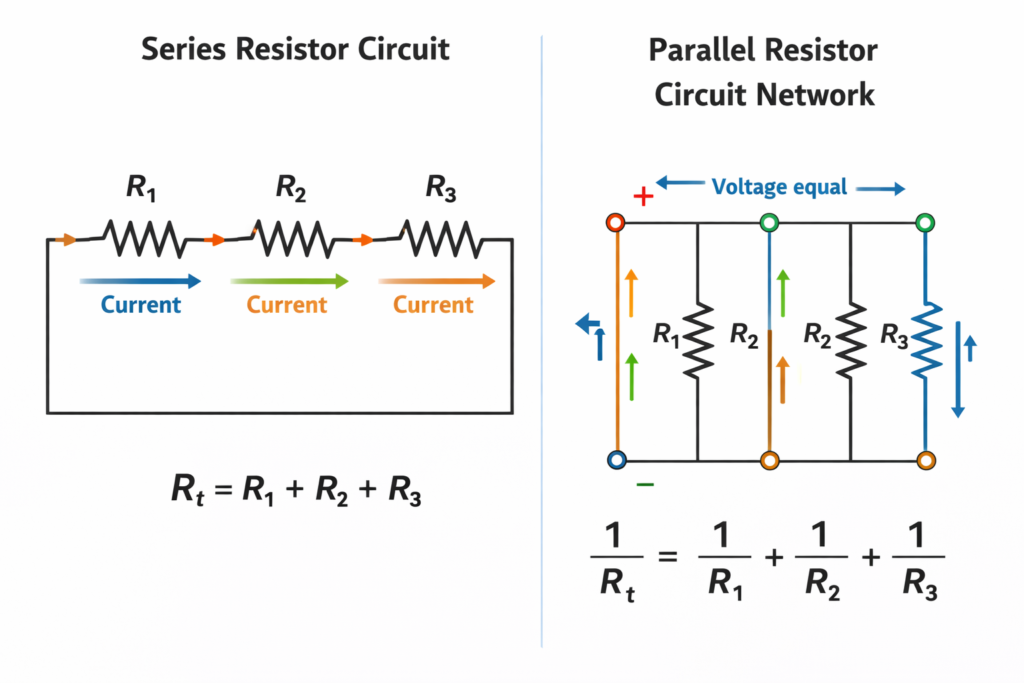
🔗 Resistance in Series Circuits
In a series circuit, resistors are connected end-to-end, meaning the same current flows through each resistor. The total resistance is simply the sum of all individual resistances.
Series Resistance Formula
Total Resistance: Rₜ = R₁ + R₂ + R₃ + … + Rₙ
Where:
- Rₜ = Total equivalent resistance
- R₁, R₂, R₃ = Individual resistor values
For example, if three resistors are connected in series:
- R₁ = 10Ω
- R₂ = 20Ω
- R₃ = 30Ω
Then the equivalent resistance is:
Rₜ = 10 + 20 + 30 = 60Ω
This configuration increases the total resistance in the circuit.
Series resistors are commonly used for:
✔ Voltage dividers
✔ Current limiting circuits
✔ LED protection circuits
✔ Sensor signal conditioning
🔀 Resistance in Parallel Circuits
In a parallel circuit, resistors are connected across the same two nodes. The voltage across each resistor remains the same, while the current splits among different branches.
The equivalent resistance in parallel circuits is calculated using the reciprocal formula.
Parallel Resistance Formula
1 / Rₜ = 1/R₁ + 1/R₂ + 1/R₃ + … + 1/Rₙ
Or
Rₜ = 1 / (1/R₁ + 1/R₂ + 1/R₃)
Example:
If three resistors are connected in parallel:
- R₁ = 10Ω
- R₂ = 20Ω
- R₃ = 30Ω
Then:
1/Rₜ = 1/10 + 1/20 + 1/30
Rₜ ≈ 5.45Ω
Notice that parallel resistance is always lower than the smallest resistor in the network.
Parallel circuits are widely used in:
✔ Household wiring
✔ Power distribution systems
✔ Electronic devices
✔ Computer motherboards
🔬 Series-Parallel Resistor Networks
Many real-world circuits contain both series and parallel resistor combinations. These are called series-parallel networks.
To solve these circuits manually, you must:
1️⃣ Identify parallel groups
2️⃣ Calculate their equivalent resistance
3️⃣ Replace them with a single resistor
4️⃣ Continue simplifying until only one equivalent resistance remains
This process can be time-consuming and prone to calculation errors.
That is why tools like the Series Parallel Resistance Calculator are extremely useful. It allows you to input resistor values and instantly calculate the equivalent resistance of complex circuits.
🧠 Why Use a Series Parallel Resistance Calculator?
Manual calculations are useful for learning concepts, but in practice they can be inefficient.
This calculator provides several advantages:
⚡ Instant calculation of equivalent resistance
📚 Perfect for physics students solving homework problems
🧮 Eliminates calculation mistakes
🔧 Useful for electrical engineering design
📱 Works online without installing software
Whether you’re studying Ohm’s Law, building a DIY electronics project, or designing a circuit board, this calculator simplifies the entire process.
🧮 How to Use the Series Parallel Resistance Calculator
Using this calculator is extremely simple:
1️⃣ Select the circuit configuration (series or parallel).
2️⃣ Enter the resistor values (in Ohms).
3️⃣ Click the Calculate button.
4️⃣ Instantly view the equivalent resistance result.
The tool automatically applies the correct series resistance formula or parallel resistance formula and displays accurate results within seconds.
📚 Importance for Physics and Engineering Students
Students studying Physics, Electrical Engineering, and Electronics frequently encounter problems involving resistor combinations. Understanding how to determine total resistance in series and parallel circuits is a core concept in these subjects.
Using this calculator helps students:
📖 Verify homework answers
🎓 Understand circuit simplification methods
⚙ Improve problem-solving speed
🧠 Strengthen conceptual understanding
Many competitive exams and university entrance tests include questions related to resistor networks and equivalent resistance calculations, making this tool extremely valuable for exam preparation.
🚀 Why This Tool Is Essential for Electronics Enthusiasts
Electronics hobbyists often work with breadboards, Arduino boards, sensors, and microcontrollers. When designing circuits, selecting the correct resistor combinations is essential to protect components and ensure proper circuit functionality.
The Series Parallel Resistance Calculator helps hobbyists:
🔧 Design safe electronic circuits
⚡ Control current and voltage precisely
📟 Build DIY electronics projects
🔬 Test resistor networks quickly
🔧 Applications in Daily Life ⚡
The concept of series and parallel resistance plays a vital role in everyday electrical systems.
🏠 Household Electrical Wiring: Most home electrical systems use parallel circuits so that appliances receive the same voltage. Calculating equivalent resistance ensures safe current distribution.
💡 LED Lighting Circuits: LED strips and lighting systems use series resistor combinations to limit current and protect LEDs from damage.
📱 Electronic Devices: Smartphones, laptops, and tablets contain complex resistor networks that regulate voltage and current across internal components.
🚗 Automotive Electrical Systems: Modern vehicles rely on series-parallel resistor circuits for sensors, lighting systems, and control modules.
🔋 Battery Management Systems: Resistance calculations help engineers design efficient battery charging and protection circuits.
🧪 Physics Education: Students use the equivalent resistance calculator to verify results while solving circuit problems in physics labs and exams.
⚠️ Disclaimer 📢
The Series Parallel Resistance Calculator provides calculated results based on standard electrical formulas for series and parallel resistor combinations. While every effort has been made to ensure accuracy, the results generated by this tool should be used for educational and informational purposes only.
Users working on professional electrical projects should verify results using appropriate engineering methods and safety standards. Electrical systems involve real-world variables such as temperature, tolerance, and component variation that may affect actual resistance values.
Always consult qualified professionals when designing or working with critical electrical systems.
📌 Related Calculator
❓ FAQs ⚡
❓ What is equivalent resistance in a circuit?
Equivalent resistance is the single resistance value that replaces a group of resistors in a circuit while maintaining the same electrical behavior.
❓ How do you calculate total resistance in series?
In a series circuit, total resistance is simply the sum of all resistor values.
Formula: Rₜ = R₁ + R₂ + R₃
❓ How do you calculate resistance in parallel circuits?
Parallel resistance is calculated using the reciprocal formula: 1/Rₜ = 1/R₁ + 1/R₂ + 1/R₃
The resulting equivalent resistance is always lower than the smallest resistor.
❓ Why is parallel resistance lower than individual resistors?
Because current has multiple paths to flow, reducing the total opposition to current.
❓ When should I use a series parallel resistance calculator?
You should use it when solving complex resistor networks, electronics homework, circuit design problems, or engineering calculations.
🌍 Free Online Physics Calculator for Everyone
Our Series Parallel Resistance Calculator is part of the growing collection of tools available on AllCalculators.co.in. These tools are designed to help students, professionals, and everyday users solve problems quickly and efficiently.
Instead of spending time performing complex calculations, you can use this calculator to obtain accurate results instantly.
Whether you are learning basic electronics, circuit analysis, or electrical engineering, this tool makes resistance calculations simple, fast, and reliable.