
⚡ RC Circuit Calculator
📘 Formula Used:
Time Constant (τ) = R × C
✍️ Author & Academic Authority: Dr. Nitish Kr. Bharadwaj
📘 Qualifications: B.Sc., B.Ed., M.Sc., Ph.D. (Biochemistry), MBA (Financial Management)
⚡ RC Circuit Calculator – Instantly Calculate RC Time Constant, Charging & Discharging of Capacitors
Electronics and physics students frequently work with resistor–capacitor circuits, commonly known as RC circuits. These circuits are one of the most fundamental building blocks in electrical engineering, electronics, and applied physics. Understanding how voltage changes across a capacitor over time is crucial when designing filters, timers, oscillators, power supplies, and many modern electronic systems.
The RC Circuit Calculator helps users instantly determine the RC time constant, capacitor charging voltage, and capacitor discharging voltage using standard physics equations. Instead of solving exponential equations manually, students and engineers can quickly calculate results using this online physics calculator.
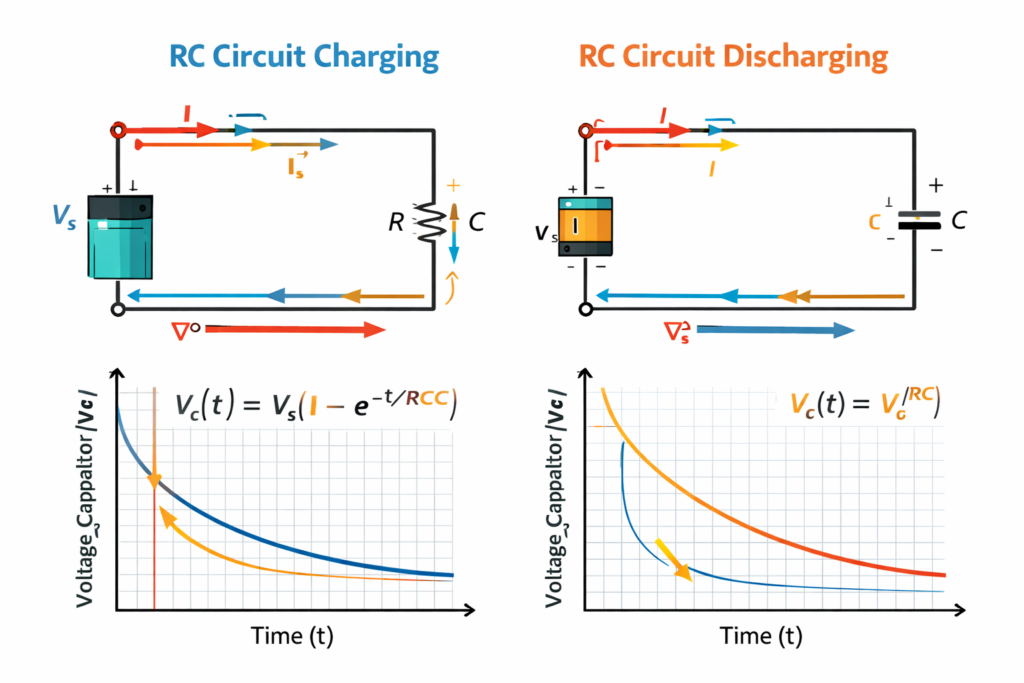
An RC circuit consists of two basic components: a resistor (R) and a capacitor (C) connected in series or parallel with a voltage source. When voltage is applied to the circuit, the capacitor begins to store electrical charge. However, unlike resistors, capacitors do not charge instantly. The voltage across the capacitor increases gradually over time.
This charging process follows an exponential curve, which is governed by the RC time constant.
The time constant (τ) of an RC circuit is defined as: τ = R × C
Where
R = Resistance (Ohms Ω)
C = Capacitance (Farads F)
τ = Time Constant (seconds)
The time constant indicates how quickly the capacitor charges or discharges. After one time constant, the capacitor charges to approximately 63.2% of the supply voltage. After five time constants, the capacitor is considered fully charged (over 99%).
Because of this predictable behavior, RC circuits are widely used in electronic timing applications.
Our RC Time Constant Calculator simplifies this process by automatically computing the time constant when resistance and capacitance values are entered. This allows physics students, electronics hobbyists, and engineers to analyze circuits quickly.
When a capacitor charges in an RC circuit, the voltage across the capacitor follows this equation:
Vc(t) = Vs (1 − e(−t/RC))
Where
Vc = Voltage across capacitor
Vs = Supply voltage
t = Time
RC = Time constant
Similarly, during capacitor discharge:
Vc(t) = V₀ e(−t/RC)
Where
V₀ is the initial voltage stored in the capacitor.
These exponential equations are extremely important in analog electronics and signal processing. However, manually solving them requires logarithmic calculations and exponential functions, which can be time-consuming. The RC Charging and Discharging Calculator automates this calculation instantly.
RC circuits are not only theoretical concepts found in textbooks. They are heavily used in real-world electronics such as:
• audio filters
• signal smoothing circuits
• timing circuits
• sensor interfaces
• microcontroller reset circuits
• oscillators
• communication systems
For example, in audio electronics, RC filters are used to remove unwanted noise or frequencies. In microcontrollers, RC circuits create a small delay during startup to ensure stable operation.
Students learning electronics, electrical engineering, and physics often need to calculate the RC time constant while solving circuit problems. The Resistor Capacitor Calculator eliminates repetitive calculations and helps learners focus on understanding the concept rather than performing manual math.
Another advantage of using this online tool is accuracy. Human calculations can sometimes introduce rounding errors or mistakes when solving exponential equations. Our online RC circuit calculator ensures reliable and accurate results instantly.
This tool is particularly useful for:
• Physics students solving capacitor charging problems
• Electrical engineering students analyzing RC networks
• Electronics hobbyists designing timing circuits
• Professionals designing analog circuits
The RC time constant also determines the cutoff frequency of RC filters. The cutoff frequency of a simple RC filter is given by:
f = 1 / (2πRC)
Where
f = cutoff frequency
R = resistance
C = capacitance
Because of this relationship, RC circuits are frequently used in low-pass filters, high-pass filters, and signal conditioning circuits.
Modern electronics heavily rely on such simple circuits. Even advanced devices like smartphones, sensors, audio systems, and IoT electronics use RC networks internally.
Using the RC Circuit Calculator, users simply input resistance and capacitance values to instantly determine:
• RC time constant
• capacitor charging voltage
• capacitor discharging voltage
• exponential voltage behavior over time
This tool eliminates complex manual calculations and provides fast, accurate results for physics and electronics calculations.
Whether you are preparing for physics exams, solving homework problems, designing circuits, or studying electronics, this RC calculator provides a quick and reliable solution.
Our mission at AllCalculators.co.in is to provide simple, fast, and educational online tools that help students and professionals solve problems efficiently.
The RC Circuit Calculator is part of our growing collection of physics calculators designed for learning, research, and engineering analysis.
Use this calculator to simplify RC circuit analysis and gain a deeper understanding of capacitor charging behavior.
📱Applications in Daily Life ⚙️
Although RC circuits are studied in physics classes, they are widely used in everyday electronic devices.
🎧 Audio Filters: RC circuits are used in low-pass and high-pass filters inside audio systems. These filters remove unwanted noise and improve sound quality.
⏱️ Timing Circuits: Many electronics use RC circuits to create delays or timers. For example, blinking LEDs, camera flashes, and oscillators rely on RC timing.
📡 Signal Processing: RC networks are used to smooth signals in communication systems and radio electronics.
📱 Smartphones & Electronics: Modern electronics like smartphones, sensors, and microcontrollers use RC circuits to stabilize voltage signals.
🔋 Power Supply Filtering: RC circuits help remove voltage ripple in power supply circuits.
🚗 Automotive Electronics: RC circuits are used in car sensors, ignition timing circuits, and electronic control units (ECUs).
💡 LED Lighting: RC circuits help control LED brightness and timing circuits.
These real-world uses make the RC Time Constant Calculator extremely valuable for students and engineers.
⚠️ Disclaimer
The RC Circuit Calculator on AllCalculators.co.in is designed for educational, academic, and general informational purposes.
While we strive to provide highly accurate physics calculations, the results should be used as reference estimates only.
Users should always verify results when performing:
• professional electrical design
• industrial engineering calculations
• safety-critical systems
AllCalculators.co.in is not responsible for design decisions or damages resulting from the use of this calculator. Always consult qualified engineers, textbooks, or academic sources for advanced electrical circuit design.
📌 Related Calculator
❓ FAQs
❓ What is an RC circuit?
An RC circuit is an electrical circuit made from a resistor (R) and capacitor (C) connected to a voltage source. It is commonly used to study capacitor charging and discharging behavior.
❓ What is the RC time constant?
The RC time constant (τ) is the time required for a capacitor to charge up to 63.2% of the supply voltage or discharge to 36.8% of its original voltage. Formula: τ = R × C
❓ How do you calculate RC time constant?
The RC time constant calculator multiplies the resistance value by the capacitance value.
Example:
R = 1000 Ω
C = 100 μF
τ = 1000 × 0.0001 = 0.1 seconds
❓ Why are RC circuits important?
RC circuits are essential in electronics, signal processing, filters, and timing circuits. They help control how signals change over time.
❓ Where are RC circuits used?
RC circuits are used in:
• audio filters
• timers
• oscillators
• signal processing circuits
• microcontrollers
• communication electronics