
🚀 Orbital Period Calculator
T = 2π √(a³ / GM)
✍️ Author & Academic Authority: Dr. Nitish Kr. Bharadwaj
📘 Qualifications: B.Sc., B.Ed., M.Sc., Ph.D. (Biochemistry), MBA (Financial Management)
🚀 Orbital Period Calculator – Kepler’s Third Law & Orbital Mechanics
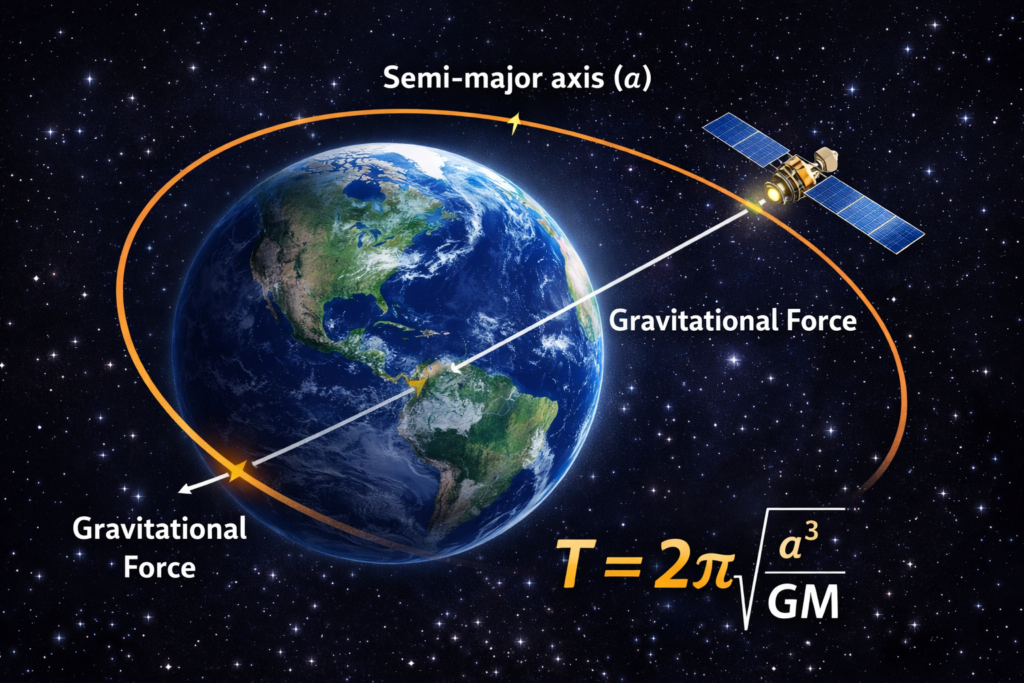
The Orbital Period Calculator is a powerful physics and astronomy tool designed to calculate the time required for a satellite, planet, or celestial body to complete one full orbit around another massive object 🌍✨. This calculation is based on Kepler’s Third Law of Planetary Motion, which mathematically connects the orbital period of an object with its semi-major axis and the mass of the central body.
In physics and space science 🚀, the orbital period (T) represents the time taken by an object to complete one revolution around another object due to gravitational attraction. Whether you’re studying planetary motion in school, preparing for competitive exams like JEE/NEET, or exploring astrophysics concepts, understanding orbital mechanics is fundamental.
The formula used in this orbital period calculator is:
T = 2π √(a³ / GM)
Where:
- T = Orbital Period (seconds)
- a = Semi-major axis (meters)
- G = Universal Gravitational Constant
- M = Mass of central object (kg)
🌌 Why Orbital Period is Important?
Orbital period plays a crucial role in:
✔️ Satellite design
✔️ Space mission planning
✔️ GPS system calculations
✔️ Planetary astronomy
✔️ Physics numerical problem solving
✔️ Engineering simulations
Without orbital mechanics, modern satellite communication 📡, weather forecasting 🌦️, and space exploration 🚀 would not be possible.
📘 Understanding Kepler’s Third Law
Kepler discovered that the square of the orbital period is directly proportional to the cube of the semi-major axis of its orbit.
Mathematically:
T² ∝ a³
This principle applies to planets orbiting the Sun ☀️ and satellites orbiting Earth 🌍.
🛰️ Applications in Satellite Technology
Artificial satellites orbit Earth at calculated orbital periods. For example:
• Low Earth Orbit (LEO) satellites
• Geostationary satellites
• Communication satellites
• Weather satellites
Geostationary satellites must have an orbital period equal to Earth’s rotational period (24 hours) 🌍🕒.
🎓 Educational Importance
Students studying:
• Class 11 & 12 Physics
• Engineering Physics
• Astronomy
• Astrophysics
• Space Science
frequently encounter orbital period numerical problems. This calculator simplifies complex calculations and presents the final answer in scientific notation format (like 1.00 × 10⁵), making it ideal for exam preparation.
🔬 Scientific Notation Output
Since orbital values often involve extremely large or small numbers, scientific notation is essential. For example:
6.78 × 10⁶ meters
5.97 × 1024 kg
This tool automatically converts answers into student-friendly exponent format 📊.
🌍 Real World Example
If a satellite orbits Earth at 7 × 10⁶ meters, and Earth’s mass is 5.97 × 1024 kg, this calculator determines the precise orbital period in seconds.
This is crucial for:
✔️ Space agencies
✔️ NASA-style mission calculations
✔️ ISRO simulations
✔️ Aerospace engineering
🚀 Orbital Mechanics in Modern Technology
Today’s technologies such as:
• GPS navigation
• Satellite internet
• Space stations
• Space tourism
• Mars missions
all depend heavily on orbital period calculations.
This Orbital Period Calculator helps simplify these advanced concepts into easy-to-understand results.
🌍 Applications in Daily Life
Even though orbital mechanics sounds advanced, it impacts daily life:
🛰️ GPS Navigation – Works using satellite orbital timing
📱 Mobile Communication – Satellite synchronization
🌦️ Weather Forecasting – Meteorological satellites
📡 DTH Television – Geostationary satellite timing
🌍 Earth Observation – Disaster monitoring
Without orbital period calculations, modern communication systems would collapse.
⚠️ Disclaimer
This Orbital Period Calculator is designed for educational, academic, and general informational purposes 📘🚀. While the formulas used are scientifically accurate based on Kepler’s Third Law and gravitational physics principles, results should not be used for official aerospace engineering, satellite deployment, or mission-critical calculations without professional validation. Always consult qualified astrophysics or aerospace experts for high-precision scientific computations. 🌌
🚀 FAQs
❓ What is Orbital Period?
Orbital Period is the time taken by a satellite or planet to complete one full revolution around another body due to gravitational force.
❓ What formula is used in this calculator?
The formula used is T = 2π √(a³ / GM).
❓ Why are results shown in scientific notation?
Because orbital calculations involve extremely large numbers like 10^24 kg and 10^6 meters.
❓ Can I use this for satellite calculations?
Yes, for academic and conceptual purposes.
❓ Is this calculator useful for JEE or NEET physics?
Absolutely ✅ It is highly useful for competitive exam numerical practice.