
🌡️ Mixed Air Temperature Calculator
Tmixed = ( Treturn × Qreturn + Toutside × Qoutside ) / ( Qreturn + Qoutside )
Table of Contents
✍️ Author & Academic Authority: Dr. Nitish Kr. Bharadwaj
📘 Qualifications: B.Sc., B.Ed., M.Sc., Ph.D. (Biochemistry), MBA (Financial Management)
🌡️ Mixed Air Temperature Calculator – Introduction
Instantly Calculate HVAC Air Mixing Temperature
In heating, ventilation, and air conditioning (HVAC) systems, understanding how different air streams combine is essential for maintaining indoor comfort, energy efficiency, and proper system performance. The Mixed Air Temperature Calculator is a powerful physics-based HVAC tool that helps engineers, students, and technicians determine the final temperature when two air streams mix together. This calculation is extremely common in ventilation systems where return air and outside air combine before entering the HVAC unit.
Air mixing occurs in nearly every ventilation system used in homes, commercial buildings, hospitals, schools, and industrial facilities. When fresh outside air enters a building and combines with indoor return air, the resulting temperature becomes the mixed air temperature (MAT). Accurately calculating this temperature helps determine heating or cooling requirements and ensures the system operates efficiently.
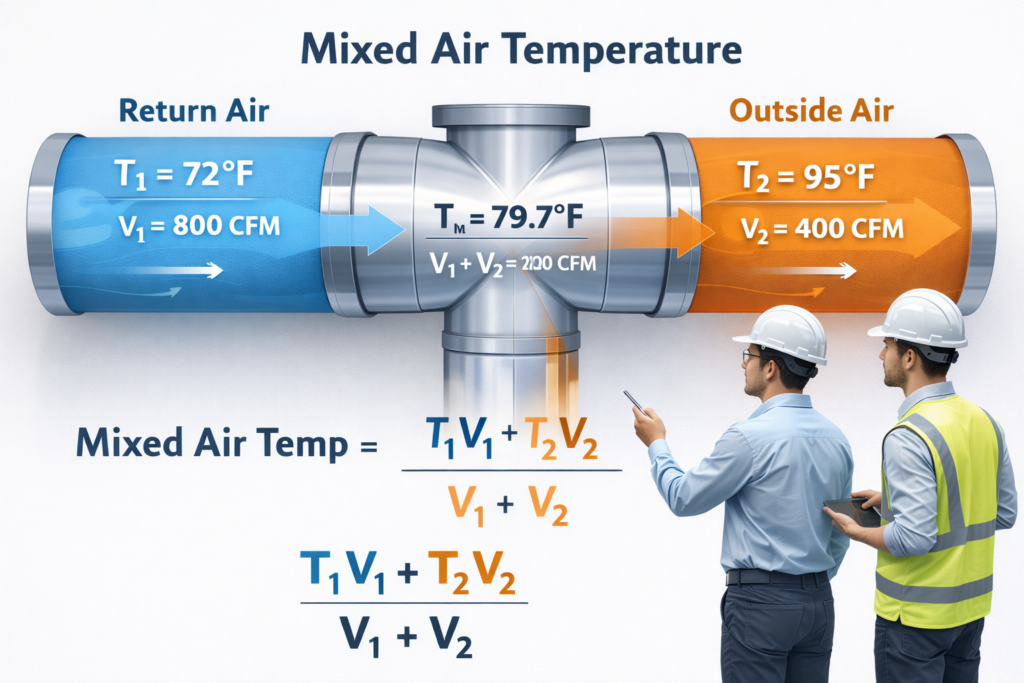
Our online Mixed Air Temperature Calculator simplifies this calculation instantly. Instead of performing manual formulas or complicated HVAC engineering calculations, users simply input the required values and receive immediate results. This makes it ideal for engineering students, HVAC professionals, facility managers, and physics learners.
🔬 What is Mixed Air Temperature?
Mixed air temperature refers to the temperature of the air that results when two or more air streams combine. In HVAC systems, the most common scenario involves:
• Return Air (RA) – Air returning from inside the building
• Outside Air (OA) – Fresh air entering from outdoors
• Mixed Air (MA) – The combined air entering the HVAC unit
When these two air streams mix, their temperatures combine according to their airflow rates. The resulting temperature determines how much heating or cooling the HVAC system must provide.
The mixed air temperature formula is based on the principle of energy balance in thermodynamics, where the heat content of air streams is averaged according to their airflow.
🧮 Mixed Air Temperature Formula
The standard HVAC mixed air temperature equation is: Mixed Air Temperature = (T₁ × V₁ + T₂ × V₂) / (V₁ + V₂)
Where:
T₁ = Temperature of Air Stream 1
T₂ = Temperature of Air Stream 2
V₁ = Airflow Rate of Stream 1
V₂ = Airflow Rate of Stream 2
This formula calculates a weighted average temperature, meaning the air stream with higher airflow has greater influence on the final temperature.
⚙️ Example of Mixed Air Temperature Calculation
Imagine an HVAC system mixing:
Return Air Temperature = 24°C
Outside Air Temperature = 34°C
Airflow rates:
Return Air Flow = 800 CFM
Outside Air Flow = 200 CFM
Using the formula:
Mixed Air Temperature = (24 × 800 + 34 × 200) / (800 + 200)
= (19200 + 6800) / 1000
= 26°C
So the air entering the HVAC unit is 26°C.
This calculation is crucial because it tells the HVAC system how much cooling is required before distributing air to the building.
🏫 Importance in Physics and Engineering
The concept of mixed air temperature is deeply connected to thermodynamics and heat transfer principles in physics. When two air masses mix, heat energy redistributes until equilibrium is reached. This principle applies not only in HVAC systems but also in atmospheric science, ventilation engineering, and environmental studies.
Students studying physics, mechanical engineering, or HVAC technology frequently encounter these calculations during coursework and practical laboratory work. Understanding how temperature mixing works improves knowledge of energy conservation and airflow dynamics.
🌍 Energy Efficiency and Sustainability
Modern buildings are designed with energy efficiency in mind. Ventilation systems must provide fresh air while minimizing heating and cooling loads. Calculating mixed air temperature helps engineers optimize:
• Outdoor air intake levels
• HVAC cooling load calculations
• Energy consumption of air conditioning systems
• Indoor air quality control
Accurate air mixing calculations ensure buildings remain comfortable while reducing energy waste. This contributes to sustainable building design and green engineering practices.
💡 Who Should Use This Calculator?
The Mixed Air Temperature Calculator is useful for a wide range of users:
👨🎓 Engineering and physics students solving thermodynamics problems
👨🔧 HVAC technicians designing ventilation systems
🏢 Facility managers monitoring air conditioning performance
📚 Teachers demonstrating heat transfer concepts
🔬 Researchers studying airflow behavior
Whether you are learning HVAC fundamentals or working on real-world ventilation systems, this tool simplifies the calculation process.
🌍 Applications in Daily Life
The mixed air temperature calculation is widely used in everyday systems and industries.
🏢 Building HVAC Systems: Modern offices, malls, and homes mix outside air with return air to maintain indoor comfort. Engineers use the HVAC mixed air temperature formula to optimize ventilation efficiency.
🏥 Hospitals & Healthcare Facilities: Hospitals require strict air quality control. Mixed air calculations ensure proper temperature and sterile ventilation environments.
🏫 Schools & Universities: Large buildings need efficient ventilation. Mixed air temperature helps maintain comfortable learning environments.
🏭 Industrial Ventilation Systems: Factories mix outdoor and indoor air to control heat, fumes, and working conditions.
✈️ Aircraft Environmental Control Systems: Airplanes mix recirculated cabin air with fresh outside air to maintain safe cabin temperatures.
🏠 Smart Home Climate Control: Advanced HVAC systems in modern homes use air mixing to improve energy efficiency.
⚠️ Disclaimer
The Mixed Air Temperature Calculator available on this website is designed for educational, academic, and general informational purposes only. While we strive to ensure accurate calculations based on standard HVAC and thermodynamic formulas, results generated by this tool should not replace professional engineering analysis.
📌 Actual HVAC system performance may vary due to factors such as humidity, pressure variations, airflow measurement errors, and system design conditions.
👨🔧 For critical engineering projects, building design, or professional HVAC system installations, always consult a qualified HVAC engineer or mechanical professional. By using this calculator, users acknowledge that AllCalculators.co.in is not responsible for decisions made based on the calculated results.
📌 Related Calculator
❓ FAQs
❓ What is mixed air temperature in HVAC?
Mixed air temperature is the final temperature produced when outside air and return air combine inside an HVAC system. It determines the air temperature entering the heating or cooling unit.
❓ What is the formula for mixed air temperature?
The mixed air temperature formula is: MAT = (T₁V₁ + T₂V₂) / (V₁ + V₂). This equation calculates the weighted average temperature of two air streams based on airflow rates.
❓ Why is mixed air temperature important in HVAC systems?
Mixed air temperature helps determine how much heating or cooling is required before air is supplied to a building. It improves energy efficiency, indoor comfort, and ventilation performance.
❓ Can mixed air temperature be calculated online?
Yes. An online Mixed Air Temperature Calculator allows users to enter airflow rates and temperatures to instantly compute the final air temperature without manual formulas.
❓ Who uses mixed air temperature calculations?
These calculations are commonly used by HVAC engineers, mechanical engineers, energy auditors, facility managers, and engineering students.