
🫁 Lung Capacity Calculator
Vital Capacity (VC) = IRV + TV + ERV
Total Lung Capacity (TLC) = VC + RV
Where:
IRV = Inspiratory Reserve Volume
TV = Tidal Volume
ERV = Expiratory Reserve Volume
RV = Residual Volume
Table of Contents
✍️ Author & Academic Authority: Dr. Nitish Kr. Bharadwaj
📘 Qualifications: B.Sc., B.Ed., M.Sc., Ph.D. (Biochemistry), MBA (Financial Management)
🫁 Lung Capacity Calculator – Introduction
Measure Your Breathing Power & Lung Health Easily 💨
The Lung Capacity Calculator is a powerful online health tool designed to estimate the total volume of air your lungs can hold and utilize during breathing. Understanding your lung capacity is crucial for evaluating respiratory health, physical fitness, and overall well-being. Whether you’re an athlete, student, medical learner, or simply health-conscious, this calculator provides an easy and efficient way to analyze your breathing performance.
🔬 What is Lung Capacity?
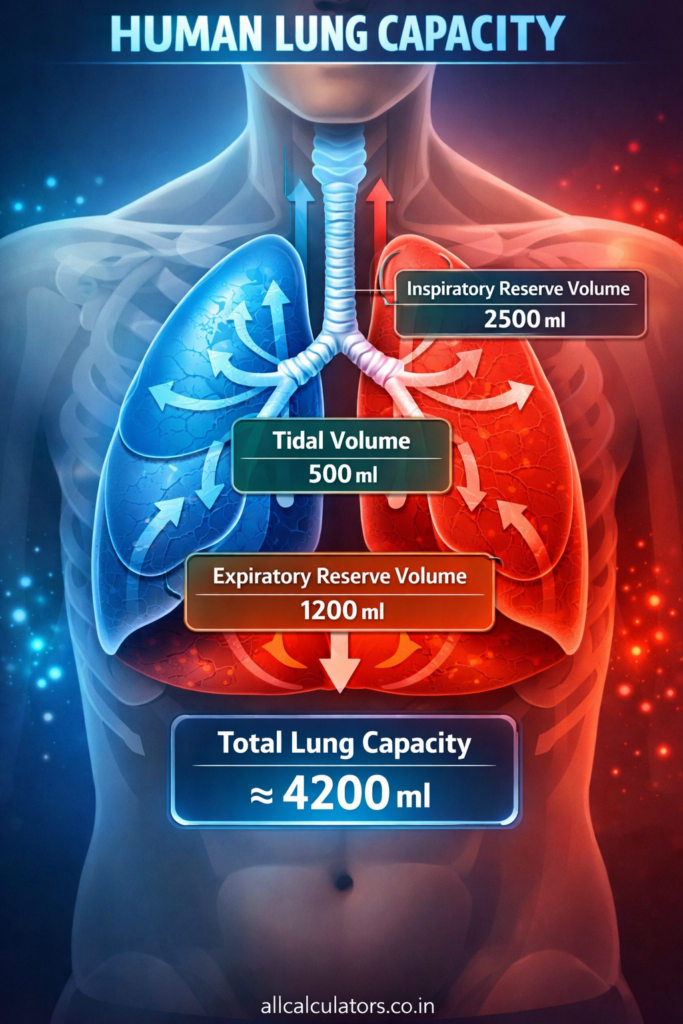
Lung capacity refers to the total volume of air that the lungs can hold at any given point in the respiratory cycle. It is not a single number — rather, it is a collection of several measurable lung volumes and capacities that together paint a detailed picture of your respiratory health and pulmonary function. Understanding lung capacity is a cornerstone of human biology, health science, physiology education, and clinical medicine. Whether you are a student, a fitness enthusiast, an athlete, or simply a curious individual, knowing your lung volumes can offer profound insights into your overall well-being. 💪
Lung capacity is typically divided into different measurable components, including Tidal Volume (TV), Inspiratory Reserve Volume (IRV), Expiratory Reserve Volume (ERV), and Residual Volume (RV). These values together determine key metrics such as Vital Capacity (VC) and Total Lung Capacity (TLC). With this calculator, users can input basic physiological parameters like age, gender, height, and sometimes activity level to get an accurate estimate of their lung function.
💡 The importance of lung capacity goes far beyond breathing—it is directly linked to endurance, oxygen supply efficiency, and even long-term cardiovascular health. Individuals with higher lung capacity often exhibit better stamina and physical performance, while reduced lung capacity can indicate underlying conditions such as asthma, chronic obstructive pulmonary disease (COPD), or other respiratory disorders.
📊 Key Lung Volumes & Capacities — Explained Simply
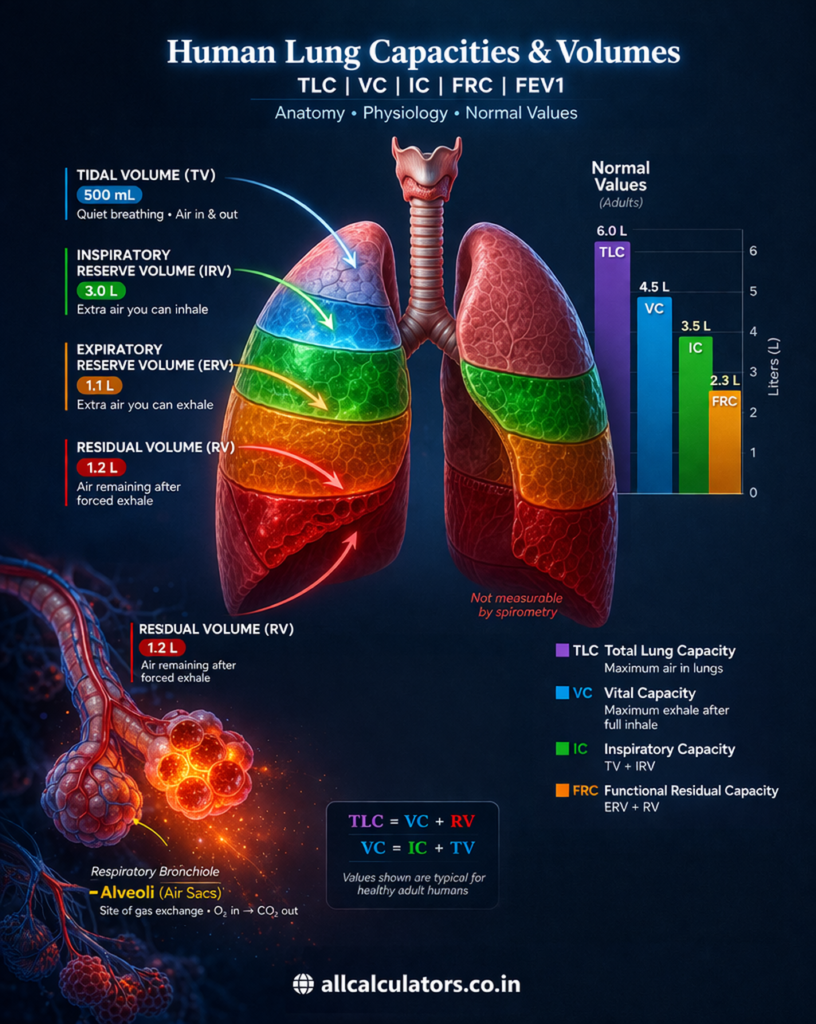
Before diving into how our lung capacity calculator works, let’s understand what each term means:
🔵 Tidal Volume (TV) — The volume of air inhaled or exhaled during normal, effortless breathing at rest. In a healthy adult, this is approximately 500 mL (0.5 litres) per breath. This is the air your body uses just to survive at baseline.
🟢 Inspiratory Reserve Volume (IRV) — The extra volume of air you can forcefully inhale above and beyond a normal tidal breath. For a healthy adult, this ranges between 1,900 – 3,300 mL.
🟡 Expiratory Reserve Volume (ERV) — The additional air you can forcefully exhale after a normal tidal exhalation. Typical values range from 700 – 1,200 mL in healthy adults.
🔴 Residual Volume (RV) — The air that permanently remains in your lungs even after the most forceful exhalation possible. You cannot expel this air voluntarily — it keeps your alveoli from completely collapsing. Normal RV is approximately 1,100 – 1,200 mL.
From these four core lung volumes, four major lung capacities are derived:
🫁 Total Lung Capacity (TLC) = TV + IRV + ERV + RV This is the absolute maximum volume of air your lungs can hold. In healthy adults, TLC ranges from 5 to 7 litres, depending on age, sex, height, and body composition. Men generally have a higher TLC than women, and taller individuals tend to have larger lung capacities.
💨 Vital Capacity (VC) = TV + IRV + ERV This is the maximum volume of air you can exhale after a maximal inhalation. It represents the usable lung capacity. Normal VC in adults ranges from 3 to 5 litres. Our vital capacity calculator estimates this based on your age, sex, and height using validated medical formulas.
🌀 Inspiratory Capacity (IC) = TV + IRV The maximum volume of air you can inhale from a resting state. Normal range is approximately 2 to 4 litres.
🌊 Functional Residual Capacity (FRC) = ERV + RV The volume of air remaining in the lungs after a normal, passive exhalation. Normal FRC is approximately 2 litres.
📐 How Is Lung Capacity Calculated?
From an educational perspective, this calculator is extremely useful for students studying biology, physiology, and medical sciences. It helps simplify complex respiratory concepts and allows users to visualize how different lung volumes interact. For example, the formula for Vital Capacity is: 👉 Vital Capacity (VC) = IRV + TV + ERV
Similarly, Total Lung Capacity is calculated as: 👉 Total Lung Capacity (TLC) = VC + RV
🎯 What Factors Affect Lung Capacity?
Lung capacity is not fixed — it changes throughout your life and is influenced by numerous biological and lifestyle factors:
👤 Age — Lung capacity peaks in your mid-20s and gradually declines with age. After age 25, FEV1 decreases by approximately 30 mL per year in non-smokers.
📏 Height & Body Size — Taller individuals have larger thoracic cavities and therefore greater lung volumes. This is why our calculator asks for your height.
⚧️ Biological Sex — Males generally have higher TLC and FVC values than females of the same height and age due to differences in thoracic cage dimensions and muscle strength.
🚬 Smoking Status — Smoking is the single largest modifiable risk factor for reduced lung function. Smokers experience accelerated FEV1 decline and increased risk of COPD. Our calculator accounts for smoking history.
🏃 Physical Fitness & Exercise — Regular aerobic exercise, swimming, and yoga can improve respiratory muscle strength and endurance, potentially increasing vital capacity over time.
🌍 Altitude & Environment — People living at high altitudes often develop slightly larger lung capacities as an adaptive response to lower oxygen partial pressure.
🧬 Ethnicity — Research shows some variation in lung volumes across ethnic groups, though the Global Lung Function Initiative has developed inclusive, race-neutral reference equations for fairer assessment.
🏥 Clinical Significance — Why Does Lung Capacity Matter?
In clinical medicine, lung capacity measurements are essential for:
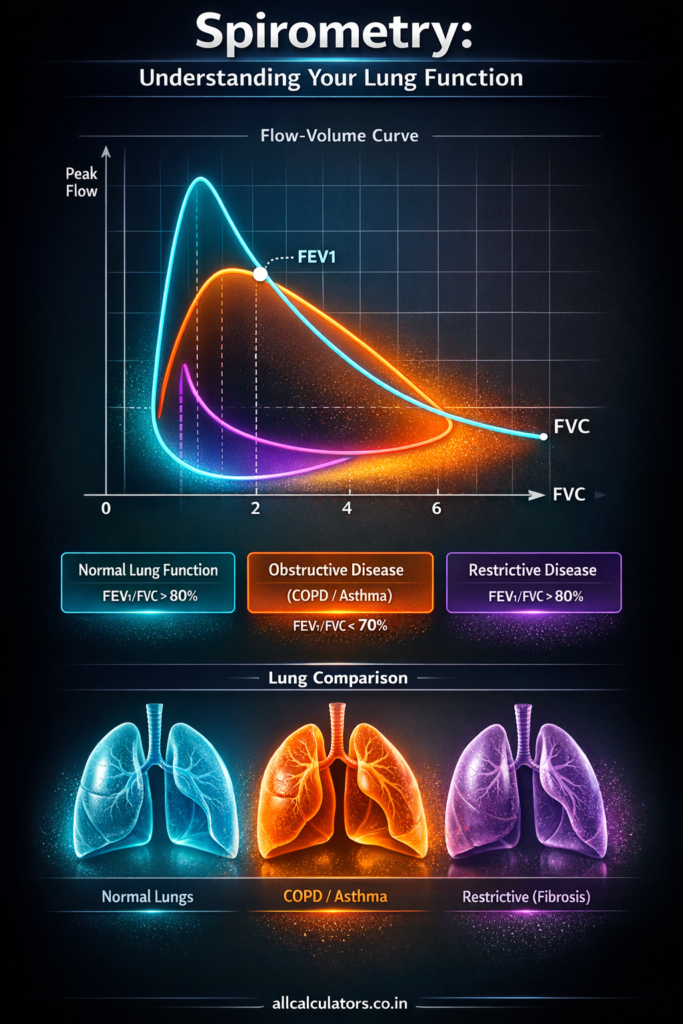
✅ Diagnosing COPD, Asthma, and Emphysema — Obstructive diseases show a reduced FEV1/FVC ratio. ✅ Identifying Restrictive Diseases — Conditions like pulmonary fibrosis, pleural effusion, and kyphoscoliosis reduce TLC and FVC. ✅ Pre-surgical Pulmonary Assessment — Surgeons evaluate lung function before thoracic or abdominal surgeries. ✅ Monitoring Disease Progression — Serial spirometry helps track how a disease evolves over time. ✅ Evaluating Disability & Fitness — Insurance assessors, military boards, and occupational health professionals use lung function tests to evaluate work-related respiratory impairments.
By using this calculator, users can instantly compute these values without manual calculations, saving time and reducing errors.
🚀 In today’s digital era, online tools like the lung capacity calculator are gaining massive popularity due to their accessibility and instant results. Instead of relying on expensive spirometry tests, users can get a quick estimation anytime, anywhere. While it does not replace clinical diagnosis, it serves as an excellent preliminary assessment tool.
Another major benefit of this tool is its relevance for fitness enthusiasts. People involved in activities like running, swimming, yoga, and meditation can track improvements in their breathing capacity over time. Practices such as pranayama and deep breathing exercises are known to significantly enhance lung function, and this calculator helps quantify that progress.
📊 Additionally, this tool supports preventive healthcare by encouraging users to monitor their respiratory health regularly. Early detection of reduced lung capacity can prompt timely lifestyle changes or medical consultation, potentially preventing severe health issues.
From an SEO standpoint, tools like this have extremely high engagement metrics because users actively interact with them. This increases dwell time, reduces bounce rate, and improves ranking potential on Google Discover and Featured Snippets. Including structured data (schema markup), FAQs, and optimized content further boosts visibility.
🌍 In countries like India, where pollution levels can impact respiratory health, having access to a free lung capacity calculator online is especially valuable. It empowers individuals to stay informed and proactive about their health.
In conclusion, the Lung Capacity Calculator is not just a tool—it is a gateway to understanding your body better. It combines science, technology, and user convenience to deliver actionable insights into your respiratory system. Whether you want to improve your fitness, study physiology, or monitor your lung health, this calculator is an essential addition to your daily digital toolkit.
🌟 Applications in Daily Life
🧘 Fitness & Yoga Tracking: Use the lung capacity calculator to measure improvement in breathing after yoga, pranayama, and cardio workouts.
🏃 Athletic Performance Monitoring: Athletes can track lung function to improve stamina, endurance, and oxygen efficiency.
🏥 Health Awareness & Early Detection: Helps identify reduced lung capacity which may indicate respiratory issues like asthma or pollution impact.
📚 Educational Use (Biology & Physiology): Students can easily understand concepts like tidal volume, vital capacity, and total lung capacity.
🌬️ Breathing Exercise Optimization: Evaluate how breathing techniques improve lung performance over time.
👨⚕️ Preliminary Health Assessment Tool: Useful for basic respiratory health checks before consulting a doctor.
⚠️ Disclaimer
This Lung Capacity Calculator is intended for educational and informational purposes only. The results provided are approximate estimations based on general formulas and should not be considered a medical diagnosis. 🏥
If you experience symptoms such as shortness of breath, chest pain, or persistent coughing, please consult a qualified healthcare professional immediately. 👨⚕️
🔍 This tool does not replace professional spirometry tests or clinical evaluations. Always rely on certified medical advice for accurate diagnosis and treatment.
📌 Related Calculator
❓ FAQs
❓ What is lung capacity?
Lung capacity refers to the total amount of air your lungs can hold, including tidal volume, inspiratory reserve volume, and expiratory reserve volume.
❓ How is lung capacity calculated?
Lung capacity is calculated using formulas like:
👉 Vital Capacity = IRV + TV + ERV
👉 Total Lung Capacity = VC + RV
❓ What is a normal lung capacity?
Normal lung capacity varies by age, gender, and height, but typically ranges between 4 to 6 liters in healthy adults.
❓ Can I increase my lung capacity?
Yes ✅ Regular exercise, breathing techniques, yoga, and avoiding pollution can help improve lung capacity.
❓ Is this calculator accurate?
It provides a good estimation but is not a substitute for medical tests like spirometry.