
🌍 Island Biogeography Calculator 📊
Formula Used:
Equilibrium Species (S*) = (I × P) / (I + E)
Table of Contents
✍️ Author & Academic Authority: Dr. Nitish Kr. Bharadwaj
📘 Qualifications: B.Sc., B.Ed., M.Sc., Ph.D. (Biochemistry), MBA (Financial Management)
🏝️ Island Biogeography Calculator
Predict Species Richness, Immigration & Extinction on Islands 🌿🔬
Have you ever wondered why remote tropical islands teem with unique wildlife found nowhere else on Earth 🌏, while tiny isolated islets barely host a handful of species? Or why a massive nature reserve supports far more biodiversity than a small fragmented forest patch? 🌳 The answer lies in one of the most elegant, celebrated, and powerfully predictive theories in all of ecological science — the Theory of Island Biogeography. And now, with our free online Island Biogeography Calculator at AllCalculators.co.in, you can instantly apply this revolutionary theory to predict species richness, model immigration and extinction equilibrium, and explore the species-area relationship — all without complex manual calculations 🧮✨.
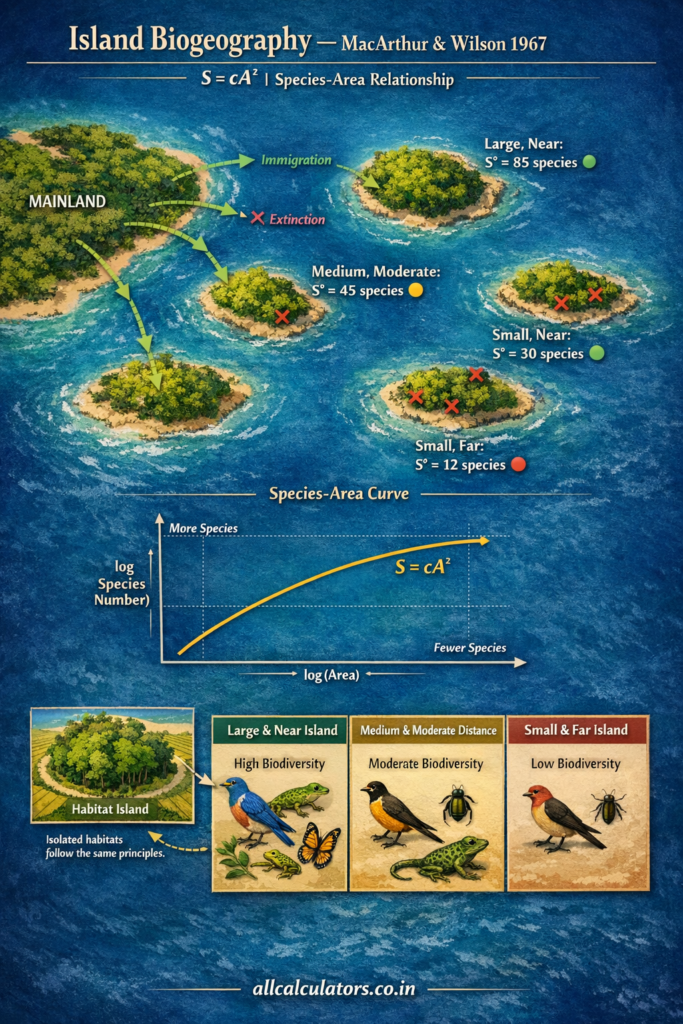
🌐 The Birth of Island Biogeography — MacArthur & Wilson’s Revolutionary Theory
The Theory of Island Biogeography (TIB) was formally introduced to the scientific world in a landmark 1963 paper and then comprehensively developed in the iconic 1967 book “The Theory of Island Biogeography” by two brilliant American scientists — ecologist Robert H. MacArthur of Princeton University and biologist Edward O. Wilson of Harvard University 🎓. This work, widely regarded as one of the most influential books in the history of ecology, fundamentally transformed how scientists, conservationists, and policymakers think about biodiversity, habitat loss, species extinction, and ecological equilibrium 📚.
Before MacArthur and Wilson, biogeography was largely a descriptive science — naturalists catalogued species distributions but lacked a rigorous predictive mathematical framework. MacArthur and Wilson changed everything. They proposed that the number of species on an island is not random — it is governed by a dynamic equilibrium between two opposing forces: the rate of immigration of new species arriving from a mainland or source region 🚢, and the rate of extinction of species already established on the island 💀. These two rates — immigration decreasing as the island fills up, and extinction increasing as more species compete for limited resources — intersect at a predictable equilibrium species number (S*) 📊.
📐 The Core Formulas Behind the Island Biogeography Calculator
Our Island Biogeography Calculator is built on two foundational mathematical relationships that have been validated by decades of field research across the world’s islands, forest fragments, lakes, and nature reserves:
🧮 1. The Species-Area Relationship (SAR): S = c × A^z
This is the most fundamental equation in island biogeography and one of ecology’s most universal laws 📏. It states: S = c × A^z
Where:
- S = Predicted number of species 🦋
- A = Area of the island or habitat patch (in km², ha, or mi²) 🗺️
- c = A constant that varies with the taxonomic group and biogeographic region (e.g., tropical birds vs. temperate insects)
- z = The slope of the species-area curve on a log-log scale; reflects the rate at which species richness increases with area
The value of z is remarkably consistent across many biological groups and geographic regions. Research has established:
- 🏝️ True oceanic islands: z = 0.20–0.35 (commonly ~0.25–0.30)
- 🌲 Continental habitat fragments (e.g., forest patches): z = 0.12–0.17
- 🏔️ Mountainous “sky island” habitats: z = 0.20–0.30
This equation can also be expressed in its logarithmic linear form for easy graphing: log(S) = log(c) + z × log(A)
This log-linear transformation means that when species richness is plotted against area on a log-log graph, the relationship appears as a straight line with slope z — the hallmark of the species-area curve 📈.
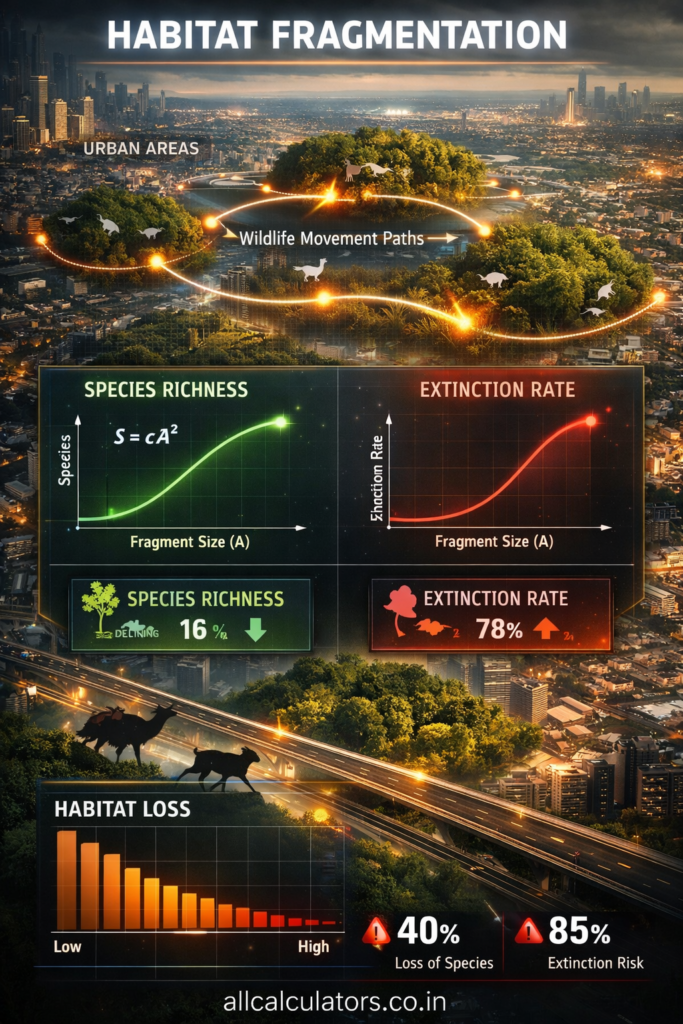
🔄 2. The Equilibrium Immigration-Extinction Model
The second pillar of island biogeography is the Equilibrium Model, which predicts the dynamic balance between species immigration and extinction:
- Immigration rate (I) — The rate at which new species colonize the island. Immigration decreases as more species accumulate on the island (fewer mainland species remain to immigrate) and decreases with greater distance from the source region 🌊.
- Extinction rate (E) — The rate at which established species go locally extinct. Extinction increases as more species compete for the island’s finite resources and decreases on larger islands that can support larger, more viable populations 🌿.
- Equilibrium Species Number (S*) — The point where Immigration Rate = Extinction Rate (I = E). This is the predicted stable biodiversity of the island ⚖️.
Key predictions of the Equilibrium Model, all backed by extensive empirical evidence:
| Island Characteristic | Effect on Immigration | Effect on Extinction | Effect on S* |
|---|---|---|---|
| 🟢 Larger Area | No direct effect | ⬇️ Decreases | ⬆️ More species |
| 🔴 Smaller Area | No direct effect | ⬆️ Increases | ⬇️ Fewer species |
| 🟢 Near Mainland | ⬆️ Increases | No direct effect | ⬆️ More species |
| 🔴 Far from Mainland | ⬇️ Decreases | No direct effect | ⬇️ Fewer species |
🧪 The Simberloff & Wilson Experiment — Proof in the Florida Keys
The equilibrium theory wasn’t just mathematical speculation. It was experimentally tested with stunning results by E.O. Wilson and his graduate student Daniel Simberloff in the late 1960s 🔬. They selected six small mangrove islands in the Florida Keys, fumigated them to remove all arthropod (insect, spider, and crustacean) populations, and then tracked species recolonization over two years. Their results confirmed the theory’s core predictions: species numbers recovered toward predicted equilibrium values, and closer islands recolonized faster than distant ones 🎯. This elegant natural experiment cemented island biogeography as one of ecology’s most empirically robust theories.
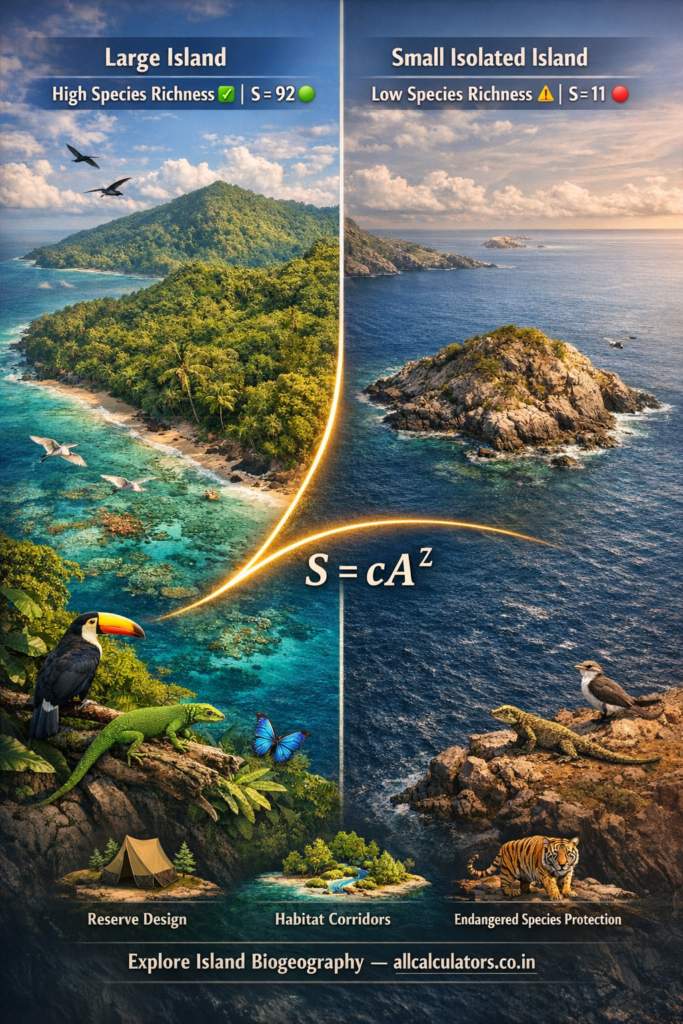
🌲 Beyond Islands — Habitat Fragments as “Ecological Islands”
One of the most profound and practically important extensions of MacArthur and Wilson’s theory is the recognition that habitat fragments are ecological islands 🏝️. A patch of old-growth forest surrounded by agricultural land, a freshwater lake surrounded by terrestrial habitat, a mountain peak surrounded by lowland terrain, or a nature reserve surrounded by urban development — all function as islands in a sea of hostile or unsuitable habitat 🏙️.
This insight has made island biogeography theory the cornerstone of conservation biology and reserve design 🌿. The theory directly informs:
- The SLOSS debate (Single Large Or Several Small reserves) — is one large reserve better than several small ones of equal total area? 🏕️
- Minimum viable habitat area for protecting endangered species 🦁
- Wildlife corridor design to reduce isolation between habitat patches 🦌
- Predicting extinction debt — species that will eventually go extinct due to habitat loss, even if still present today ⏳
🎓 Who Uses This Calculator?
Our Island Biogeography Calculator is designed for a wide audience of learners, researchers, and professionals:
✅ Students of Ecology, Environmental Science, Conservation Biology, and Geography ✅ Researchers studying species distribution, biodiversity, and population dynamics ✅ Conservation biologists designing national parks and wildlife reserves ✅ Environmental consultants assessing habitat fragmentation impacts ✅ Teachers preparing biodiversity and ecology lessons and lab exercises ✅ Policy makers and urban planners working on green corridor projects ✅ Wildlife enthusiasts and nature lovers curious about island species patterns ✅ UPSC, GATE, and competitive exam aspirants studying ecology topics
Simply input your island area (A), the biogeographic constants c and z, and optionally your immigration and extinction rate estimates — and our calculator delivers instant, scientifically grounded predictions of species richness and equilibrium status 🚀. Free, fast, no signup required — AllCalculators.co.in makes ecological science accessible to everyone 🌍💙.
🌍Applications in Daily Life
The Island Biogeography Calculator has practical applications beyond academic theory and plays a vital role in real-world environmental decision-making 🌱:
- 🌳 Urban Planning & Green Spaces
Helps design parks and green areas to maximize biodiversity using species richness calculation models. - 🐾 Wildlife Conservation
Used by conservationists to predict species survival in fragmented habitats using immigration-extinction models. - 🌊 Marine Biology & Coral Reefs
Assists in analyzing biodiversity in isolated marine ecosystems using island biogeography formulas. - 🌾 Agriculture & Land Use Planning
Optimizes land usage while maintaining ecological balance using environmental biology calculators. - 🌍 Climate Change Studies
Predicts how rising temperatures affect species distribution across isolated ecosystems. - 🏙️ Smart City Development
Supports sustainable development by integrating biodiversity considerations into urban ecosystems.
⚠️ Disclaimer 📢
⚠️ Important Disclaimer
This Island Biogeography Calculator provides estimated results based on standard ecological models and mathematical assumptions. While it is highly useful for educational and research purposes 📚, real-world ecosystems are influenced by multiple complex variables such as climate conditions, human activities, genetic diversity, and environmental disturbances 🌪️.
🚫 The results should not be used as the sole basis for critical environmental or policy decisions.
✅ Always consult ecological experts or scientific studies for accurate field analysis.
📌 Related Calculator
❓🌴 FAQs Section
❓ What is Island Biogeography in ecology? 🌍
Island biogeography is a scientific theory that explains how species richness on islands is determined by the balance between immigration and extinction rates.
❓ How does the Island Biogeography Calculator work? 🧮
It uses ecological formulas like the species-area relationship and equilibrium models to estimate biodiversity based on island size and distance.
❓ Why is species richness important? 🌿
Species richness indicates biodiversity health and helps in conservation planning and environmental sustainability.
❓ What is the species-area relationship formula? 📊
It is expressed as S = cA^z, where S is species number, A is area, and c & z are constants.
❓ Can this calculator be used for real ecosystems? 🌍
Yes, but results are approximate and should be combined with real-world ecological data.