
🔁 Hysteresis Loop Calculator
Formula Used:
Hysteresis Loss = Area of B-H Loop × Frequency × Volume
Mathematically:
P = η × f × V
Where:
P = Power Loss (W)
η = Area of B-H Loop (J/m3)
f = Frequency (Hz)
V = Volume (m3)
Result
Table of Contents
✍️ Author & Academic Authority: Dr. Nitish Kr. Bharadwaj
📘 Qualifications: B.Sc., B.Ed., M.Sc., Ph.D. (Biochemistry), MBA (Financial Management)
🔄 Hysteresis Loop Calculator –Introduction
Instantly Analyze Magnetic Hysteresis in Materials ⚡
Magnetic materials play a critical role in modern electrical systems, power generation, electronics, and industrial machines. One of the most important characteristics used to analyze magnetic materials is the hysteresis loop, which describes how magnetic flux density behaves when a material is magnetized and demagnetized. The Hysteresis Loop Calculator is an advanced online physics tool that helps students, engineers, and researchers quickly compute key magnetic properties such as coercivity, remanence, magnetic field strength, and hysteresis loss. 📊
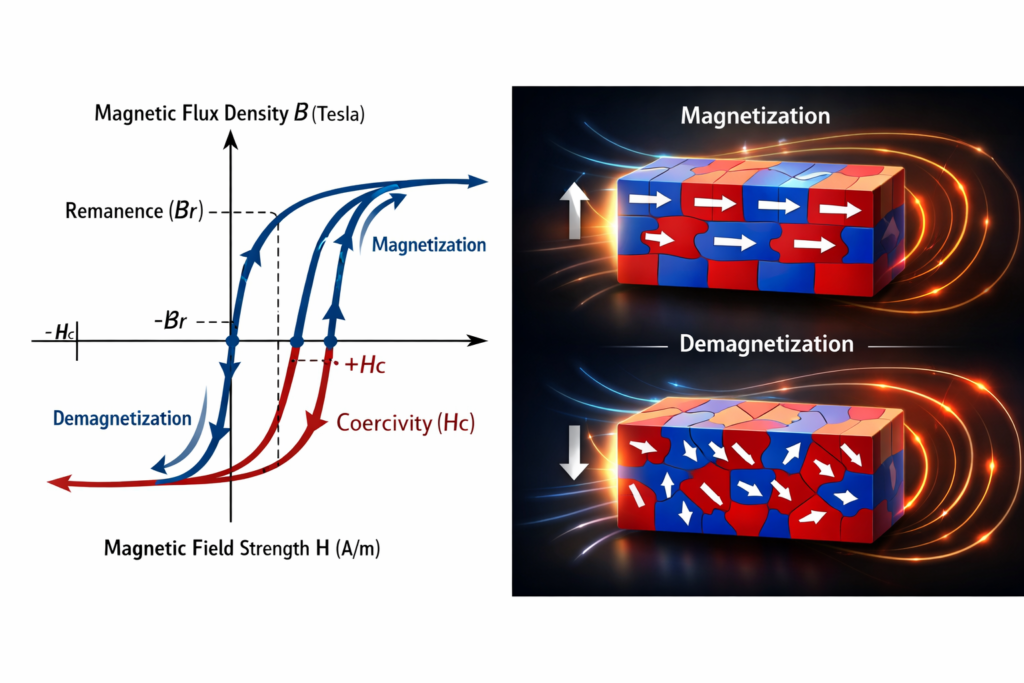
In simple terms, a hysteresis loop represents the relationship between magnetic flux density (B) and magnetic field intensity (H) when a ferromagnetic material undergoes cyclic magnetization. When a magnetic field is applied to materials like iron, steel, or ferrites, the magnetic domains align with the applied field. However, when the external field is removed, the material does not instantly lose its magnetism. Instead, it retains a portion of magnetization known as remanent magnetism. This delay or lag between magnetization and demagnetization is known as magnetic hysteresis. 🔁
The graphical representation of this behavior is called the B-H curve or hysteresis loop. Understanding this curve is extremely important in physics and electrical engineering because it determines how efficiently magnetic materials perform in devices such as transformers, motors, inductors, generators, and electromagnetic circuits.
Our Hysteresis Loop Calculator simplifies complex calculations associated with magnetic hysteresis. Instead of manually solving equations or plotting curves, users can input parameters such as magnetic field strength (H), magnetic flux density (B), permeability, and material constants, and instantly obtain accurate results. ⚙️
This calculator is especially valuable for students studying electromagnetism, electrical engineering, and applied physics. In textbooks, hysteresis loop problems often require multiple formulas, graphical interpretation, and numerical approximations. By using this online tool, students can verify their solutions, understand concepts faster, and avoid calculation mistakes.
Another key concept associated with hysteresis loops is hysteresis loss. Whenever magnetic materials undergo repeated magnetization cycles—such as in alternating current (AC) systems—energy is lost due to the internal friction of magnetic domains. This energy loss appears as heat and reduces the efficiency of electrical devices. The area enclosed by the hysteresis loop represents the energy lost per cycle per unit volume of the material.
Therefore, engineers aim to select materials with narrow hysteresis loops for applications like transformer cores because these materials minimize energy loss. On the other hand, materials with wide hysteresis loops are useful in permanent magnets where strong residual magnetism is desirable.
The Hysteresis Loop Calculator helps analyze these magnetic behaviors quickly and accurately. It enables users to compute values related to coercive force (Hc), remanent flux density (Br), magnetic permeability, and hysteresis energy loss using standard physics equations.
From an educational perspective, visualizing hysteresis loops helps students understand why certain magnetic materials behave differently under external magnetic fields. For example:
• Soft magnetic materials have small hysteresis loops and low coercivity, making them ideal for transformer cores.
• Hard magnetic materials have wide loops and high coercivity, making them suitable for permanent magnets.
With the help of this calculator, users can experiment with different values and immediately observe how magnetic parameters affect the hysteresis loop behavior.
Another advantage of using this online magnetic hysteresis calculator is accessibility. Since it is web-based, it works across desktops, tablets, and smartphones without requiring any installation. This makes it an ideal tool for students completing physics assignments, teachers explaining magnetic concepts, and engineers performing quick calculations.
Additionally, calculators like this support modern digital education by turning complex theoretical concepts into interactive learning tools. Instead of memorizing formulas, learners can explore how changing parameters impacts results in real time. 📚
Whether you are preparing for physics exams, electrical engineering coursework, research experiments, or industrial design projects, the Hysteresis Loop Calculator provides a reliable and efficient way to analyze magnetic properties. By combining accurate formulas with an easy-to-use interface, this calculator ensures that users can perform magnetic hysteresis calculations in seconds.
Ultimately, understanding hysteresis loops is essential for designing efficient electrical devices, improving energy performance, and advancing magnetic material research. With this powerful online calculator, anyone can quickly compute and analyze magnetic hysteresis properties without complicated manual calculations. 🚀
🌍 Applications in Daily Life
⚡ 1. Transformer Core Design: Engineers use hysteresis loop calculations to select magnetic materials with minimal energy loss. This ensures transformers operate efficiently in power distribution systems.
🔌 2. Electric Motors and Generators: Magnetic hysteresis analysis helps improve the efficiency of motors and generators used in appliances, industrial machines, and electric vehicles.
💻 3. Magnetic Storage Devices: Hard drives and magnetic storage technologies rely on materials with specific hysteresis loop characteristics to store and retain data reliably.
🧲 4. Permanent Magnets: Materials with large hysteresis loops are used to create strong permanent magnets used in speakers, sensors, and magnetic locks.
⚙️ 5. Industrial Magnetic Sensors: Hysteresis loop analysis is used to design magnetic sensors and electromagnetic actuators used in automation and robotics.
🔬 6. Research in Magnetic Materials: Scientists analyze hysteresis loops to develop advanced magnetic materials used in renewable energy systems and electronic devices.
⚠️ Disclaimer
📢 The Hysteresis Loop Calculator provided on this website is intended for educational and informational purposes only. While every effort has been made to ensure the accuracy of the formulas and calculations, results generated by this tool should be considered approximate estimates.
Users should verify results independently before applying them to engineering designs, scientific experiments, or industrial applications. The website allcalculators.co.in shall not be held responsible for any errors, omissions, or consequences arising from the use of this calculator.
Always consult qualified educators, engineers, or subject experts when performing critical physics calculations. 🧠
📌 Related Calculator
❓ FAQs
❓ What is a hysteresis loop in physics?
A hysteresis loop is a graphical representation of the relationship between magnetic flux density (B) and magnetic field strength (H) during the magnetization and demagnetization of a magnetic material.
❓ What does the area of a hysteresis loop represent?
The area enclosed by the hysteresis loop represents the energy lost due to hysteresis during each magnetization cycle in a magnetic material.
❓ What is coercivity in a hysteresis loop?
Coercivity is the magnetic field strength required to reduce the magnetic flux density of a material to zero after it has been magnetized.
❓ What is remanence in magnetic hysteresis?
Remanence (remanent magnetism) is the residual magnetization that remains in a magnetic material when the external magnetic field is removed.
❓ Why is hysteresis loss important in transformers?
Hysteresis loss determines the energy efficiency of transformer cores. Materials with smaller hysteresis loops reduce power loss and heat generation.
❓ How does the Hysteresis Loop Calculator work?
The calculator uses standard magnetic hysteresis formulas to compute values such as coercivity, remanence, magnetic flux density, and hysteresis energy loss based on user inputs.