
Gas Laws Calculator
Table of Contents
✍️ Author & Academic Authority: Dr. Nitish Kr. Bharadwaj
📘 Qualifications: B.Sc., B.Ed., M.Sc., Ph.D. (Biochemistry), MBA (Financial Management)
🔬 Gas Laws Calculator – Instantly Solve Boyle’s, Charles’s & Ideal Gas Law Equations 🚀
The Gas Laws Calculator is a scientifically engineered online tool designed to compute relationships between pressure (P), volume (V), temperature (T), and number of moles (n) with high accuracy. Based on Boyle’s Law, Charles’s Law, Gay-Lussac’s Law, Avogadro’s Law, and the Ideal Gas Equation (PV = nRT), this calculator simplifies complex thermodynamic calculations in seconds ⚗️.
Widely used in chemistry education, physics experiments, engineering applications, medical sciences, and industrial gas systems, this calculator eliminates manual errors and delivers precise, real-time results. Whether you are preparing for IIT-JEE, NEET, board exams, or solving real-world gas behavior problems, this tool acts as a reliable scientific companion 📊.
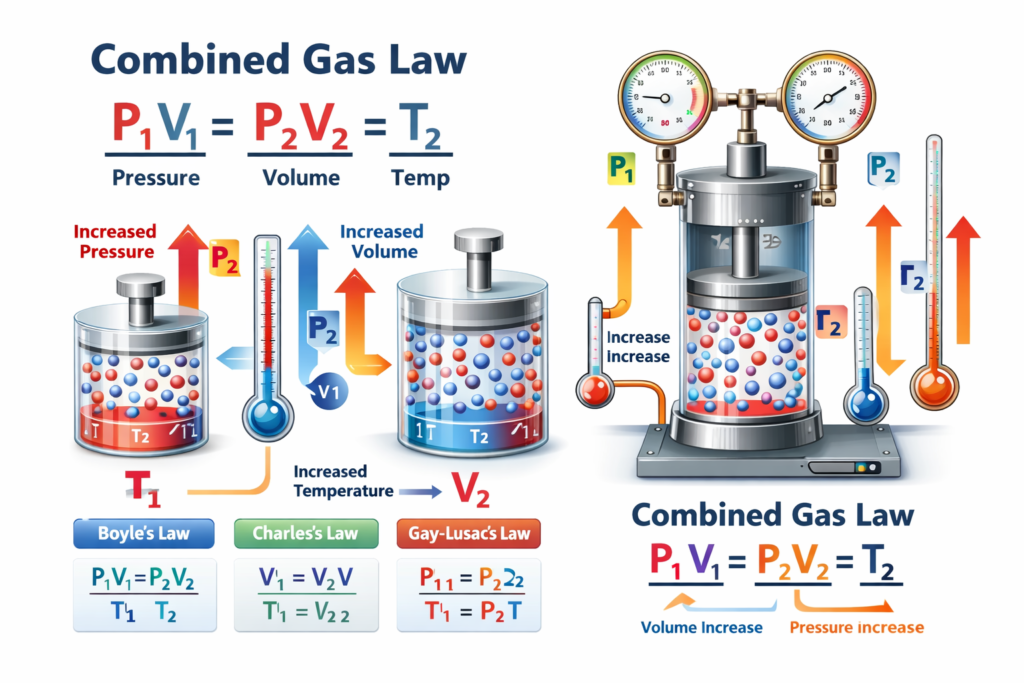
The Gas Laws Calculator is a powerful physics calculator designed to help students, teachers, engineers, and science enthusiasts quickly solve relationships between pressure, volume, and temperature of gases. Instead of manually solving complex thermodynamics equations, this online combined gas law calculator instantly computes the missing variable using the famous formula:
P₁V₁ / T₁ = P₂V₂ / T₂
This formula merges three fundamental gas laws of physics:
• Boyle’s Law – Relationship between pressure and volume
• Charles’s Law – Relationship between volume and temperature
• Gay-Lussac’s Law – Relationship between pressure and temperature
By combining these laws into one equation, scientists created the Combined Gas Law, which allows you to calculate gas behavior under changing conditions.
Our Combined Gas Laws Calculator at allcalculators.co.in simplifies this process dramatically. Whether you are solving physics homework, preparing for competitive exams like JEE, NEET, SAT, or GCSE, or analyzing gas systems in engineering, this tool helps you obtain results instantly with maximum accuracy.
🌍 Applications of Gas Laws in Daily Life 🔥
Gas laws are not limited to textbooks—they actively govern our daily experiences:
🔹 Breathing & Human Lungs – Boyle’s Law explains lung expansion and contraction 🫁
🔹 Pressure Cookers – Increased pressure raises boiling point for faster cooking 🍲
🔹 Hot Air Balloons – Charles’s Law controls altitude through temperature changes 🎈
🔹 Car Tyres – Tyre pressure changes with temperature during long drives 🚗
🔹 Aerosol Sprays – Gas expansion ensures smooth spray flow 🧴
🔹 Refrigeration & AC Systems – Ideal Gas Law optimizes cooling cycles ❄️
🔹 Medical Oxygen Cylinders – Accurate pressure-volume calculations save lives 🏥
This Gas Laws Calculator helps quantify these phenomena with scientific precision.
⚠️ Disclaimer
The Gas Laws Calculator is intended for educational and informational purposes only. The calculations are based on standard gas law formulas and ideal assumptions. Real-world gas behavior may vary due to factors such as non-ideal conditions, extreme temperatures, or high pressures.
This tool should not be used as a substitute for professional scientific analysis or laboratory measurements. No guarantee is made regarding suitability for industrial, medical, or safety-critical applications.
📌 Related Calculator
❓Frequently Asked Questions– Gas Laws Calculator
1. What is a Gas Laws Calculator❓
It is an online tool used to calculate gas properties using Boyle’s Law, Charles’s Law, and the Ideal Gas Law.
2. Which gas laws are included in this calculator❓
It includes Boyle’s Law, Charles’s Law, and the Ideal Gas Law.
3. What inputs are required❓
Depending on the law, inputs may include pressure, volume, temperature, and number of moles.
4. Is this calculator accurate❓
Yes ✅, it provides accurate results under ideal gas assumptions.
5. Can students use this calculator for homework❓
Yes ✅, it is widely used for academic and learning purposes.
6. Does the calculator support different units❓
Yes ✅, most calculators support common pressure, volume, and temperature units.
7. Is this calculator free to use❓
Yes ✅, it is completely free and requires no registration.
8. Can it be used for real gases❓
The calculator assumes ideal behavior; real gases may deviate under extreme conditions.
9. Does it work on mobile devices❓
Yes ✅, it is mobile-friendly and works across devices.
10. Is prior knowledge of gas laws required❓
Basic understanding helps, but the calculator is user-friendly for beginners.