
🧬 Enzyme Kinetics Vmax Calculator
Michaelis-Menten Equation:
V = (Vmax × [S]) / (Km + [S])
Table of Contents
✍️ Author & Academic Authority: Dr. Nitish Kr. Bharadwaj
📘 Qualifications: B.Sc., B.Ed., M.Sc., Ph.D. (Biochemistry), MBA (Financial Management)
🧬 Enzyme Kinetics Vmax Calculator - Introduction
⚡Instantly Calculate Maximum Reaction Velocity (Vmax)
Understanding enzyme behavior is a cornerstone of biochemistry, molecular biology, and medical sciences, and one of the most critical parameters in enzyme kinetics is Vmax (Maximum Reaction Velocity). The Enzyme Kinetics Vmax Calculator is a powerful online tool designed to help students, researchers, and professionals instantly compute the maximum rate of an enzyme-catalyzed reaction using validated biochemical equations such as the Michaelis-Menten equation. 🚀
In enzyme kinetics, Vmax represents the maximum rate at which an enzyme converts substrate into product when the enzyme is fully saturated with substrate molecules. This occurs when all active sites of the enzyme are occupied, meaning adding more substrate will no longer increase the reaction rate. The ability to calculate Vmax accurately is essential in fields such as drug development, metabolic engineering, clinical diagnostics, and biotechnology. 🧫
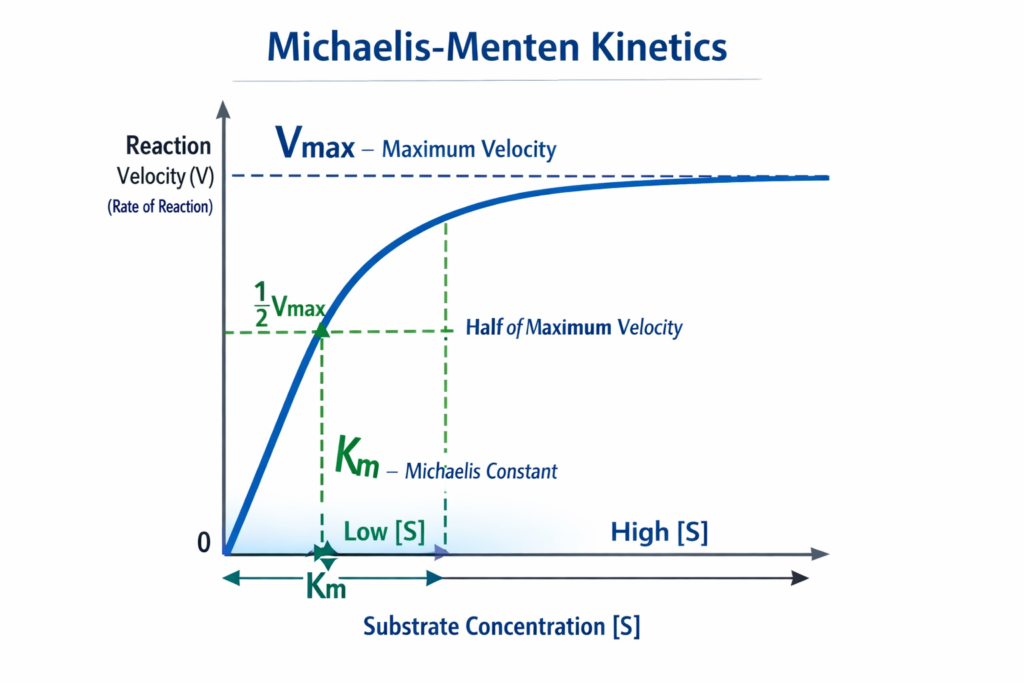
🧠 How to calculate reaction kinetics?
The mathematical foundation of this calculator is based on the Michaelis-Menten equation: 👉 V = (Vmax × [S]) / (Km + [S])
Where:
- V = Reaction velocity
- Vmax = Maximum reaction velocity
- [S] = Substrate concentration
- Km = Michaelis constant
By rearranging this equation or using experimental data, the Vmax calculator enables users to determine enzyme efficiency quickly and accurately without manual calculations. ⚙️
This tool is especially useful for students preparing for competitive exams such as NEET, GATE, CSIR-NET, or university-level biology and chemistry courses. Instead of struggling with complex calculations, users can simply input known values like substrate concentration, reaction rate, or Km to instantly get Vmax results. 🎯
Moreover, understanding Vmax helps in interpreting enzyme inhibition mechanisms. For instance, in competitive inhibition, Vmax remains unchanged, while in non-competitive inhibition, Vmax decreases. These insights are crucial in pharmacology, where enzyme inhibitors are used as drugs to regulate metabolic pathways. 💊
The enzyme kinetics Vmax calculator online is also highly relevant in industrial biotechnology, where enzymes are used in processes like fermentation, food production, and waste management. By optimizing Vmax, industries can improve efficiency and reduce operational costs. 🏭
Another key advantage of this calculator is its ability to support graph-based analysis, such as Lineweaver-Burk plots, which are commonly used to determine Vmax and Km experimentally. While manual plotting is time-consuming and error-prone, this tool simplifies the process and delivers precise results instantly. 📈
In addition, this calculator aligns with modern educational needs by offering interactive and intuitive interfaces, making learning enzyme kinetics more engaging. Whether you are a beginner or an advanced researcher, this tool eliminates computational barriers and allows you to focus on conceptual understanding. 🧠
With increasing demand for online enzyme calculators, biochemical tools, and scientific computation platforms, this Vmax calculator stands out as a reliable, accurate, and user-friendly solution. It bridges the gap between theoretical knowledge and practical application, making it an indispensable resource in the digital learning ecosystem. 🌐
If you are looking to calculate enzyme reaction rates, determine Vmax and Km values, or analyze enzyme efficiency, this tool is your go-to solution. Try it now and experience the power of instant biochemical calculations! ⚡
🌍 Applications in Daily Life
🔬 Medical Diagnostics & Healthcare: Enzyme kinetics and Vmax calculation are used in diagnosing diseases like liver disorders and metabolic conditions. Doctors analyze enzyme activity levels to detect abnormalities. 🏥
💊 Drug Development & Pharmacology: Pharmaceutical companies use enzyme kinetics calculators to design drugs that inhibit or enhance enzyme activity, optimizing treatment efficiency. 🚀
🍞 Food Industry & Fermentation: Enzymes control processes like baking, brewing, and dairy production. Understanding maximum reaction velocity (Vmax) helps improve product quality and consistency. 🧀
🌱 Agriculture & Biotechnology: Enzyme efficiency affects soil health and crop yield. Scientists use enzyme reaction rate calculators to optimize fertilizers and bio-processes. 🌾
🧴 Daily Consumer Products: Laundry detergents contain enzymes. Their effectiveness depends on enzyme activity and Vmax, ensuring better stain removal. 🧼
🧬 Academic Learning & Exams: Students use Vmax calculators online to solve complex biochemistry problems quickly and accurately. 📚
⚠️ Disclaimer
This Enzyme Kinetics Vmax Calculator is designed for educational, academic, and informational purposes only. While the tool uses scientifically validated formulas like the Michaelis-Menten equation, results should not be considered a substitute for professional laboratory analysis or expert consultation. 🧪
Users are advised to verify results before applying them in clinical, pharmaceutical, or industrial settings. We do not take responsibility for any inaccuracies arising from incorrect input values or misuse of the calculator. Always consult a qualified professional for critical applications. ✅
📌 Related Calculator
❓ FAQs
❓ What is Vmax in enzyme kinetics? 🧬
Vmax is the maximum rate of an enzyme-catalyzed reaction when the enzyme is fully saturated with substrate. It is a key parameter in the Michaelis-Menten equation.
❓ How do you calculate Vmax using a calculator? ⚙️
You can use the enzyme kinetics Vmax calculator by entering known values such as reaction velocity, substrate concentration, and Km to instantly compute Vmax.
❓ What is the difference between Km and Vmax? 📊
Km indicates substrate affinity, while Vmax represents the maximum reaction rate. Both are essential for analyzing enzyme efficiency.
❓ Why is Vmax important in biochemistry? 🔬
Vmax helps determine enzyme performance, reaction limits, and is widely used in drug development, diagnostics, and biotechnology.
❓ Can Vmax change with inhibitors? 💊
Yes, in non-competitive inhibition, Vmax decreases, while in competitive inhibition, Vmax remains unchanged.