
⚡ Drift Velocity Calculator 📘
📌 Formula Used
vd = I / (n × q × A)
Where:
vd = Drift Velocity (m/s)
I = Electric Current (A)
n = Number density of charge carriers (m-3)
q = Charge of electron = 1.602 × 10⁻¹⁹ C
A = Cross-sectional Area of conductor (m2)
🧮 Enter Values
📊 Result
✍️ Author & Academic Authority: Dr. Nitish Kr. Bharadwaj
📘 Qualifications: B.Sc., B.Ed., M.Sc., Ph.D. (Biochemistry), MBA (Financial Management)
⚡ Drift Velocity Calculator – Complete Concept Explanation
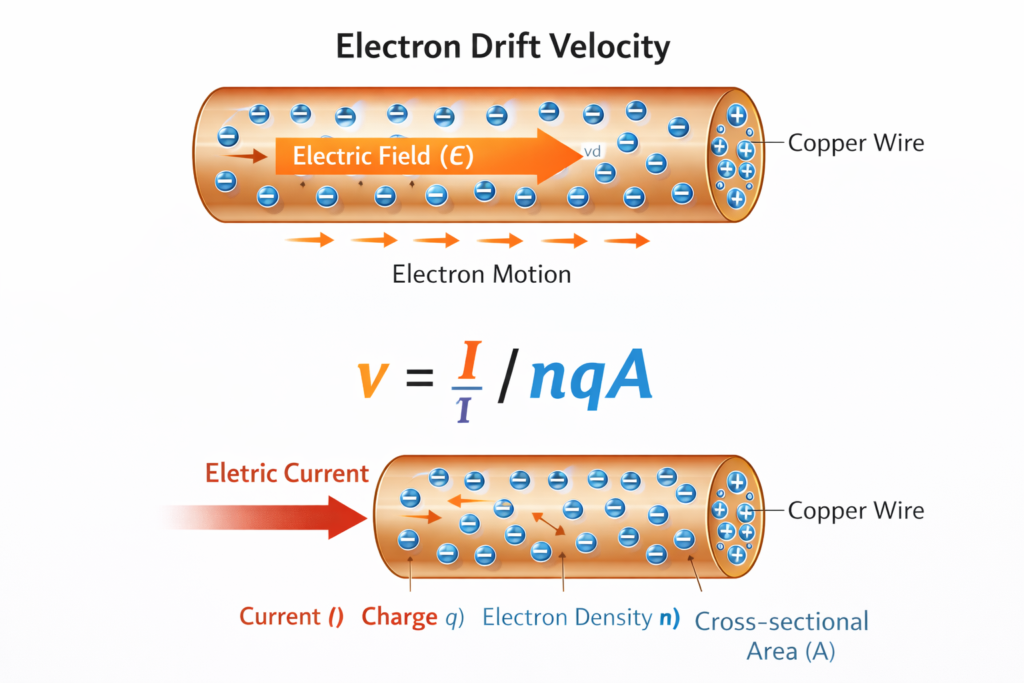
Drift velocity is one of the most fundamental concepts in physics and electrical science that explains how electric current flows inside a conductor. When an electric field is applied across a metallic conductor, the free electrons inside the material begin to move slowly in a particular direction. This slow average motion of electrons is known as drift velocity.
Even though electrons move randomly due to thermal motion, when an external electric field is applied, they acquire a small net velocity opposite to the direction of the electric field. This average velocity is called drift velocity (vₙ).
Understanding drift velocity is extremely important for students studying electromagnetism, current electricity, semiconductor physics, and electronic engineering.
📘 What is Drift Velocity? Definition of Drift Velocity
Drift velocity can be defined as the average velocity attained by charged particles (such as electrons) in a conductor when an electric field is applied.
It is mathematically expressed using the formula: vₙ = I / (nqA)
Where:
- vₙ = Drift velocity
- I = Electric current flowing through conductor
- n = Number density of electrons
- q = Charge of an electron (1.602 × 10⁻¹⁹ C)
- A = Cross-sectional area of conductor
This formula connects macroscopic current with microscopic electron motion, making it extremely useful in physics education.
⚡ Why Drift Velocity is Important
Drift velocity helps explain how electric current flows in metals. Although electrons move very fast randomly, the actual drift velocity is surprisingly small — often only millimeters per second.
However, the electrical signal travels almost at the speed of light because the electric field propagates instantly through the conductor.
This concept is extremely important for:
- Understanding Ohm’s Law
- Studying current density
- Explaining electrical conductivity
- Designing electronic circuits
🔬 Relationship with Electric Field
Drift velocity can also be expressed using another formula:
vₙ = μE
Where:
- μ = Mobility of charge carriers
- E = Electric field strength
This equation shows that drift velocity is directly proportional to the electric field.
📊 Drift Velocity in Metals
In metallic conductors like copper or aluminum, the number density of free electrons is extremely high (about 10²⁸ electrons per cubic meter). Because of this high density, even a very small drift velocity can produce a large electric current.
For example:
A typical copper wire carrying 3 amperes of current may have a drift velocity of only 0.0001 m/s.
This demonstrates that electric current does not require extremely fast electron motion.
⚡ Microscopic View of Electric Current
Electric current in a conductor can be understood using the drift velocity concept.
Current is defined as the flow of charge per unit time.
I = nqAvₙ
This equation shows that current depends on:
- Charge carrier density
- Charge magnitude
- Cross-sectional area
- Drift velocity
Thus, drift velocity is a crucial link between microscopic charge motion and macroscopic current measurement.
📘 Importance in Semiconductor Physics
In semiconductors, drift velocity plays a vital role in the operation of electronic devices.
Semiconductor devices like:
- Diodes
- Transistors
- Integrated circuits
- Solar cells
all rely on the movement of charge carriers under an electric field.
Understanding drift velocity helps engineers design efficient semiconductor devices.
🧠 Drift Velocity vs Random Velocity
Electrons in metals already move randomly due to thermal energy at extremely high speeds.
However, these random motions cancel out in every direction.
When an electric field is applied, electrons gain a small directional component, which is the drift velocity.
This is why current flows.
⚡ Effect of Temperature
Temperature affects drift velocity indirectly through electrical resistance.
Higher temperatures cause more collisions between electrons and atoms, reducing mobility and therefore decreasing drift velocity.
This is why electrical resistance increases with temperature in metals.
📚 Why Students Study Drift Velocity
Drift velocity is a core topic in Class 12 Physics (Current Electricity) and is frequently asked in competitive exams like:
- JEE
- NEET
- Engineering entrance exams
- Physics Olympiads
Using a Drift Velocity Calculator helps students solve numerical problems quickly and verify their answers during practice.
⚡ Applications of Drift Velocity in Real Life
🔌 Electric Power Transmission: Drift velocity explains how electrons move through power lines to deliver electricity to homes and industries.
💡 Electrical Appliances: Devices such as fans, refrigerators, washing machines, and televisions operate because electrons drift through circuits.
📱 Electronics and Smartphones: Integrated circuits and microprocessors rely on controlled drift of electrons in semiconductors.
🔋 Battery Powered Devices: When a battery is connected to a circuit, the electric field causes electrons to drift, powering the device.
🚗 Electric Vehicles: Drift velocity explains electron flow inside electric vehicle motors and battery systems.
💻 Computer Hardware: Microchips rely on charge carrier drift in semiconductor materials to perform billions of operations per second.
⚠️ Educational Disclaimer
This Drift Velocity Calculator is designed for educational and learning purposes only 📚. The calculations are based on standard physics formulas used in academic textbooks and engineering references.
While we strive to ensure maximum accuracy, results generated by this calculator should be used for study, homework verification, and conceptual understanding rather than critical engineering applications.
Users should always cross-verify calculations when applying them to scientific research, professional engineering work, or safety-critical systems. By using this calculator, you agree that the website allcalculators.co.in is not responsible for any decisions made based on the generated results.
❓FAQs
❓ What is drift velocity in physics?
Drift velocity is the average velocity attained by charged particles such as electrons in a conductor when an electric field is applied.
❓ What is the formula for drift velocity?
The formula is:
vₙ = I / (nqA)
❓ Why is drift velocity very small?
Electrons frequently collide with atoms inside a conductor, which reduces their net velocity.
❓ Does drift velocity depend on current?
Yes. Drift velocity increases when electric current increases.
❓ What is the unit of drift velocity?
The SI unit is meters per second (m/s).
❓ Is drift velocity the same as electron velocity?
No. Electrons move randomly at high speeds, but drift velocity is the slow average directional motion.