
🧬 DNA Melting Temperature Calculator
Tm = 2°C × (A + T) + 4°C × (G + C)
Table of Contents
✍️ Author & Academic Authority: Dr. Nitish Kr. Bharadwaj
📘 Qualifications: B.Sc., B.Ed., M.Sc., Ph.D. (Biochemistry), MBA (Financial Management)
🧬 DNA Melting Temperature Calculator -Introduction
Accurate Tm Calculation for PCR, Primers & DNA Hybridization
The DNA Melting Temperature Calculator (Tm Calculator) is a powerful and essential biology tool used to determine the temperature at which a DNA double helix denatures into single strands. This temperature, known as the melting temperature (Tm), plays a critical role in molecular biology applications such as PCR (Polymerase Chain Reaction), DNA hybridization, primer design, and gene analysis. 🚀
Understanding the DNA melting temperature is crucial because it directly affects how DNA strands interact, bind, and separate under varying thermal conditions. In simple terms, Tm is the point where 50% of the DNA double-stranded structure becomes single-stranded, making it a key parameter in experiments involving DNA amplification and analysis.
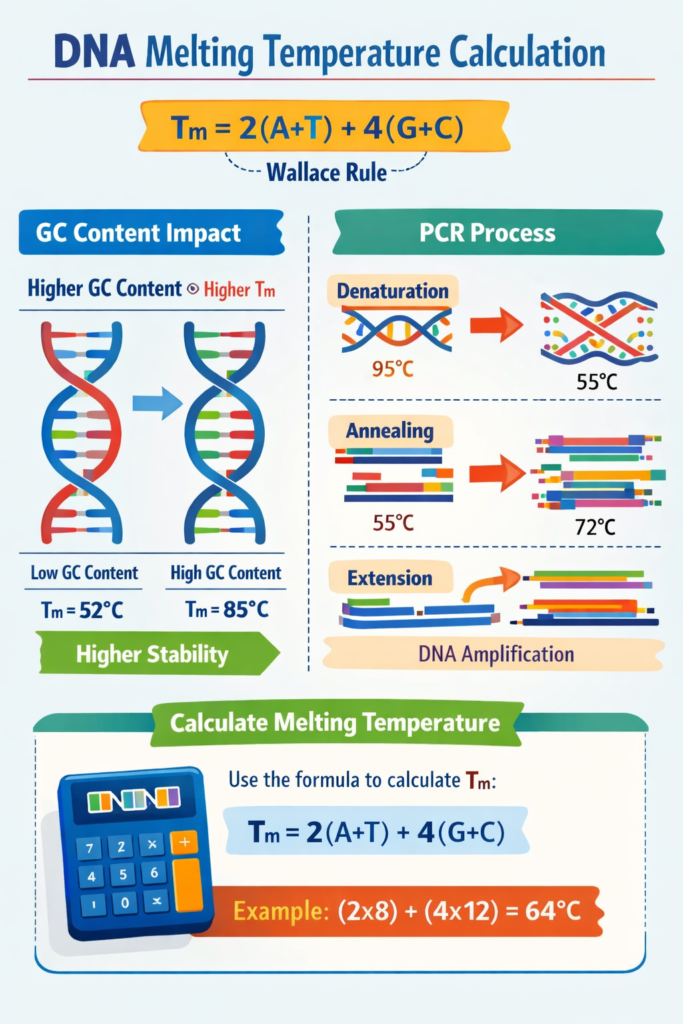
🔬 What is DNA Melting Temperature (Tm)?
The melting temperature (Tm) refers to the temperature at which half of the DNA molecules in a sample lose their double-stranded structure. This occurs due to the breaking of hydrogen bonds between complementary base pairs:
- Adenine (A) pairs with Thymine (T) via 2 hydrogen bonds
- Guanine (G) pairs with Cytosine (C) via 3 hydrogen bonds
Because GC pairs have stronger bonding, DNA sequences with higher GC content have higher melting temperatures. 📈
🧪 Why is Tm Important in Molecular Biology?
Accurate Tm calculation ensures optimal conditions in experiments like:
- PCR amplification 🔄
- DNA sequencing 🧬
- Primer design for gene targeting 🎯
- DNA hybridization assays 🔗
If the temperature is too low, non-specific binding occurs. If too high, primers fail to bind. Therefore, using a DNA melting temperature calculator online ensures precision and efficiency.
⚙️ How Does This DNA Tm Calculator Work?
This calculator uses established formulas such as:
🔹 Wallace Rule (Simple Method)
Tm = 2°C × (A + T) + 4°C × (G + C)
This is best suited for short oligonucleotides (≤14 bases).
🔹 Advanced Thermodynamic Models
For longer sequences, more accurate formulas consider:
- Salt concentration (Na⁺, Mg²⁺) 🧂
- DNA concentration 📊
- Sequence length 📏
- Nearest-neighbor thermodynamics 🔬
These factors significantly impact the DNA duplex stability.
🧠 Key Factors Affecting DNA Melting Temperature
Understanding these variables improves accuracy:
✔️ GC Content – Higher GC increases Tm
✔️ Sequence Length – Longer DNA = higher Tm
✔️ Salt Concentration – Stabilizes DNA duplex
✔️ Mismatches – Reduce Tm significantly
✔️ pH Levels – Affect hydrogen bonding
💡 Why Use an Online DNA Melting Temperature Calculator?
Manual calculation is time-consuming and error-prone. This online DNA Tm calculator tool provides:
✅ Instant and accurate results
✅ Supports primer design optimization
✅ Reduces experimental errors
✅ Improves PCR success rates
✅ Saves time for students and researchers
Whether you’re a student learning molecular biology or a researcher designing primers, this calculator ensures reliable outcomes.
📊 Real-World Relevance of DNA Tm Calculation
From medical diagnostics to biotechnology innovations, Tm calculation is everywhere:
- 🏥 Disease detection using PCR
- 🧬 Genetic engineering
- 💊 Drug development
- 🧪 DNA fingerprinting
- 🌱 Agricultural biotechnology
It’s designed not just as a tool—but as a complete educational and practical resource.
🌍 Applications in Daily Life
🧬 1. PCR Testing & Medical Diagnostics: Used in COVID-19 tests, genetic disease detection, and lab diagnostics. Accurate Tm calculation ensures reliable DNA amplification.
🧪 2. Biotechnology & Research: Scientists use DNA melting temperature calculators for gene cloning, sequencing, and DNA analysis.
🎓 3. Education & Student Learning: Biology students use this Tm calculator tool to understand DNA structure, base pairing, and thermodynamics.
💊 4. Drug Development: Pharmaceutical companies rely on DNA hybridization temperature calculations for drug targeting and development.
🌱 5. Agriculture & GM Crops: Used in genetic modification of crops to improve yield and resistance.
🔬 6. Forensic Science: DNA analysis in crime labs depends on accurate DNA duplex stability and melting temperature calculations.
⚠️ Disclaimer
This DNA Melting Temperature Calculator provides estimated results based on standard scientific formulas such as the Wallace rule and thermodynamic models. 🧬
🔍 While we strive for high accuracy, results may vary depending on experimental conditions like salt concentration, pH levels, and laboratory protocols.
🚫 This tool is intended for educational and informational purposes only and should not replace professional laboratory analysis or expert consultation.
💡 Always verify results with advanced software or laboratory testing for critical applications such as medical diagnostics, research, or biotechnology development.
📌 Related Calculator
❓ FAQs
❓ What is DNA melting temperature (Tm)? 🧬
DNA melting temperature (Tm) is the temperature at which 50% of the DNA double helix separates into single strands.
❓ How do you calculate DNA melting temperature? 🔢
You can calculate Tm using formulas like the Wallace rule: Tm = 2(A+T) + 4(G+C).
❓ Why is Tm important in PCR? 🔬
Tm helps determine the correct annealing temperature, ensuring accurate DNA amplification.
❓ What factors affect DNA melting temperature? 📊
Key factors include GC content, sequence length, salt concentration, and mismatches.
❓ What is a good Tm for primers? 🎯
Typically, primers should have a Tm between 50°C to 65°C for optimal PCR performance.