
🌫️ Dew Point Calculator
γ(T,RH) = ln(RH/100) + (a × T) / (b + T)
Dew Point (Td) = (b × γ(T,RH)) / (a − γ(T,RH))
Where:
T = Air Temperature (°C)
RH = Relative Humidity (%)
a = 17.27
b = 237.7
Table of Contents
✍️ Author & Academic Authority: Dr. Nitish Kr. Bharadwaj
📘 Qualifications: B.Sc., B.Ed., M.Sc., Ph.D. (Biochemistry), MBA (Financial Management)
🌫️ Dew Point Calculator – Introduction
Instantly Calculate Dew Point Temperature from Humidity & Air Temperature
The Dew Point Calculator is a powerful physics and meteorology tool that allows users to determine the dew point temperature of air based on relative humidity and air temperature. The dew point is the temperature at which air becomes fully saturated with moisture and water vapor begins to condense into liquid droplets. This phenomenon explains common natural events such as morning dew, fog formation, condensation on windows, and cloud formation. Understanding dew point is essential in weather forecasting, climate science, HVAC engineering, agriculture, aviation, and daily weather comfort analysis.
In simple terms, the dew point temperature tells you how much moisture is present in the air. When the air temperature drops to the dew point, the air can no longer hold all the moisture in vapor form, causing condensation to occur. A high dew point indicates humid air, while a low dew point means dry air conditions. This is why meteorologists often use dew point instead of relative humidity to describe how comfortable or sticky the air feels.
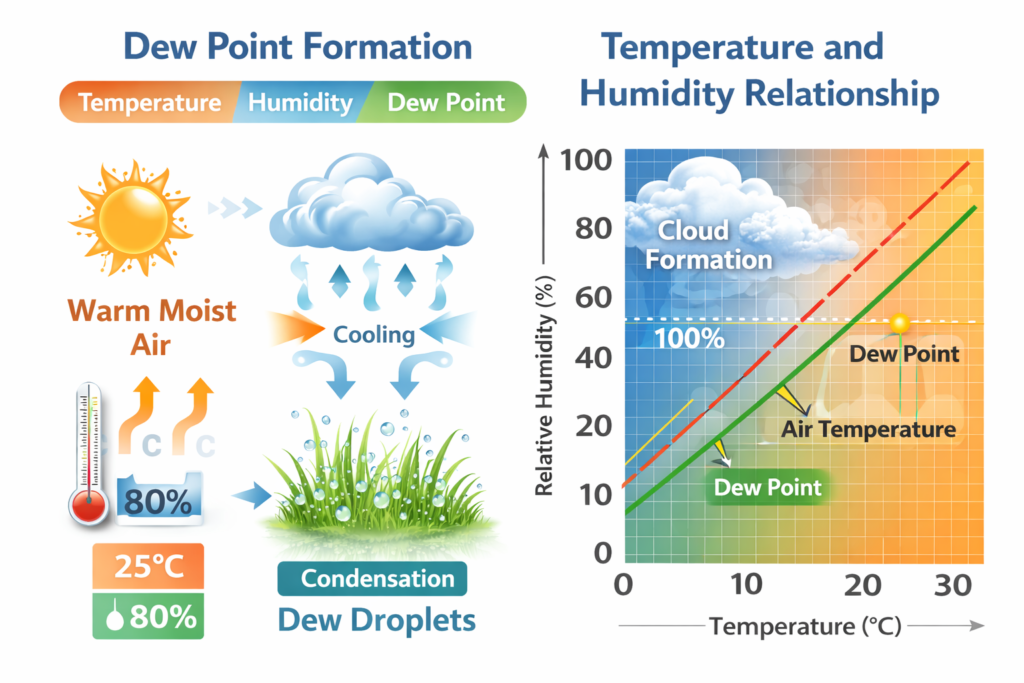
Our online Dew Point Calculator simplifies complex atmospheric physics calculations and allows students, researchers, engineers, and weather enthusiasts to quickly determine the dew point without manually solving complicated equations. The calculator typically requires two main inputs:
✔ Air Temperature
✔ Relative Humidity (%)
Using these inputs, the tool applies the Magnus formula, one of the most widely used equations in meteorology to calculate dew point temperature accurately.
The Magnus formula used in dew point calculations is: Dew Point (Td) = (b × γ(T,RH)) / (a − γ(T,RH))
Where: γ(T,RH) = (a × T / (b + T)) + ln(RH/100)
T = Air temperature (°C)
RH = Relative Humidity (%)
a = 17.27
b = 237.7 °C
This formula provides highly accurate results for typical atmospheric conditions and is widely used in weather stations, meteorological models, and climate studies.
Understanding dew point is important because it directly affects human comfort levels, weather prediction, and environmental monitoring. For example, when the dew point is above 24°C (75°F), the air feels extremely humid and uncomfortable. On the other hand, when the dew point is below 10°C (50°F), the air feels dry and pleasant.
The dew point calculator is particularly useful for students studying physics, atmospheric science, environmental science, and meteorology. Instead of spending time performing logarithmic calculations manually, users can instantly obtain results using this interactive tool.
Another important aspect of dew point is its role in condensation and weather formation. When air temperature drops to the dew point, water vapor condenses into droplets. This is how fog, clouds, dew, and frost form in nature. In aviation and weather forecasting, dew point data helps predict visibility conditions and potential precipitation.
The dew point is also widely used in HVAC (Heating, Ventilation, and Air Conditioning) systems. Engineers rely on dew point calculations to prevent condensation inside buildings, which can lead to mold growth, equipment damage, and poor indoor air quality. By maintaining air temperature above the dew point, HVAC systems ensure comfortable and safe indoor environments.
Another fascinating application is in agriculture and farming. Farmers monitor dew point to understand plant moisture conditions, irrigation needs, and frost risks. When dew point temperatures drop close to freezing, crops may be at risk of frost damage. Monitoring this helps farmers protect sensitive plants and manage agricultural productivity.
In industrial environments, dew point measurement is used in compressed air systems, manufacturing processes, and storage facilities. Moisture in air pipelines can damage equipment or contaminate products. Therefore, calculating dew point helps maintain proper environmental conditions.
From a daily life perspective, dew point affects how the weather feels to humans. A temperature of 30°C may feel comfortable if the dew point is low, but extremely sticky if the dew point is high. This is why weather reports often include dew point data alongside temperature and humidity.
The Dew Point Calculator on our website is designed to be simple, accurate, and fast. Whether you are a student solving physics problems, a weather enthusiast analyzing atmospheric conditions, or an engineer working with humidity control systems, this calculator provides instant results with minimal input.
By combining temperature and relative humidity, this tool accurately calculates dew point and helps users better understand air moisture levels, condensation processes, and atmospheric conditions.
If you are studying thermodynamics, meteorology, environmental science, or physics, this tool will save time and improve accuracy when solving dew point related problems.
Use the Dew Point Calculator now to instantly calculate atmospheric moisture conditions and understand how humidity affects weather, comfort, and environmental systems. 🌦️
🌍 Applications of Dew Point in Daily Life
💧 Weather Forecasting: Meteorologists use dew point temperature calculations to predict fog, rain, and cloud formation. A higher dew point often signals humid and unstable weather conditions.
🌾 Agriculture & Crop Protection: Farmers monitor dew point and humidity levels to determine irrigation schedules and predict frost conditions that may damage crops.
🏠 HVAC & Indoor Climate Control: Engineers use dew point calculations to prevent condensation inside buildings and improve indoor air quality.
✈️ Aviation Safety: Pilots and aviation meteorologists monitor dew point to predict fog formation and visibility conditions at airports.
🏭 Industrial Air Systems: In manufacturing and compressed air systems, dew point helps control moisture levels to protect machinery and maintain product quality.
🧑⚕️ Human Comfort & Health: Dew point determines how comfortable the air feels. High dew points cause sticky weather, while low dew points make air feel dry.
❄️ Frost Prediction: Meteorologists and farmers use dew point calculations to forecast frost conditions that may damage vegetation.
⚠️ Disclaimer
The Dew Point Calculator available on AllCalculators.co.in is designed for educational, informational, and general problem-solving purposes only. While the calculator uses scientifically accepted meteorological formulas and physics principles, the results should be considered approximate estimations rather than precise environmental measurements.
Weather conditions may vary depending on altitude, atmospheric pressure, and local climate factors. For professional meteorological analysis, aviation safety planning, or industrial environmental control, users should consult certified meteorological instruments or professional experts. By using this online dew point calculator, you acknowledge that the website is not responsible for any decisions made based on calculated results.
📌 Related Calculator
❓ FAQs
❓ What is dew point in simple terms?
The dew point is the temperature at which air becomes fully saturated with water vapor and condensation begins to occur. It indicates the amount of moisture present in the air.
❓ How do you calculate dew point temperature?
Dew point is calculated using air temperature and relative humidity through formulas such as the Magnus equation, widely used in meteorology.
❓ Why is dew point more useful than humidity?
Unlike relative humidity, dew point directly measures moisture content in the air, making it a better indicator of how humid or comfortable the air feels.
❓ What does a high dew point mean?
A high dew point indicates that the air contains a large amount of moisture, resulting in humid and uncomfortable weather conditions.
❓ What dew point feels comfortable for humans?
A dew point between 10°C and 16°C (50–60°F) generally feels comfortable. Dew points above 24°C (75°F) feel very humid.
❓ Can dew point be higher than temperature?
No. The dew point temperature cannot exceed the current air temperature because condensation would occur immediately.