
💧 Daily Water Intake Calculator
Base Water (L) = Body Weight (kg) × 0.033
Activity Bonus = +0.35 L/hr (moderate) | +0.6 L/hr (intense)
Climate Bonus = +0 to +1.0 L based on heat/humidity
Total = Base + Activity Bonus + Climate Bonus
| 📊 Component | 💧 Amount (mL) | 📐 Amount (L) |
|---|
Table of Contents
✍️ Author & Academic Authority: Dr. Nitish Kr. Bharadwaj
📘 Qualifications: B.Sc., B.Ed., M.Sc., Ph.D. (Biochemistry), MBA (Financial Management)
💧 Daily Water Intake Calculator Introduction
How Much Water Should You Drink Per Day?
Water is not just a beverage — it is the single most critical nutrient your body depends on for survival, performance, and long-term health. 🌊 Every single cell, tissue, and organ in the human body requires adequate hydration to function optimally. Yet despite this biological imperative, an alarming majority of people worldwide — including up to 75% of Americans — are chronically dehydrated without even realizing it. That is exactly why using a reliable Daily Water Intake Calculator is no longer a luxury; it is a health necessity.
🔬 The Science Behind Your Hydration Needs
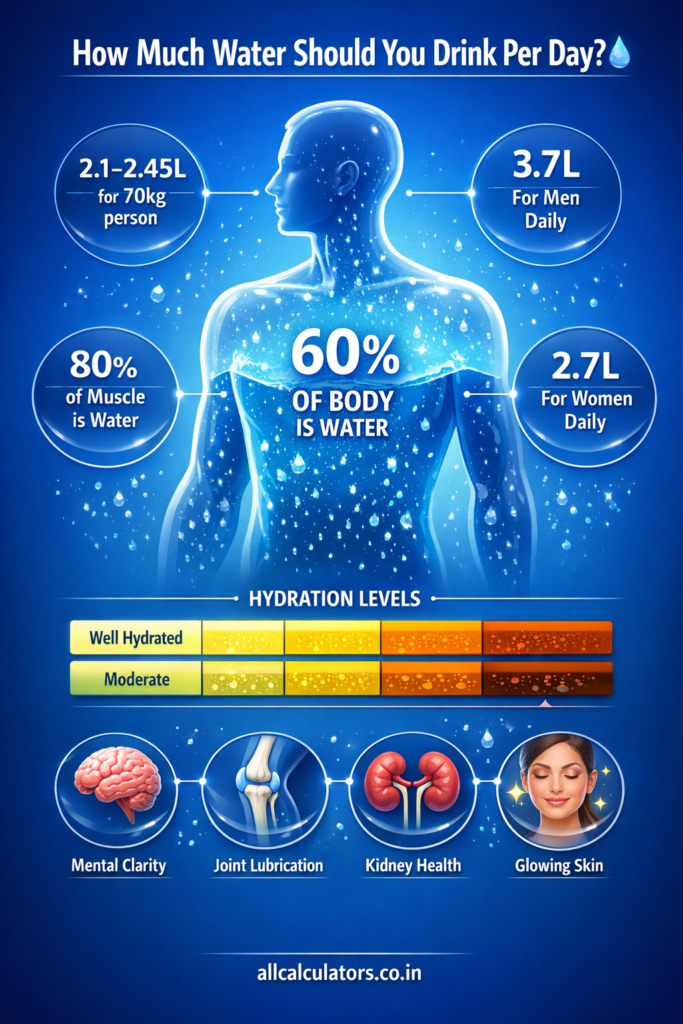
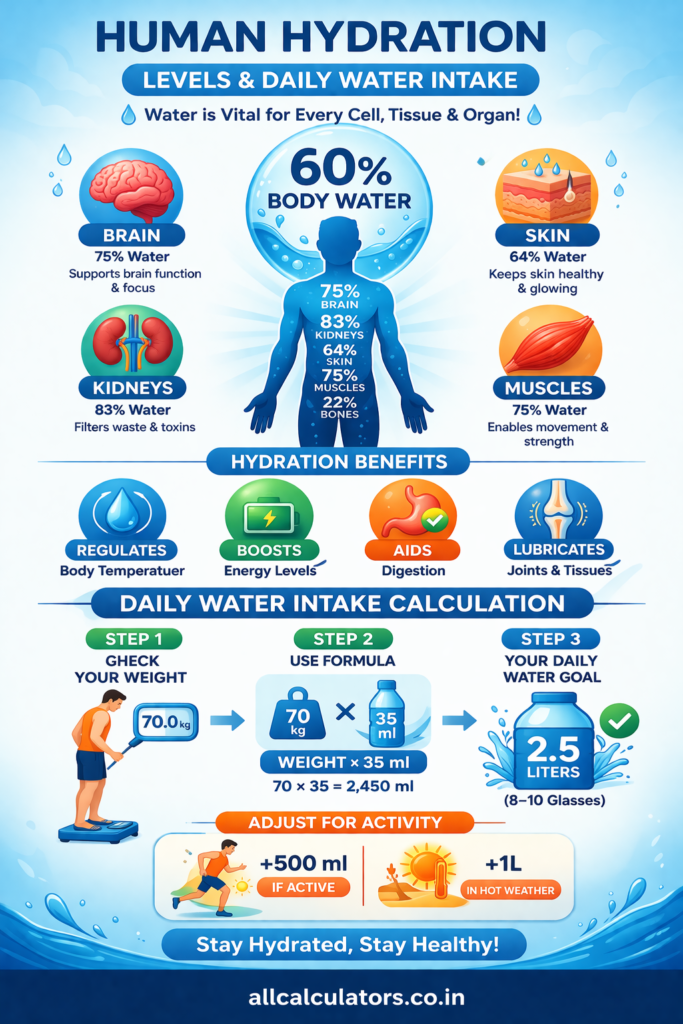
The human body is approximately 60% water by total body weight. This percentage varies with age, sex, and body composition — infants carry nearly 75% water in their bodies, while the elderly may carry as little as 55%. Every day, your body loses water through multiple pathways: breathing (~400 ml), sweating (~500 ml under normal conditions), urination (~1,500 ml), and bowel movements (~200 ml). This means a healthy adult must replenish approximately 2.5 to 3.5 liters of water daily simply to maintain basic physiological balance — a state scientists call euhydration.
The question “How much water should I drink per day?” does not have a single universal answer. Leading health authorities including the World Health Organization (WHO), Mayo Clinic, Harvard T.H. Chan School of Public Health, and the European Food Safety Authority (EFSA) all agree that daily water requirements are deeply personal and depend on a combination of biological and environmental variables. For adult men, total fluid intake recommendations stand at approximately 3.7 liters (15.5 cups or ~125 oz) per day, while adult women need around 2.7 liters (11.5 cups or ~91 oz) per day — inclusive of all fluids and water-rich foods. However, these are only baseline figures. Your actual optimal daily water intake could be significantly higher.
⚖️ Key Factors That Determine Your Daily Water Requirement
Understanding what drives your personal hydration needs is essential before relying on any generic “8 glasses a day” rule. Here is a breakdown of the most scientifically validated factors:
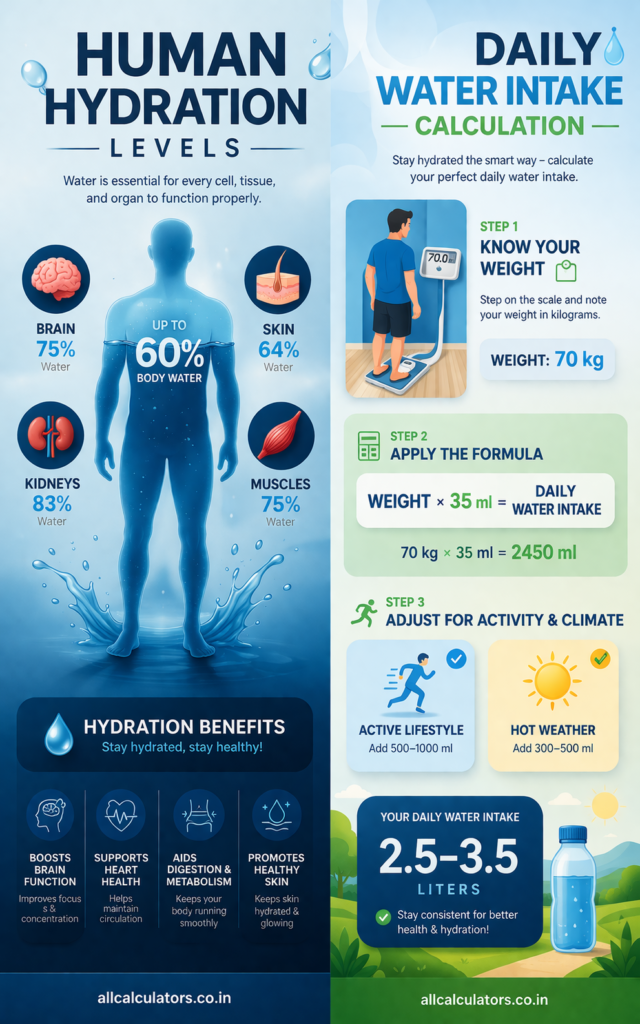
🏋️ Body Weight & Muscle Mass: The most reliable starting point for estimating daily water needs is body weight. A widely accepted formula used by nutritionists and health practitioners is 30–35 ml of water per kilogram of body weight. In simpler terms: a person weighing 70 kg should aim for approximately 2.1 to 2.45 liters of water per day as a bare minimum. Individuals with greater lean muscle mass — since muscle tissue contains roughly 80% water — have proportionally higher hydration demands.
🏃 Physical Activity Level: Exercise dramatically increases your body’s water requirement. Moderate to high-intensity workouts generate significant sweat losses, typically ranging from 0.5 to 1 liter per hour of exercise. Athletes, manual laborers, and highly active individuals should add at least 400–600 ml of water for every 30 to 60 minutes of physical activity. Failure to compensate for these exercise-induced fluid losses leads to dehydration, reduced physical performance, and prolonged recovery times.
🌡️ Climate & Environmental Temperature: Geography plays a significant role in your hydration needs. People living in hot, humid, or tropical climates — such as large parts of India — experience much higher rates of perspiration and therefore need considerably more water than someone in a temperate or cold region. Hot or humid weather alone can increase your daily water requirement by 20–30%. At high altitudes, increased respiratory water loss also adds to daily fluid needs.
👴 Age: Children and teenagers have faster metabolisms and higher activity levels, requiring consistent hydration for healthy growth and development. Older adults, on the other hand, face a unique challenge: the natural sensation of thirst diminishes with age, meaning seniors are at a significantly higher risk of chronic dehydration even when they feel perfectly fine. Research shows dehydration affects up to 28% of adults over the age of 60, making regular use of a water intake calculator by age and weight especially important for the elderly.
🤰 Pregnancy & Breastfeeding: Pregnant women require additional fluid intake to support amniotic fluid, increased blood volume, and fetal development. Breastfeeding women need even more — as producing breast milk significantly increases daily fluid demands, typically by an extra 700 ml to 1 liter per day over standard recommendations.
🤒 Health Conditions: Fever, vomiting, diarrhea, urinary tract infections, kidney stones, and certain medications (especially diuretics) all dramatically increase your body’s water needs. Conversely, conditions like kidney disease, heart failure, or certain hormonal disorders may require fluid restriction — which is precisely why personalized calculators are valuable tools.
🧪 What Happens When You Don’t Drink Enough Water?
Dehydration is not just about feeling thirsty. Even mild dehydration — as little as a 1–2% loss of body water — produces measurable and clinically significant effects on both physical and cognitive performance. Research published in peer-reviewed journals has demonstrated that losing just 2% of body fluids impairs memory, concentration, mood, and physical endurance. At 5% dehydration, symptoms include severe headaches, muscle cramps, rapid heartbeat, and heat exhaustion. Chronic low-grade dehydration is now being studied as a potential contributing factor to kidney stone formation, urinary tract infections, metabolic dysfunction, and even increased obesity risk.
The CDC and NIH both confirm that adequate daily hydration helps:
- 🧠 Maintain sharp cognitive function and mental clarity
- 🫀 Support cardiovascular performance and healthy blood pressure
- 🦷 Aid digestion, nutrient absorption, and regular bowel movements
- 🧬 Regulate core body temperature through sweating and respiration
- 💪 Lubricate joints and cushion vital organs
- 🧹 Flush toxins via kidneys and prevent urinary tract infections
- ✨ Maintain healthy, youthful-looking skin
💡 How to Use the Daily Water Intake Calculator on AllCalculators.co.in
Our free online Daily Water Intake Calculator takes into account all the key physiological and lifestyle factors that influence your unique hydration needs. Simply enter your body weight (in kilograms or pounds), age, biological sex, daily activity level, and climate/environment to receive a personalized water intake recommendation — expressed in liters, milliliters, cups (glasses), and the equivalent number of standard 500 ml water bottles. Whether you are a student, office worker, athlete, pregnant mother, or senior citizen, this tool delivers science-backed, instantly actionable hydration guidance.
The formula used in our calculator is based on TDEE-linked hydration science and weight-based hydration ratios validated by the EFSA, WHO, and Harvard nutrition research. Unlike the outdated “8 glasses a day” rule — which has no robust scientific basis — our calculator adjusts outputs dynamically based on your inputs to give you the most accurate estimate possible.
📊 Quick Reference: Water Intake by Body Weight (Standard Guide)
| Body Weight | Min. Daily Water Intake | Max. Daily Water Intake |
|---|---|---|
| 50 kg | 1.5 liters | 1.75 liters |
| 60 kg | 1.8 liters | 2.1 liters |
| 70 kg | 2.1 liters | 2.45 liters |
| 80 kg | 2.4 liters | 2.8 liters |
| 90 kg | 2.7 liters | 3.15 liters |
| 100 kg | 3.0 liters | 3.5 liters |
Note: These are baseline values for sedentary adults in a temperate climate. Active individuals, those in hot climates, and those with specific health conditions should increase intake accordingly.
💧 Pro Hydration Tips to Hit Your Daily Water Goal
Knowing your target is step one — actually meeting it is step two. Here are practical, science-approved strategies to stay hydrated throughout the day:
- 🌅 Start your morning with water — Drink 1–2 glasses immediately upon waking to compensate for overnight fluid loss.
- ⏰ Set hourly reminders — Use a hydration app or phone alarms to prompt regular sips.
- 🍋 Infuse for flavor — Add lemon, cucumber, mint, or berries to water to make it more appealing.
- 🥗 Eat water-rich foods — Watermelon, cucumber, oranges, tomatoes, and strawberries can contribute 20–30% of your daily fluid needs.
- 💼 Carry a reusable water bottle — A marked 1-liter bottle makes tracking simple and convenient.
- 🍽️ Drink before meals — Research shows drinking 2 cups of water 20–30 minutes before meals reduces appetite, supporting weight management.
- 🌈 Check your urine color — Pale straw-yellow = well hydrated. Dark yellow = drink more. Colorless = possibly overhydrated.
The science is unambiguous: staying properly hydrated is one of the simplest, cheapest, and most powerful things you can do for your health. Use our Daily Water Intake Calculator today to discover your personalized hydration target and make every sip count! 💪🌊
🌍 Applications in Daily Life 💡
💧 Personal Health Optimization
Using a daily water intake calculator, individuals can maintain proper hydration levels, preventing fatigue, headaches, and dehydration-related issues.
🏋️♂️ Fitness & Workout Performance
Athletes and gym-goers rely on hydration calculators to balance fluid loss during workouts and maximize endurance.
🌞 Hot Climate Adaptation (India-Specific)
In regions with high temperatures, a hydration calculator India helps adjust water intake dynamically.
🧠 Cognitive Performance & Focus
Adequate hydration improves concentration, memory, and mental clarity—essential for students and professionals.
⚖️ Weight Loss & Diet Planning
A water intake calculator by weight supports metabolism and appetite control.
🧴 Skin & Beauty Care
Proper hydration improves skin elasticity, glow, and reduces dryness.
🚰 Preventing Health Issues
Maintaining recommended daily water intake levels reduces risk of kidney stones, UTIs, and digestive problems.
⚠️ Disclaimer 🚨
This Daily Water Intake Calculator provides estimated hydration recommendations based on general physiological formulas and user inputs. 💧 These values are intended for informational and educational purposes only and should not be considered medical advice. Individual hydration needs may vary depending on underlying medical conditions, medications, pregnancy, or specific health requirements. 🏥
Always consult a qualified healthcare professional or registered dietitian before making significant changes to your daily water intake, especially if you have kidney disorders, heart conditions, or fluid balance issues. ⚕️
Use this tool as a guideline—not a substitute for professional medical consultation. ✅
📌 Related Calculator
❓ FAQs🔥
💧 How much water should I drink daily?
The recommended daily water intake varies, but generally ranges between 2 to 4 liters, depending on body weight, activity level, and climate.
⚖️ How is water intake calculated by weight?
Most formulas suggest 30–35 ml per kg of body weight, adjusted for physical activity and environmental conditions.
🏃♂️ Do I need more water if I exercise daily?
Yes! Increased physical activity leads to fluid loss through sweat, requiring higher hydration levels.
🌞 Does climate affect daily water intake?
Absolutely. People living in hot climates (like India) need more water to compensate for heat-induced dehydration.
🚰 Can drinking too much water be harmful?
Yes. Overhydration can cause electrolyte imbalance (hyponatremia). Always follow recommended limits.