
🧲 Curie’s Law Calculator
χ = C / T
Table of Contents
✍️ Author & Academic Authority: Dr. Nitish Kr. Bharadwaj
📘 Qualifications: B.Sc., B.Ed., M.Sc., Ph.D. (Biochemistry), MBA (Financial Management)
🔬 Curie’s Law Calculator – Introduction
Instantly Calculate Magnetic Susceptibility ⚡
Understanding how materials respond to magnetic fields is a crucial concept in physics, material science, and engineering. One of the fundamental principles that explains this behavior is Curie’s Law. Our Curie’s Law Calculator helps students, researchers, and educators quickly compute magnetic susceptibility, magnetization, and Curie constant relationships without manual calculations.
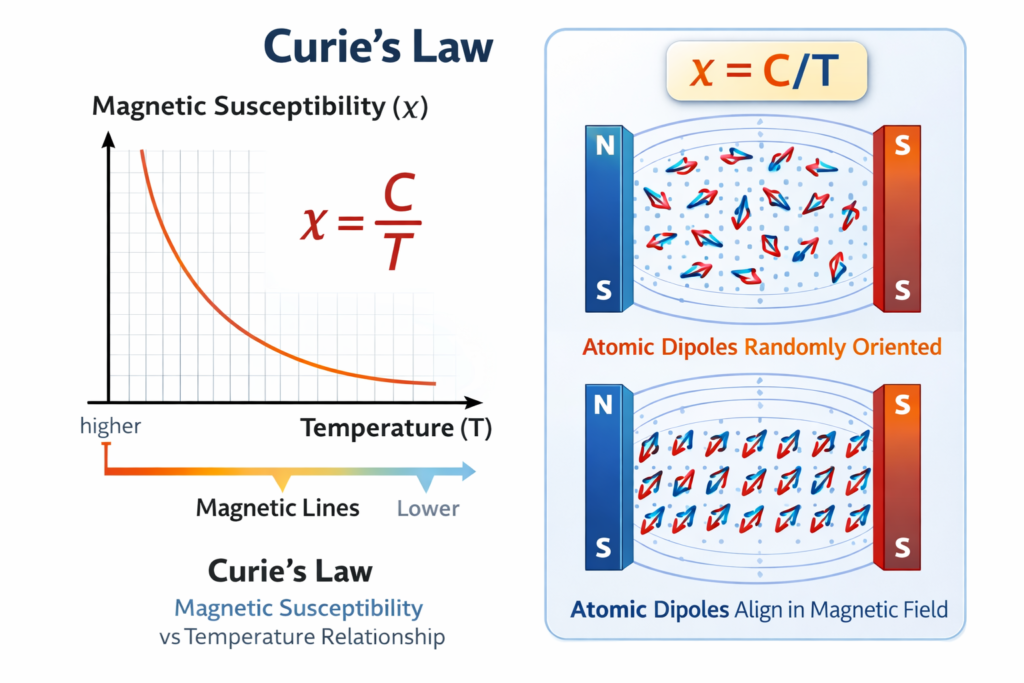
Curie’s Law is widely used in the study of paramagnetism, a property of materials that become weakly magnetized when exposed to an external magnetic field. The law states that the magnetic susceptibility (χ) of a paramagnetic material is inversely proportional to its absolute temperature (T).
The mathematical expression for Curie’s Law is: χ = C / T
Where:
χ = Magnetic susceptibility
C = Curie constant
T = Absolute temperature (Kelvin)
This relationship was discovered by the French physicist Pierre Curie, who made groundbreaking contributions to the study of magnetism and radioactive materials. His work laid the foundation for modern magnetic physics and materials science.
Our Curie’s Law Calculator simplifies the process of solving this equation. Instead of manually rearranging formulas and performing calculations, users can input the known values and instantly obtain accurate results. This is particularly useful for students solving physics problems, researchers analyzing magnetic materials, and engineers working with magnetic devices.
⚙️ What is Magnetic Susceptibility?
Magnetic susceptibility (χ) describes how strongly a material becomes magnetized when exposed to an external magnetic field. In paramagnetic materials, susceptibility decreases as temperature increases. This happens because thermal motion disrupts the alignment of magnetic dipoles within the material.
Examples of paramagnetic materials include:
• Aluminum
• Platinum
• Magnesium
• Oxygen molecules
As temperature rises, thermal agitation increases, reducing the alignment of magnetic dipoles. Consequently, the material becomes less responsive to magnetic fields.
This temperature dependence is precisely what Curie’s Law explains.
🧲 Importance of Curie’s Law in Physics
Curie’s Law is fundamental in understanding magnetism at the atomic level. It explains how magnetic dipoles respond to temperature changes, helping scientists analyze the magnetic properties of different materials.
The law is especially useful in studying:
• Paramagnetic materials
• Magnetic susceptibility measurements
• Magnetic material characterization
• Temperature-dependent magnetic behavior
By using a Curie’s Law Calculator, these complex relationships can be evaluated quickly and accurately.
🧮 How the Curie’s Law Calculator Works
Our Curie’s Law Calculator follows the formula: χ = C / T
Users simply input:
• Curie Constant (C)
• Absolute Temperature (T)
The calculator instantly determines the magnetic susceptibility (χ).
This tool is extremely useful for physics homework, competitive exam preparation, and laboratory experiments.
In some advanced problems, the formula can also be rearranged: C = χT
T = C / χ
The calculator can solve for any unknown variable when the other two values are provided.
🎓 Why Students Use Curie’s Law Calculators
Physics students frequently encounter magnetism problems involving temperature and magnetic susceptibility. Performing these calculations manually can be time-consuming and prone to errors.
Using an online Curie’s Law Calculator provides several benefits:
✔ Instant calculations
✔ Eliminates manual errors
✔ Helps verify homework solutions
✔ Useful for exam preparation
✔ Improves conceptual understanding
These tools are particularly helpful for students studying electromagnetism, thermodynamics, and material science.
🌍 Curie’s Law in Modern Science
Curie’s Law is still widely applied in modern research. Scientists studying magnetic materials, superconductors, and nanotechnology rely on the principles derived from Curie’s Law.
The concept also plays a role in:
• Magnetic resonance technologies
• Magnetic storage devices
• Advanced material design
• Medical imaging technologies
By understanding how magnetic susceptibility varies with temperature, researchers can design better magnetic materials for electronics, energy storage, and healthcare technologies.
🌍 Applications in Daily Life
Although Curie’s Law appears theoretical, it has many real-world applications.
🧲 Magnetic Material Research: Scientists use Curie’s Law calculations to analyze the magnetic properties of materials used in electronics and advanced technologies.
🏥 Medical Imaging (MRI): Magnetic susceptibility plays an important role in MRI scanners, helping researchers understand how tissues interact with magnetic fields.
⚡ Electronic Devices: Many modern electronic components depend on magnetic materials, whose behavior is studied using Curie’s Law.
🛰️ Space Science: Astrophysicists study magnetic properties of cosmic materials and planetary cores using Curie-type magnetic models.
🧪 Laboratory Experiments: Physics students frequently perform experiments involving paramagnetism and magnetic susceptibility measurements.
🎓 Physics Education: The Curie’s Law formula calculator helps students easily solve physics problems and understand temperature-dependent magnetism.
⚠️ Disclaimer
The Curie’s Law Calculator on allcalculators.co.in is designed for educational and informational purposes only.
While the calculator provides accurate results based on the Curie’s Law formula, results may vary depending on experimental conditions, measurement accuracy, and material properties.
Users should verify results when using the calculator for:
• Academic research
• Laboratory experiments
• Scientific publications
• Professional engineering work
This tool is intended to assist students, teachers, and learners in understanding magnetism and magnetic susceptibility calculations.
📌 Related Calculator
❓ FAQs
❓ What is Curie’s Law in physics?
Curie’s Law states that the magnetic susceptibility of a paramagnetic material is inversely proportional to its absolute temperature. The formula is: χ = C / T; Where χ is susceptibility, C is the Curie constant, and T is temperature in Kelvin.
❓ What does the Curie constant represent?
The Curie constant (C) is a material-specific constant that determines how strongly a paramagnetic material responds to a magnetic field.
❓ What is magnetic susceptibility?
Magnetic susceptibility measures how easily a material becomes magnetized when exposed to an external magnetic field.
❓ Why does susceptibility decrease with temperature?
As temperature increases, thermal motion disrupts the alignment of magnetic dipoles, reducing the material’s magnetic response.