
🧪 Colligative Properties Calculator
- 🌡️ Boiling Point Elevation: ΔTb = iKbm
- ❄️ Freezing Point Depression: ΔTf = iKfm
- 💧 Osmotic Pressure: π = iMRT
- 💨 Relative Lowering of Vapour Pressure: ΔP/P° = iXsolute
Table of Contents
✍️ Author & Academic Authority: Dr. Nitish Kr. Bharadwaj
📘 Qualifications: B.Sc., B.Ed., M.Sc., Ph.D. (Biochemistry), MBA (Financial Management)
🧪 Colligative Properties Calculator
⚗️Instantly Solve Freezing Point Depression, Boiling Point Elevation, Osmotic Pressure & Vapor Pressure Lowering!
Have you ever wondered why roads don’t freeze as quickly after salt is spread on them in winter ❄️? Or why your car radiator doesn’t boil over in summer ☀️? Or how hospitals prepare IV fluids that won’t damage your blood cells 🏥? The fascinating science behind all these real-life phenomena is rooted in one powerful concept — Colligative Properties of Solutions. And now, with our free online Colligative Properties Calculator at AllCalculators.co.in, you can solve every related problem in seconds — no manual formula crunching required! 🎯
🔬 What are Colligative Properties?
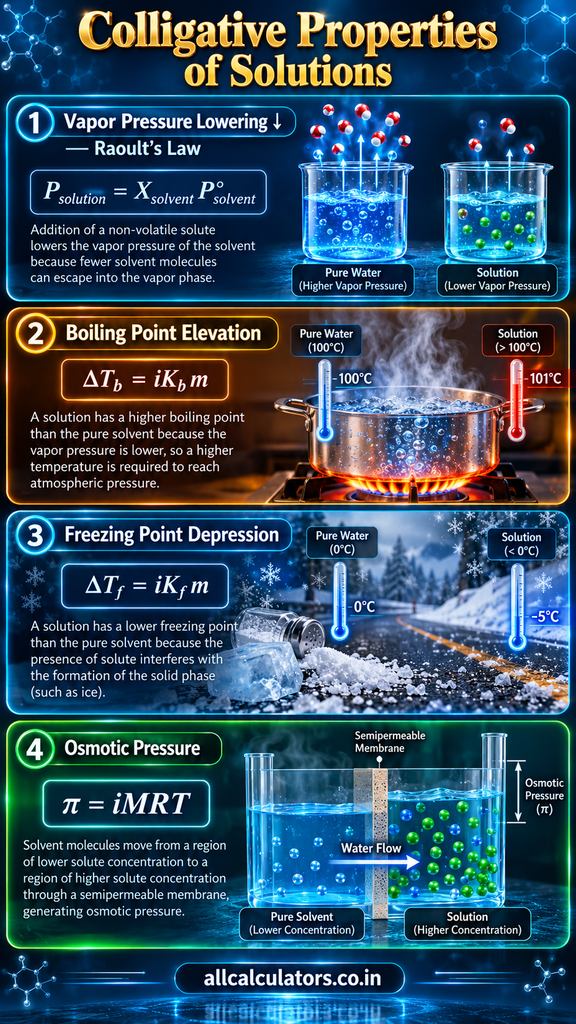
Colligative properties are physical properties of solutions that depend exclusively on the number of solute particles dissolved in a solvent — not on the chemical identity or nature of the solute itself. In simpler terms, it doesn’t matter whether you dissolve salt, sugar, or urea in water; what matters is how many particles you add. The greater the concentration of solute particles, the greater the magnitude of the colligative effect. 💡
The word “colligative” is derived from the Latin word colligatus, meaning “bound together” — a perfect descriptor for how all these properties are tied collectively to the particle count of the solute. There are four fundamental colligative properties that our calculator covers comprehensively:
🔽 1. Vapor Pressure Lowering (ΔP)
When a non-volatile solute is dissolved in a solvent, it displaces some solvent molecules at the surface, reducing the rate of evaporation and thereby lowering the vapor pressure of the solution. This is mathematically described by Raoult’s Law: ΔP = x₂ × P°, where x₂ is the mole fraction of the solute and P° is the vapor pressure of the pure solvent. Our calculator uses this principle to instantly give you the lowered vapor pressure value. 📉
🔺 2. Boiling Point Elevation (ΔTb)
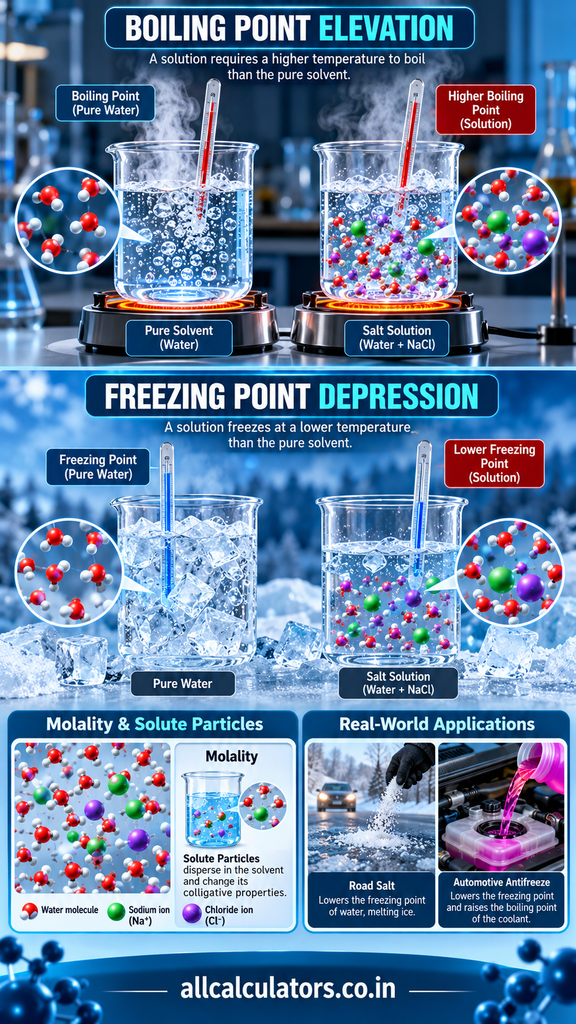
Adding any solute to a solvent raises its boiling point above the pure solvent’s boiling point. This happens because, due to lowered vapor pressure, the solution needs a higher temperature to match atmospheric pressure and begin boiling. The formula is: ΔTb = i × Kb × m, where i is the Van’t Hoff factor (accounting for ionic dissociation), Kb is the molal boiling point elevation constant (ebullioscopic constant) of the solvent, and m is the molality of the solution in mol/kg. For water, Kb = 0.512 °C·kg/mol. 🌡️
❄️ 3. Freezing Point Depression (ΔTf)
A solute in a solvent lowers the freezing point of the solution below that of the pure solvent. This is one of the most practically used colligative properties — think antifreeze in car engines or salt on icy roads! The formula is: ΔTf = i × Kf × m, where Kf is the cryoscopic constant of the solvent (for water, Kf = 1.86 °C·kg/mol). The new freezing point is: Tf (solution) = Tf° (pure solvent) − ΔTf. Our freezing point depression calculator handles electrolytes and non-electrolytes alike. 🧂

💧 4. Osmotic Pressure (π)
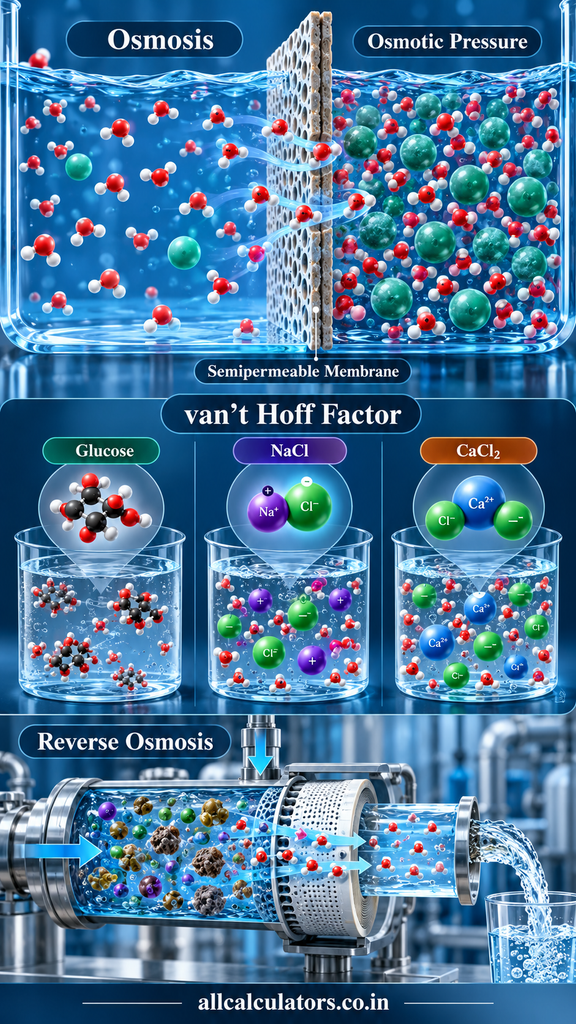
Osmosis is the movement of solvent molecules across a semipermeable membrane from a region of lower solute concentration to higher concentration. The pressure required to stop this movement is called osmotic pressure, and it is calculated using the Van’t Hoff equation: π = i × M × R × T, where M is the molar concentration of the solute, R is the universal gas constant (0.0821 L·atm/mol·K), and T is the temperature in Kelvin. This is critically important in biological systems, food preservation, and water purification. 🌊
📐 What is the Van’t Hoff Factor (i)?
The Van’t Hoff factor (i) is a dimensionless quantity that represents the number of particles a solute formula unit dissociates into in solution. For non-electrolytes like glucose or urea, i = 1 (no dissociation). For NaCl, i = 2 (Na⁺ + Cl⁻). For CaCl₂, i = 3. For strong electrolytes at ideal dilution, i equals the total number of ions formed. Our colligative properties calculator lets you input the Van’t Hoff factor manually, giving you accurate results for both electrolyte and non-electrolyte solutions! ✅
⚖️ Molality vs Molarity in Colligative Properties
One of the most important concepts when solving solution chemistry problems is knowing whether to use molality or molarity.
🧪 Molality (m) is expressed as moles of solute per kilogram of solvent. It is particularly useful for boiling point elevation and freezing point depression because it is based on solvent mass and therefore is not directly affected by temperature-driven changes in solution volume.
💧 Molarity (M) is expressed as moles of solute per litre of solution. It is commonly used in dilute-solution osmotic pressure calculations.
Because solution volume can change with temperature, molarity and molality are not universally interchangeable. OpenStax specifically notes that molar concentration can vary with temperature because solution volume changes, whereas molality is based on mass.
🌍 Applications of Colligative Properties in Human Daily Life
Colligative properties may sound like an advanced chemistry topic, but their effects are visible in many everyday situations. 🧠➡️🌍
❄️ 1. Road De-Icing & Snow Removal: 🧂 Salt and other suitable solutes lower the freezing point of water. This freezing point depression helps melt ice on roads, sidewalks, bridges, and other surfaces in cold conditions.

🚗 2. Automobile Antifreeze: 🌡️ Engine coolant systems use substances such as ethylene glycol to lower the freezing point of the coolant. This helps prevent freezing and protects cooling systems in cold environments.
💧 3. Reverse Osmosis & Water Purification: 🚰 Osmotic pressure is fundamental to reverse osmosis, a technology used for water purification and desalination. Pressure is applied to overcome osmotic effects and drive water through a semipermeable membrane.
🏥 4. Medical & Biological Solutions: 💉 Osmotic pressure is important when designing solutions that interact with biological cells. Maintaining suitable osmotic conditions helps prevent excessive water movement into or out of cells.
🥒 5. Food Preservation: 🧂 Salt and sugar solutions can reduce water availability and alter the physical environment surrounding microorganisms. Osmotic effects are therefore relevant to traditional preservation techniques such as salting and sugaring.
🧪 6. Pharmaceutical Formulation: 💊 Solution concentration and osmotic behavior are important considerations in pharmaceutical and biochemical formulations, particularly where solutions interact with biological membranes.
🧊 7. Refrigeration & Cooling Applications: ❄️ Dissolved substances can modify the freezing behavior of liquids, making colligative principles useful when designing or understanding specialized cooling mixtures.
🎓 8. Education & Competitive Exams: 📚 Colligative properties are a major physical chemistry topic. Students can use a colligative properties calculator to check calculations involving molality, freezing point depression, boiling point elevation, osmotic pressure, and van’t Hoff factor.
⚠️ Disclaimer – Colligative Properties Calculator
🧪 Educational Use Only: This Colligative Properties Calculator is provided as an educational and calculation-support tool. Results are based on standard chemistry equations and assumptions, typically including ideal or dilute-solution behavior. 📚
⚠️ Actual experimental solutions can deviate from ideal behavior because of incomplete electrolyte dissociation, ion interactions, activity effects, concentration, temperature, solvent characteristics, measurement uncertainty, and other physical or chemical conditions.
🔍 Always verify important results against your textbook, laboratory measurements, trusted reference data, or qualified professional guidance. This calculator should not replace experimental validation or professional chemical analysis.
🚫 Do not use calculated results as the sole basis for safety-critical, medical, industrial, or laboratory decisions.
❓ FAQs – Colligative Properties Calculator 🧪
❓1. What are colligative properties?
🧪 Colligative properties are properties of solutions that primarily depend on the number or concentration of dissolved solute particles, rather than the chemical identity of those particles. The four commonly studied properties are vapor pressure lowering, boiling point elevation, freezing point depression, and osmotic pressure.
❓2. What can a Colligative Properties Calculator calculate?
🧮 A comprehensive calculator can calculate boiling point elevation (ΔTb), freezing point depression (ΔTf), osmotic pressure (π), and relative lowering of vapor pressure, depending on the available inputs and assumptions.
❓3. What is the formula for boiling point elevation?
🌡️ The standard ideal-solution relationship is based on the solvent’s ebullioscopic constant, molality, and—when applicable—the van’t Hoff factor. Increasing the effective concentration of dissolved particles increases the boiling-point elevation.
❓4. What is the formula for freezing point depression?
❄️ Freezing point depression is proportional to the solvent’s cryoscopic constant and the effective molal concentration of dissolved particles. A higher effective particle concentration produces a larger decrease in freezing temperature.
❓5. What is the van’t Hoff factor?
🧬 The van’t Hoff factor (i) represents the effective number of dissolved particles generated by a solute relative to its formula units. Non-electrolytes are commonly approximated as i = 1, while ideal dissociation of electrolytes can produce larger values. Real solutions may differ from these ideal values.
❓6. Should I use molality or molarity for colligative properties?
⚖️ It depends on the property. Molality is commonly used for freezing point depression and boiling point elevation, while molarity is commonly used in the dilute-solution equation for osmotic pressure. Molarity and molality should not automatically be treated as interchangeable.
❓7. Why does salt lower the freezing point of water?
🧂 Dissolved salt increases the number of particles in the solution. The resulting colligative effect lowers the freezing temperature of the solvent, which is why salt can help melt ice under suitable conditions.
❓8. Why does adding a solute increase the boiling point?
🔥 A nonvolatile dissolved solute lowers the solvent’s vapor pressure. The solution therefore needs a higher temperature to reach the vapor pressure required for boiling at a given external pressure.
❓9. What is osmotic pressure used for?
💧 Osmotic pressure is important in biological systems, pharmaceutical formulations, membrane processes, water purification, and reverse osmosis. It describes the pressure needed to prevent net solvent movement through a semipermeable membrane.
❓10. Is this calculator useful for JEE, NEET and chemistry exams?
🎯 Yes. Colligative properties are important physical chemistry concepts, and the calculator can be useful for checking practice problems involving molality, van’t Hoff factor, freezing point depression, boiling point elevation, and osmotic pressure. It should complement—not replace—understanding the underlying formulas and assumptions.
📌 Related Calculator
Have you ever wondered why roads don’t freeze as quickly after salt is spread on them in winter 📷? Or why your car radiator doesn’t boil over in summer 📷? Or how hospitals prepare IV fluids that won’t damage your blood cells 📷? https://t.co/PQtMMNsi71
— AllCalculators (@allcalcs4u) October 4, 2026