
🌿 Carrying Capacity Calculator
Table of Contents
✍️ Author & Academic Authority: Dr. Nitish Kr. Bharadwaj
📘 Qualifications: B.Sc., B.Ed., M.Sc., Ph.D. (Biochemistry), MBA (Financial Management)
🌱 Carrying Capacity Calculator
Understand Population Limits & Ecological Balance ⚖️
The Carrying Capacity Calculator is a powerful scientific tool designed to estimate the maximum population size that an environment can sustainably support over time without degrading its resources. In the fields of ecology, environmental science, and population biology, carrying capacity—often denoted by K—is a foundational concept used to analyze how species interact with their environment and how resources limit growth.
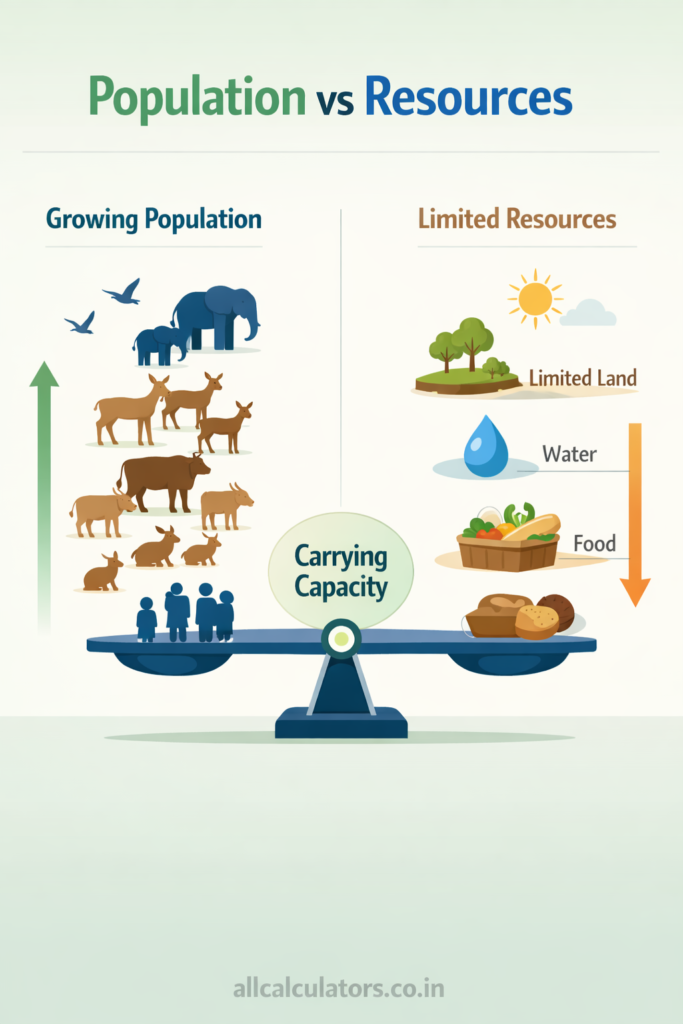
🌍 Every ecosystem has a threshold. Whether it’s a forest, a lake, or even a human city, resources such as food, water, space, and energy are finite. The carrying capacity represents the point at which the population stabilizes because resource consumption equals resource availability. When population exceeds this threshold, consequences such as resource depletion, environmental degradation, and population decline occur.
🔬 What is Carrying Capacity? (Scientific Definition)
Carrying capacity (K) is defined as the maximum population size of a given species that a specific environment can sustainably support over an extended period, given the available resources — including food, water, space, light, and shelter — without causing long-term degradation of the habitat. First formally introduced into scientific literature in the 19th century and popularized by Eugene Odum’s landmark 1953 ecology textbook, carrying capacity has since become one of the most foundational concepts in biology, environmental science, conservation biology, wildlife management, fisheries science, and even urban planning. The letter “K” itself is derived from the German word “Kapazitätsgrenze,” which literally translates to “capacity limit” — a reflection of the German roots of early ecological mathematics.
📊 The concept is most commonly modeled using the logistic growth equation, which describes how populations grow rapidly when resources are abundant but slow down as they approach carrying capacity:
👉 dN/dt = rN (1 – N/K)
Where:
- N = population size
- r = intrinsic growth rate
- K = carrying capacity
⚙️ The Carrying Capacity Calculator simplifies this complex equation into an easy-to-use online tool. By inputting variables such as current population size, growth rate, and environmental limits, users can instantly determine the sustainable population level.
📐 The Logistic Growth Model & the Carrying Capacity Formula
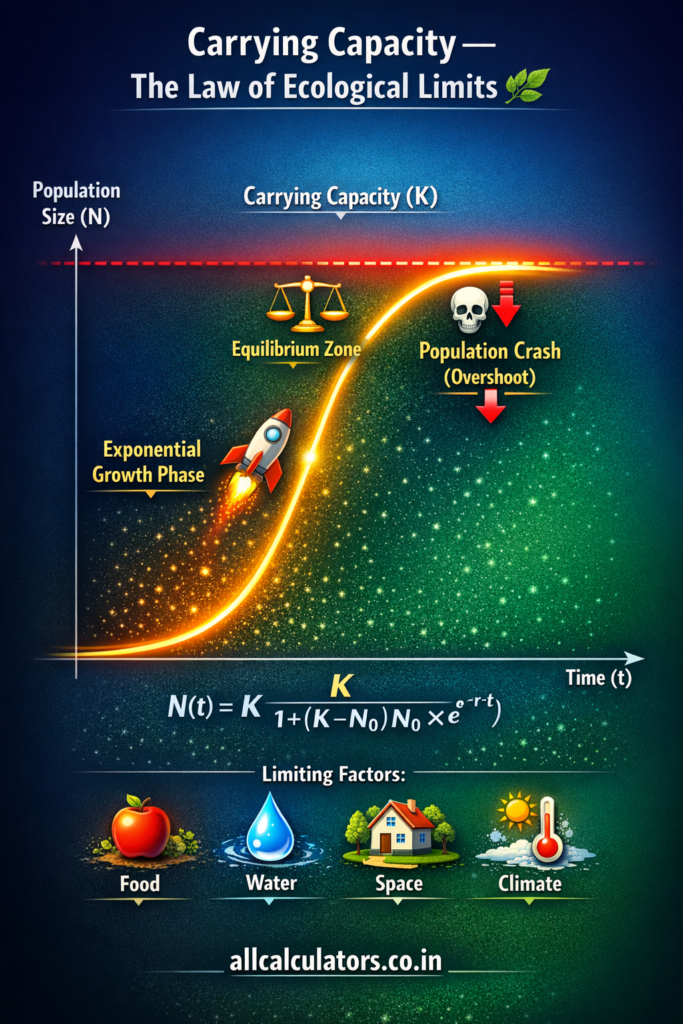
The mathematical heart of carrying capacity lies in the logistic growth equation, originally developed by the Belgian mathematician Pierre-François Verhulst in 1838 and later refined by Raymond Pearl and Lowell Reed in 1920 for human population studies. The logistic growth model is expressed as:
N(t) = K / [1 + ((K − N₀) / N₀) × e^(−r × t)]
Where: ✅ N(t) = Population size at time t
✅ K = Carrying capacity (maximum sustainable population)
✅ N₀ = Initial population at time zero
✅ r = Intrinsic (natural) growth rate of the population
✅ t = Time elapsed
✅ e = Euler’s number (≈ 2.71828)
The elegance of this formula is that it beautifully captures the S-shaped (sigmoid) population growth curve that we observe in nature. In the early stages, when the population is far below K, growth is rapid and nearly exponential — there are abundant resources for every individual. But as the population grows and resources become scarcer, competition intensifies, birth rates decline, and death rates rise. Growth slows dramatically until the population finally plateaus and stabilizes right around K. This point of equilibrium is where births equal deaths — the population neither grows nor shrinks, assuming stable environmental conditions.
🔁 What Happens When Populations Exceed Carrying Capacity?
One of the most critical insights from carrying capacity theory is understanding the consequences of overshoot. When a population temporarily exceeds its carrying capacity — driven by sudden resource availability, migration bursts, or disruption of predator-prey dynamics — the environment cannot sustain the excess numbers. Resources are consumed faster than they can regenerate. This leads to a population crash: increased mortality, reduced fertility, starvation, and disease. Classic examples in nature include the reindeer population on St. Matthew Island in Alaska, which grew explosively to nearly 6,000 animals in the 1960s before catastrophically crashing to fewer than 50 individuals due to overgrazing and vegetation destruction.
🌱 What are Limiting Factors that Determine Carrying Capacity?
Carrying capacity is not a fixed, permanent number — it can shift dramatically based on a wide range of biotic (living) and abiotic (non-living) limiting factors:
- 🍎 Food Availability — The most primary driver; insufficient food sources directly cap how many individuals can survive.
- 💧 Water Supply — Clean, accessible water is essential for survival and reproduction.
- 🏠 Habitat & Space — Overcrowding leads to stress, disease transmission, and territorial conflict.
- 🌡️ Climate & Temperature — Seasonal changes and long-term climate shifts can increase or decrease resource availability.
- 🐺 Predation & Competition — Natural predators regulate prey populations; interspecies competition further limits resources.
- 🦠 Disease & Parasites — Higher population density accelerates the spread of infections, effectively reducing K.
- ☠️ Human Interference — Deforestation, pollution, habitat fragmentation, and overexploitation can dramatically lower the carrying capacity of ecosystems.
Conversely, technological innovation, habitat restoration, and sustainable resource management can raise the effective carrying capacity for human populations — explaining why Earth’s human population has grown from 1 billion in 1800 to over 8.2 billion in 2025 without the widespread Malthusian collapse that 18th-century theorist Thomas Malthus famously predicted.
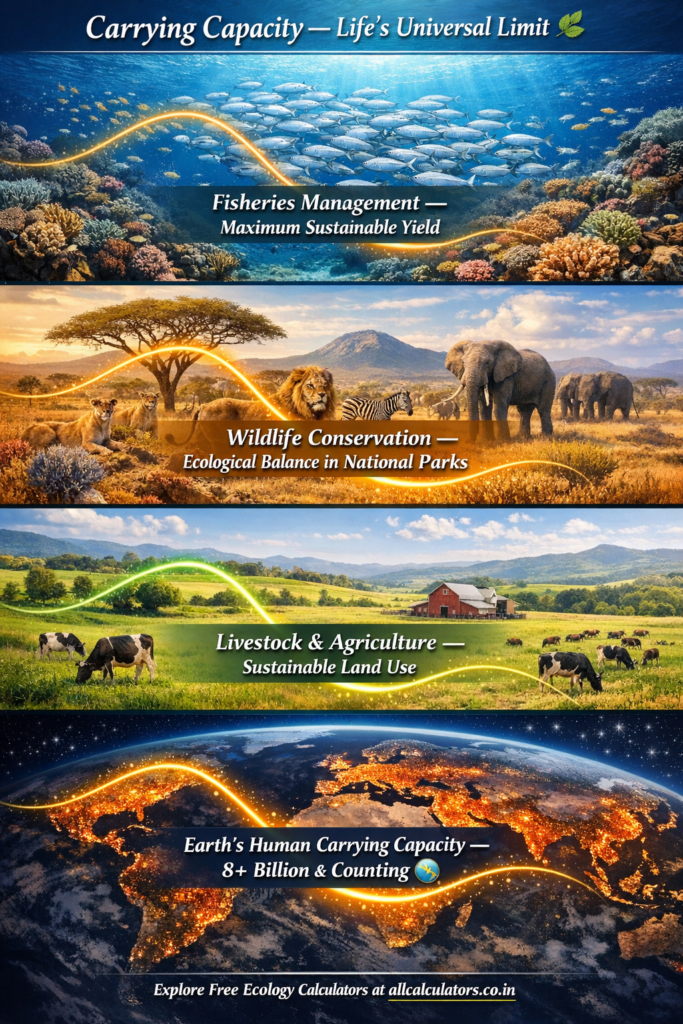
🚀 This calculator is extremely useful for:
- Students solving biology or ecology problems
- Researchers analyzing ecosystems
- Environmental planners assessing sustainability
- Farmers and resource managers optimizing yields
🌿 In real-world scenarios, carrying capacity is not fixed—it changes over time due to:
- Climate change 🌡️
- Resource availability 💧
- Technological advancements ⚙️
- Human activity 🏙️
For example, advancements in agriculture can temporarily increase the carrying capacity of land, while pollution or deforestation can drastically reduce it.
📉 When a population overshoots its carrying capacity, it often leads to a population crash. This is commonly observed in wildlife populations, where rapid growth is followed by sharp declines due to starvation or disease.
💡 On the other hand, maintaining population levels close to carrying capacity ensures sustainable development, which is crucial for long-term environmental health.
🔬 In population biology, carrying capacity is used to:
- Predict species survival
- Model ecosystem dynamics
- Analyze predator-prey relationships
🌎 In human contexts, it helps answer critical questions like:
- How many people can a city support?
- What is the sustainable population of Earth?
- How can resources be managed efficiently?
📈 The calculator works by applying scientific formulas and eliminating manual calculation errors, making it ideal for both academic and practical use.
🎯 With increasing global concerns about sustainability, climate change, and resource scarcity, understanding carrying capacity is more important than ever. This tool empowers users to make data-driven decisions and gain deeper insights into ecological balance.
✨ Whether you’re a student preparing for exams, a teacher explaining concepts, or an environmental enthusiast, the Carrying Capacity Calculator provides accurate, instant, and reliable results.
🌐 Carrying Capacity Beyond the Classroom — A Global Perspective
The concept of carrying capacity has transcended laboratory experiments and classroom textbooks to become a vital tool in some of the world’s most pressing environmental challenges. In 2025, humanity’s ecological footprint demands approximately 1.8 times the Earth’s annual regenerative capacity — meaning we are consuming resources faster than the planet can replenish them. Earth Overshoot Day 2025 fell on July 24, a sobering reminder that human civilization is, by multiple ecological metrics, operating beyond Earth’s carrying capacity. Understanding this concept — from the microscopic to the planetary scale — is not just an academic exercise; it is an urgent necessity for every conscious citizen of our shared planet.
Our Carrying Capacity Calculator is built on verified scientific formulas, designed for speed, accuracy, and ease — making it the ideal tool for students, educators, researchers, wildlife conservationists, urban planners, and eco-enthusiasts worldwide. 🌿🔬📈
🌍 Applications in Daily Life
🌱 Environmental Planning & Sustainability
Helps governments and planners determine the maximum sustainable population in cities and regions using carrying capacity calculations.
🏙️ Urban Development
Used in smart city planning to avoid overcrowding and ensure sufficient water, food, and infrastructure.
🚜 Agriculture & Farming
Farmers use carrying capacity concepts to decide how many crops or livestock their land can support without degrading soil quality.
🐄 Wildlife Conservation
Ecologists calculate carrying capacity to protect endangered species and maintain ecosystem balance.
📚 Education & Exams
Students use the carrying capacity calculator to solve biology and ecology problems quickly and accurately.
🌊 Resource Management
Helps industries manage resources like fisheries, forests, and water bodies sustainably.
🌡️ Climate Change Analysis
Used to assess how environmental changes impact the ability of ecosystems to support populations.
⚠️ Disclaimer 📢
⚠️ This Carrying Capacity Calculator provides estimated results based on standard ecological formulas and user inputs. Actual carrying capacity may vary due to dynamic environmental factors such as climate change, resource fluctuations, and human intervention.
📊 The tool is intended for educational, academic, and informational purposes only and should not be used as a sole basis for scientific research, policy-making, or environmental planning decisions.
🔍 Always consult professional ecologists or domain experts for critical analysis and real-world implementation.
📌 Related Calculator
❓ FAQs Section 📚
❓ What is carrying capacity in ecology? 🌱
Carrying capacity is the maximum population size that an environment can sustain indefinitely without exhausting its resources.
❓ What is the formula for carrying capacity? 📊
The carrying capacity is represented in the logistic growth equation as K, where population growth slows as it approaches this limit.
❓ How does a carrying capacity calculator work? ⚙️
It uses ecological formulas like the logistic growth model to calculate sustainable population levels based on user inputs.
❓ Why is carrying capacity important? 🌍
It helps prevent overpopulation, resource depletion, and environmental degradation by maintaining ecological balance.
❓ Can carrying capacity change over time? 🔄
Yes, factors like climate change, technology, and resource availability can increase or decrease carrying capacity.