
⚓ Buoyancy Calculator 🌊
F = ρ × V × g
Where:
ρ = Density of Fluid (kg/m3)
V = Volume of Displaced Fluid (m3)
g = Acceleration due to Gravity (m/s2)
Table of Contents
✍️ Author & Academic Authority: Dr. Nitish Kr. Bharadwaj
📘 Qualifications: B.Sc., B.Ed., M.Sc., Ph.D. (Biochemistry), MBA (Financial Management)
🌊 Buoyancy Calculator – Introduction
Instantly Calculate Buoyant Force Using Archimedes’ Principle ⚖️
Understanding buoyancy is one of the most fascinating concepts in physics. Whether you observe a massive ship floating on the ocean 🚢 or a tiny bubble rising through water 💧, the principle behind these phenomena is called buoyant force. The Buoyancy Calculator on this page helps students, engineers, researchers, and physics enthusiasts quickly determine the buoyant force acting on an object immersed in a fluid using the well-known Archimedes’ Principle.
Buoyancy is the upward force exerted by a fluid (liquid or gas) that opposes the weight of an object submerged in it. This force determines whether an object floats, sinks, or remains neutrally buoyant. The concept was first explained by the ancient Greek scientist Archimedes, who discovered that the buoyant force acting on an object is equal to the weight of the fluid displaced by that object.
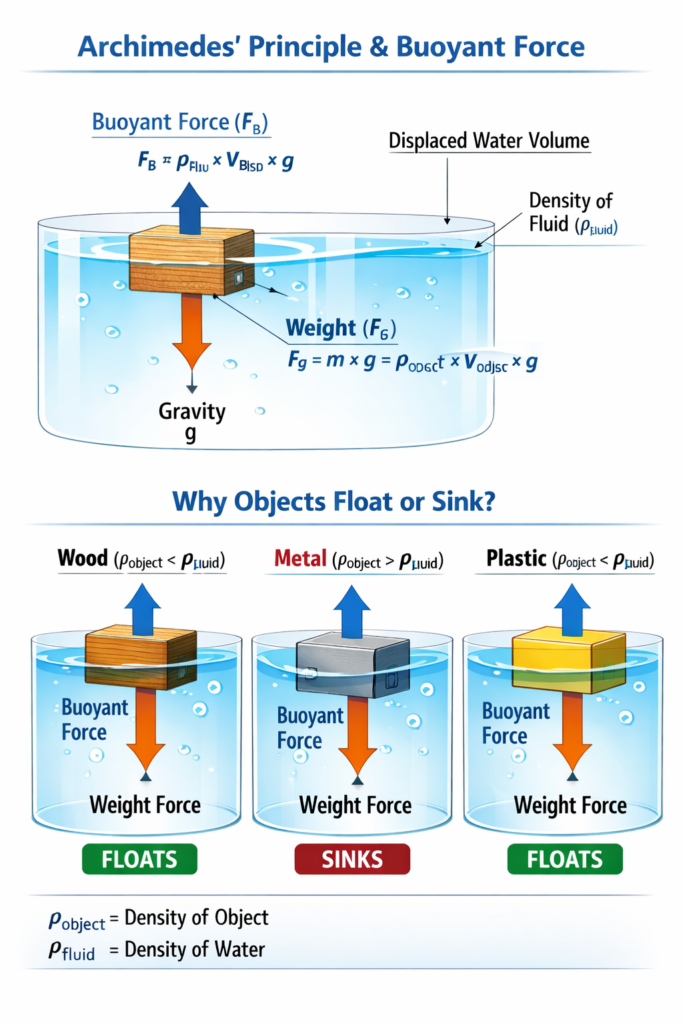
Mathematically, buoyant force is expressed using the following formula: Buoyant Force (Fb) = ρ × g × V
Where:
ρ = Density of the fluid
g = Acceleration due to gravity
V = Volume of displaced fluid
Using this Buoyancy Calculator, you can easily compute the buoyant force by entering values for fluid density, gravitational acceleration, and displaced volume. Instead of manually solving physics equations, this tool performs instant calculations, making it extremely helpful for students preparing for physics exams, engineering calculations, and real-world applications.
🔬 Why Use an Online Buoyancy Calculator?
Manual calculations can sometimes be confusing or time-consuming, especially when working with large numbers or multiple variables. An online buoyant force calculator simplifies the process by providing accurate results instantly. It reduces human error and allows students to focus more on understanding the physical concepts rather than complex arithmetic.
This calculator is particularly useful for:
📚 Physics students solving numerical problems
🧑🏫 Teachers explaining Archimedes’ principle
⚙️ Engineers analyzing fluid mechanics
🧪 Researchers studying density and fluid behavior
🚢 Marine designers calculating floating stability
The Buoyancy Calculator automatically implements the buoyancy equation and returns precise results based on your inputs. This makes it an excellent educational tool for high school, college physics, engineering, and competitive exams like JEE, NEET, and other technical entrance tests.
⚖️ Understanding the Physics of Buoyancy
Buoyancy occurs because fluid pressure increases with depth. The bottom of a submerged object experiences higher pressure than the top. This difference in pressure creates an upward force that pushes the object upward.
When an object is placed in a fluid, three outcomes are possible:
✔ Object floats – Buoyant force is greater than weight
✔ Object sinks – Weight is greater than buoyant force
✔ Neutral buoyancy – Both forces are equal
For example, large ships float because their average density is lower than the density of water. Even though ships are made of steel, their structure contains large hollow spaces filled with air, reducing overall density.
Similarly, submarines control buoyancy using ballast tanks. By filling tanks with water or air, submarines can sink or rise in the ocean.
🧠 Importance of Buoyancy in Physics and Engineering
Buoyancy plays a crucial role in many scientific and engineering fields. In fluid mechanics, it helps engineers design ships, submarines, and offshore structures. In aerospace engineering, buoyancy explains how hot air balloons and airships rise in the atmosphere.
Environmental scientists also rely on buoyancy principles to understand ocean currents, floating debris movement, and underwater exploration.
Medical technology even applies buoyancy in hydrotherapy treatments, where patients exercise in water to reduce stress on joints and muscles.
🚀 Benefits of Using This Buoyancy Calculator
The Buoyancy Calculator on this website offers several advantages:
⚡ Instant and accurate results
📱 Mobile-friendly online calculator
🎓 Perfect for physics students and teachers
📊 Eliminates complex manual calculations
🔍 Helps understand Archimedes’ Principle easily
🧮 Supports learning in fluid mechanics and density concepts
Instead of memorizing complicated formulas, users can focus on understanding the relationship between density, volume displacement, and buoyant force.
📘 Example Calculation
Suppose an object displaces 0.02 m³ of water.
Density of water = 1000 kg/m³
Gravity = 9.81 m/s²
Buoyant Force:
Fb = 1000 × 9.81 × 0.02
Fb = 196.2 Newtons
This means the object experiences an upward force of 196.2 N due to the surrounding fluid.
Using this online buoyancy calculator, the same result can be obtained instantly without performing manual multiplication.
🌍 Applications in Daily Life
🚢 Ship and Boat Design: Engineers rely on buoyancy calculations to ensure ships remain stable and float safely. The buoyant force must balance the vessel’s weight.
🎈 Hot Air Balloons: Hot air balloons float because heated air inside the balloon is less dense than surrounding air, creating upward buoyant force.
🧑⚕️ Hydrotherapy & Swimming: Water buoyancy reduces body weight stress, making swimming and aquatic therapy ideal for injury recovery.
🌊 Ocean Exploration: Researchers use buoyancy principles to design floating sensors, underwater vehicles, and scientific equipment.
🛢 Oil Industry: Buoyancy calculations help determine how oil platforms and floating rigs remain stable in the ocean.
⚠️ Disclaimer
The Buoyancy Calculator available on this website is designed primarily for educational and informational purposes. While the calculator uses scientifically accurate formulas based on Archimedes’ Principle, results should be considered approximate estimations.
📘 This tool is intended to assist students, educators, and learners in understanding buoyant force, fluid density, and displacement calculations.
🔬 For engineering projects, marine design, industrial applications, or safety-critical calculations, users should consult qualified professionals or verified engineering software.
By using this calculator, users acknowledge that allcalculators.co.in is not responsible for decisions made based on the results provided.
📌 Related Calculator
❓FAQs
❓ What is buoyancy in physics?
Buoyancy is the upward force exerted by a fluid on an object immersed in it. This force opposes the object's weight and determines whether it floats or sinks.
❓ What is the formula for buoyant force?
The buoyant force formula is: Fb = ρ × g × V; Where density of fluid, gravity, and displaced volume determine the upward force.
❓ What does the Buoyancy Calculator calculate?
The Buoyancy Calculator calculates the upward buoyant force acting on an object in a fluid using Archimedes’ principle.
❓ Why do ships float even though they are heavy?
Ships float because their average density is lower than the density of water, allowing buoyant force to support their weight.
❓ What factors affect buoyancy?
Buoyancy depends mainly on:
• Density of the fluid
• Volume of displaced fluid
• Acceleration due to gravity