
🐞🔩 Bug-Rivet Paradox Calculator
Instantly Solve Special Relativity Causality Problems using Lorentz Transformation
✍️ Author & Academic Authority: Dr. Nitish Kr. Bharadwaj
📘 Qualifications: B.Sc., B.Ed., M.Sc., Ph.D. (Biochemistry), MBA (Financial Management)
🐞🔩 Bug-Rivet Paradox Calculator – Master Special Relativity with Scientific Precision
The Bug-Rivet Paradox 🐞🔩 is one of the most fascinating thought experiments in Einstein’s Special Relativity theory. It beautifully demonstrates how simultaneity, length contraction, and causality behave differently depending on the observer’s frame of reference. For physics students preparing for competitive exams, engineering courses, or advanced conceptual understanding, mastering this paradox is essential.
At its core, the paradox involves a fast-moving rod and a rivet aimed at compressing it. A bug 🐞 sitting at the far end of the rod faces a dramatic fate depending on the observer’s perspective. In the rest frame of the rivet, the rod undergoes Lorentz length contraction, making it shorter. However, in the rod’s frame, the rivet itself is contracted. This leads to an apparent contradiction — will the bug survive or be crushed?
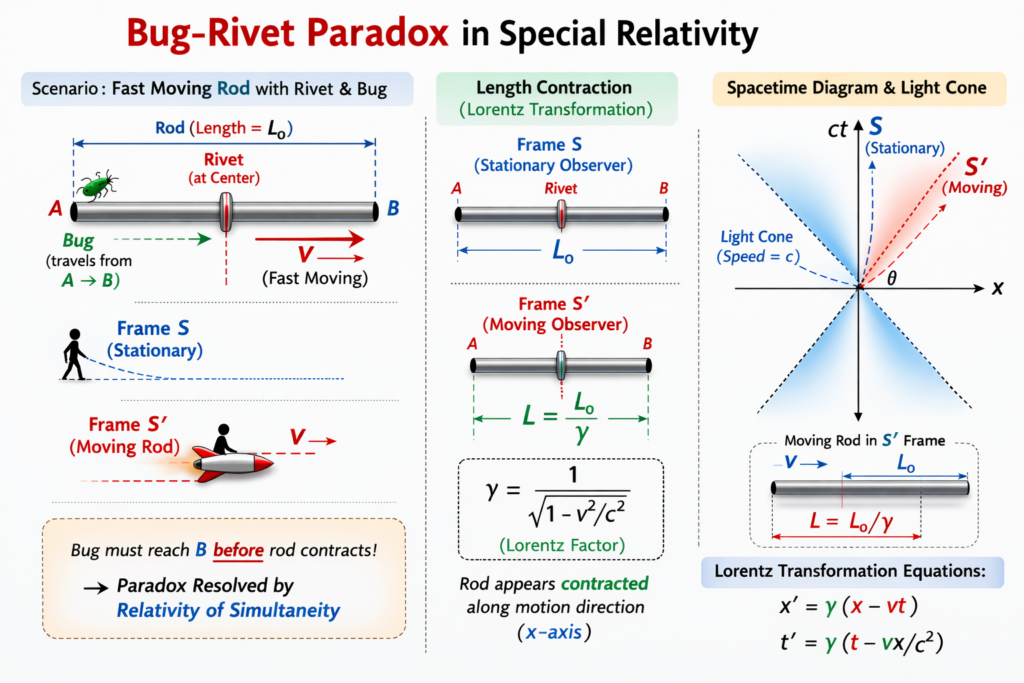
The key to resolving the Bug-Rivet Paradox lies in understanding the Lorentz Transformation equations and the relativity of simultaneity. The paradox is not a contradiction of physics laws but a demonstration of how different observers measure space and time differently when relative velocities approach the speed of light (c = 3.00 × 10⁸ m/s).
🔬 The Lorentz factor (γ) is given by: γ = 1 / √(1 − v²/c²)
This factor determines:
- 📏 Length contraction
- ⏳ Time dilation
- ⚡ Relativistic momentum
- 💡 Causality preservation
When velocity increases toward the speed of light, γ increases dramatically. For example, at 0.90c, γ ≈ 2.29. This means measurable contraction becomes significant.
This Bug-Rivet Paradox Calculator simplifies complex relativistic mathematics into student-friendly scientific notation format like: 1.23 × 10⁵; instead of confusing decimal expansions.
🎯 Why This Calculator is Important for Students:
• Eliminates calculation errors
• Uses exact exponent format
• Shows Lorentz factor clearly
• Displays equations step-by-step
• Perfect for exam preparation
• Supports conceptual learning
The paradox reinforces a deeper principle: Causality is never violated in relativity. Although observers disagree on simultaneity, no information travels faster than light. Therefore, the bug’s fate remains consistent across frames once full relativistic analysis is applied.
Understanding this paradox strengthens comprehension of:
• Special Relativity
• Frame of reference
• Space-time intervals
• Minkowski spacetime
• Causal structure of physics
Modern applications of relativistic principles include:
🚀 Particle accelerators
🛰️ GPS satellite corrections
⚛️ High-energy physics experiments
🌌 Astrophysical jet modeling
By using this calculator, students can visually understand how relativistic contraction changes physical dimensions at high velocities.
🌍Applications in Daily Life
Even though the Bug-Rivet Paradox is theoretical, its principles power real-world technologies:
🚗 GPS Systems – Satellite clocks adjust for time dilation
✈️ High-speed aviation physics
🔭 Astrophysics research
⚛️ Nuclear particle experiments
📡 Space communication systems
Special relativity ensures accurate global positioning and space navigation.
⚠️ Disclaimer
This Bug-Rivet Paradox Calculator is designed for educational and academic purposes only 📚. While every effort has been made to ensure mathematical accuracy using relativistic physics formulas, users are advised to cross-verify results for research-level applications. This tool simplifies complex relativistic mechanics concepts and does not replace advanced tensor-based relativity calculations. Always consult academic references when performing high-precision scientific analysis.
❓ FAQs
1️⃣ What is the Bug-Rivet Paradox in physics?
It is a thought experiment in special relativity illustrating length contraction and simultaneity differences.
2️⃣ Does this paradox violate causality?
No. Relativity strictly preserves causality.
3️⃣ Why use scientific notation?
Because relativistic quantities can become extremely large or small.
4️⃣ What is Lorentz factor (γ)?
It quantifies relativistic effects at high velocity.
5️⃣ Can velocity exceed speed of light?
No. According to Einstein’s theory, nothing with mass can exceed c.