
🧬 Antibiotic Resistance Calculator
🧫 MIC Breakpoint & Susceptibility Analyzer
📐 Formula Used
R = MICtest / Breakpointreference
MIC Value
Minimum Inhibitory Concentration
S – I – R
Susceptible / Intermediate / Resistant
CFU/mL
Colony Forming Units per mL
💡 Typical MIC range: 0.001 – 512 μg/mL
💡 Standard test inoculum: 5 × 10⁵ CFU/mL
| Category | Symbol | MIC Range | Meaning |
|---|---|---|---|
| Susceptible | S | ≤ breakpoint | Treatment likely effective ✅ |
| Intermediate | I | = breakpoint | Marginal efficacy ⚠️ |
| Resistant | R | > breakpoint | Treatment likely failed ❌ |
Table of Contents
✍️ Author & Academic Authority: Dr. Nitish Kr. Bharadwaj
📘 Qualifications: B.Sc., B.Ed., M.Sc., Ph.D. (Biochemistry), MBA (Financial Management)
🧬 Antibiotic Resistance Calculator
Your Ultimate Free Tool to Understand & Calculate Antimicrobial Resistance (AMR)
🦠 Antibiotic resistance is one of the most alarming and rapidly escalating public health crises of the 21st century. Whether you are a microbiology student trying to understand the science behind bacterial resistance, a medical professional evaluating antimicrobial susceptibility test (AST) results, or a researcher working on next-generation antibiotics, our free online Antibiotic Resistance Calculator is built precisely for you! 💊🔬 This powerful tool bridges the gap between complex laboratory science and real-world application — helping you compute resistance indicators with speed, accuracy, and clarity.
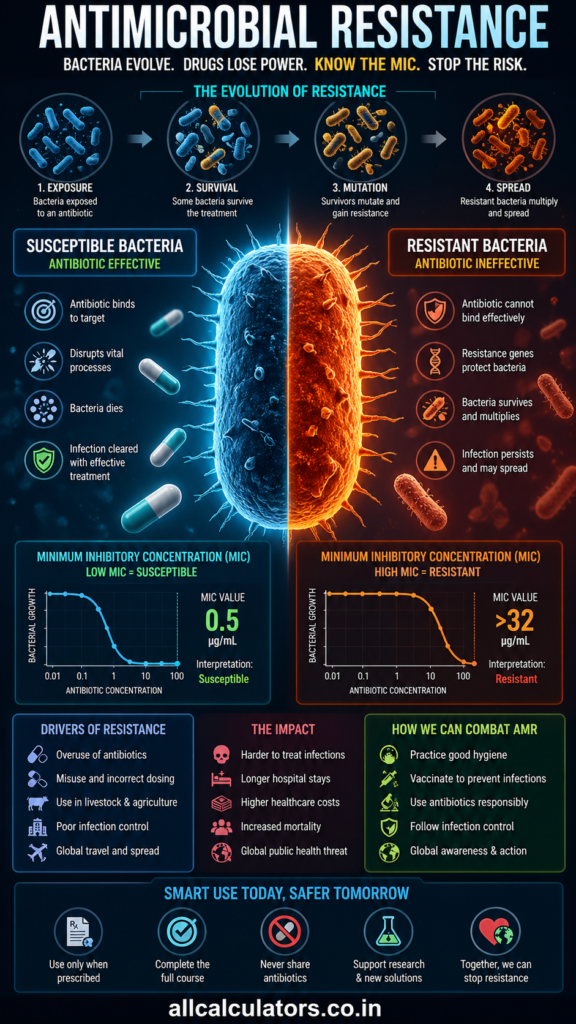
🔎 But what exactly is antibiotic resistance, and why does calculating it matter so much? Antibiotic resistance — formally known as Antimicrobial Resistance (AMR) — occurs when bacteria evolve and develop the ability to survive and continue growing even in the presence of antibiotic drugs that were once effective against them. This happens through various mechanisms: bacteria can produce enzymes (like beta-lactamases) that break down antibiotic molecules, they can develop efflux pumps that actively push antibiotics out of their cells, they can alter their cell wall permeability, or they can simply mutate the specific target site of the drug so the antibiotic can no longer bind to it. 🧫⚗️ The result? Infections become harder, sometimes impossible, to treat — leading to prolonged illnesses, extended hospital stays, increased medical costs, and tragically, preventable deaths.
📊 At the core of measuring antibiotic resistance in clinical and research microbiology is a critical value called the Minimum Inhibitory Concentration (MIC) — the lowest concentration of an antibiotic that is required to inhibit the visible growth of a bacterial organism under standardized in-vitro conditions. MIC values are measured in micrograms per milliliter (µg/mL or mg/L) and serve as the gold-standard measurement of antibiotic activity. A lower MIC value indicates that a drug is more potent and effective — meaning less of the drug is needed to stop bacterial growth. 📉 Conversely, a higher MIC value signals that bacteria are less susceptible and may be developing or expressing resistance.
🏥 In clinical practice, MIC values are compared against established clinical breakpoints — standardized concentration thresholds defined by globally recognized bodies like the Clinical and Laboratory Standards Institute (CLSI) and the European Committee on Antimicrobial Susceptibility Testing (EUCAST). Based on this comparison, a bacterial isolate is classified into one of three critical categories: Susceptible (S), Intermediate (I), or Resistant (R). These SIR classifications guide physicians and healthcare professionals in selecting the most appropriate antibiotic treatment for a patient’s specific infection. Our Antibiotic Resistance Calculator makes this comparison instant and effortless! ✅🩺
🧪 AMR is not just a clinical problem — it is a monumental scientific, ecological, and societal challenge. According to the WHO Global Antibiotic Resistance Surveillance Report 2025, resistance trends for critical antibiotic-bacteria combinations have worsened significantly between 2018 and 2023. 📈 Superbugs like MRSA (Methicillin-Resistant Staphylococcus aureus), VRSA (Vancomycin-Resistant Staphylococcus aureus), carbapenem-resistant Klebsiella pneumoniae, and multi-drug resistant (MDR) Gram-negative bacteria are spreading globally, threatening the very foundation of modern medicine. Even routine surgical procedures, cancer chemotherapy, and organ transplantations — all of which depend on working antibiotics — are at serious risk. 🌍⚠️
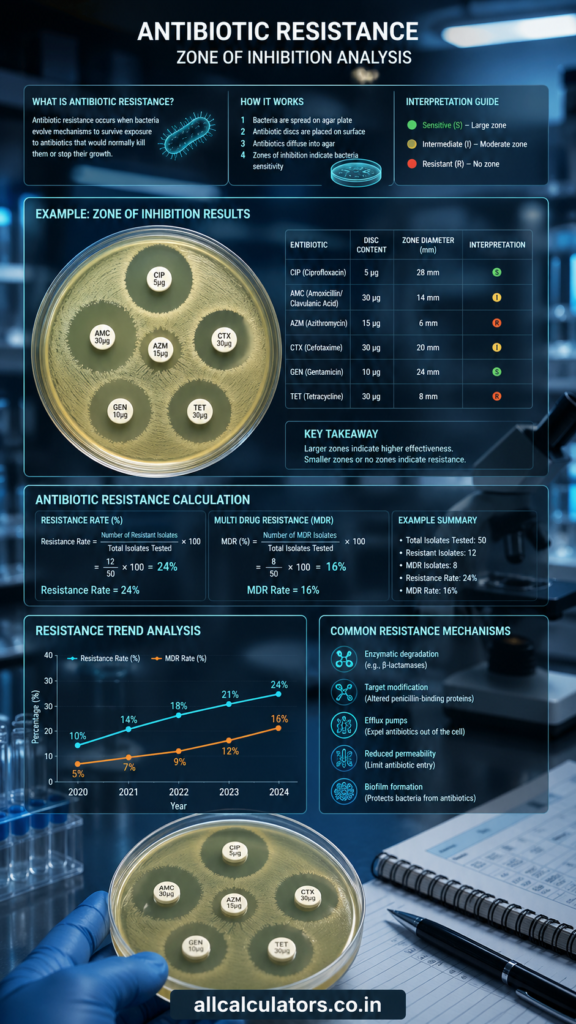
🎓 For microbiology and biology students, understanding and calculating antibiotic resistance is a fundamental academic requirement. Whether you are studying the Kirby-Bauer disk diffusion test, computing inhibition zone diameters, analyzing broth microdilution results, or preparing for competitive exams in pharmacology and medical microbiology, our calculator simplifies complex AMR formulas into clean, step-by-step outputs. 📐✏️ You can use it to calculate resistance indices, analyze dose-response relationships, and even interpret susceptibility categories as per the latest CLSI/EUCAST 2025 breakpoints.
🔬 For researchers and laboratory scientists, the calculator supports rapid analysis of MBC (Minimum Bactericidal Concentration), MBEC (Minimum Biofilm Eradication Concentration), and multiple antibiotic resistance (MAR) index computations — all without needing complex software or manual lookup tables. 🖥️💡 The MAR index, which ranges from 0 to 1, is especially useful for epidemiological studies: a MAR index greater than 0.2 indicates that the bacterial strain originates from high-risk environments with regular antibiotic use and exposure.
⚡ Our Antibiotic Resistance Calculator at AllCalculators.co.in is 100% free, browser-based, and works across all devices — mobile 📱, tablet, and desktop 🖥️. No downloads, no sign-ups, no complexity. Just input your laboratory values and get instant, accurate resistance classification and scoring. It is designed with intuitive UI for students, educators, lab technicians, pharmacists, and healthcare professionals worldwide. 🌐
💡 Whether you are calculating MIC for E. coli susceptibility to ciprofloxacin, determining MRSA resistance levels, or studying biofilm-associated resistance patterns for your research paper — this is the smartest, fastest, and most reliable antibiotic resistance calculation tool available online. Bookmark it today and make your microbiology studies and clinical evaluations smarter! 🔖🧬

🌍 Applications in Human Daily Life
🏥 Clinical Medicine & Hospital Care — Doctors use antibiotic resistance calculations to choose the right drug for bacterial infections, avoiding ineffective treatments and reducing patient suffering. MIC values guide precise dosing decisions every single day in hospitals worldwide.
💊 Pharmacy & Drug Dispensing — Pharmacists apply AMR knowledge to counsel patients against self-medication with antibiotics, which is a leading driver of resistance. Understanding resistance scores helps ensure prescribed drugs actually work! 🧾
🎓 Student Education & Exam Prep — Biology, pharmacy, medical, and microbiology students use resistance calculators as quick study tools for computing MIC values, MAR index, and SIR classifications for their exams, lab practicals, and assignments. 📚✏️
🌾 Agriculture & Veterinary Medicine — AMR calculators help veterinarians and agricultural scientists monitor antibiotic use in livestock and poultry, reducing the risk of resistant bacteria spreading from animals to humans through the food chain. 🐄🐔
🔬 Medical Research & Drug Development — Scientists computing resistance indices for new antibiotic candidates depend on accurate AMR tools to evaluate drug efficacy, identify resistant strains, and publish valid research findings. 🧪📊
🦠 Infection Control & Epidemiology — Public health professionals use the MAR index and resistance trend data to map outbreaks of drug-resistant bacteria, design stewardship programs, and protect communities from superbug spread. 🗺️🛡️
🏫 Science Competitions & Projects — Students participating in biology Olympiads, science fairs, and school projects use AMR calculators to back their experiments with real computational data. 🏆

⚠️ Disclaimer 🧬
🔬 The Antibiotic Resistance Calculator on AllCalculators.co.in is designed strictly for educational, academic, and informational purposes only. 📚 All results generated by this tool — including MIC values, MAR index scores, resistance classifications, and susceptibility interpretations — are based on generalized scientific formulas and publicly available breakpoint references (CLSI / EUCAST guidelines). 🧪
🩺 This tool is NOT a substitute for professional clinical diagnosis, laboratory testing, or medical advice. Actual antibiotic susceptibility testing must be carried out in accredited clinical microbiology laboratories using standardized protocols and validated reagents. Always consult a qualified physician, microbiologist, or infectious disease specialist before making any treatment decisions. 👨⚕️👩🔬
💊 Never self-medicate or alter antibiotic therapy based solely on calculator results. Misuse and overuse of antibiotics is the leading cause of antibiotic resistance globally. Use antibiotics responsibly — always as prescribed by a licensed healthcare professional. 🌍🛡️
📌 AllCalculators.co.in holds no liability for any clinical, medical, or research decisions made based on outputs of this tool. Results should always be cross-verified with certified laboratory procedures and expert professional judgment. ✅
📌 Related Calculators
❓ FAQs
❓ What is an Antibiotic Resistance Calculator?
🧪 It is an online tool used to calculate antimicrobial resistance metrics like MIC, susceptibility, and resistance rates in microbiology.
❓ How is antibiotic resistance calculated?
📊 It is calculated using formulas involving bacterial counts, antibiotic concentration, and growth inhibition data.
❓ What is MIC in microbiology?
🦠 MIC (Minimum Inhibitory Concentration) is the lowest concentration of an antibiotic that prevents bacterial growth.
❓ Why is antimicrobial resistance important?
🌍 AMR is a global health concern because it makes infections harder to treat and increases medical risks.
❓ Who can use this calculator?
🎓 Students, researchers, microbiologists, and healthcare professionals can use this tool for accurate calculations.
Antibiotic resistance is one of the most alarming and rapidly escalating public health crises of the 21st century. Whether you are a microbiology student trying to understand the science behind bacterial resistance. https://t.co/PlUGXsgwQH pic.twitter.com/krRA6FOsVT
— AllCalculators (@allcalcs4u) April 27, 2026