
Last Updated: Loading…
🩸 Anion Gap Calculator
AG = Na+ − ( Cl− + HCO3− ) | Corrected AG = AG + 2.5 × (4.0 − Albumin)
Normal Range: 8–12 mEq/L (without K+) | 10–14 mEq/L (with K+)
| 🔢 Parameter | Symbol | Value (mEq · L−1) |
|---|
🌐 AllCalculators.co.in
Table of Contents
✍️ Author & Academic Authority: Dr. Nitish Kr. Bharadwaj
📘 Qualifications: B.Sc., B.Ed., M.Sc., Ph.D. (Biochemistry), MBA (Financial Management)
🩸 Anion Gap Calculator
Understand Your Blood’s Acid-Base Balance Instantly
Your blood is far more than a red liquid — it is a precisely engineered chemical ocean 🌊, teeming with electrically charged particles called ions. Among the most powerful diagnostic windows into that ocean is a simple but profoundly important calculation known as the Anion Gap (AG). The Anion Gap Calculator on this page empowers students, medical professionals, nursing aspirants, and health-conscious individuals to instantly compute this critical value, interpret its meaning, and understand what their body might be signaling about its internal chemistry. ⚗️
🔬 What is the Anion Gap?
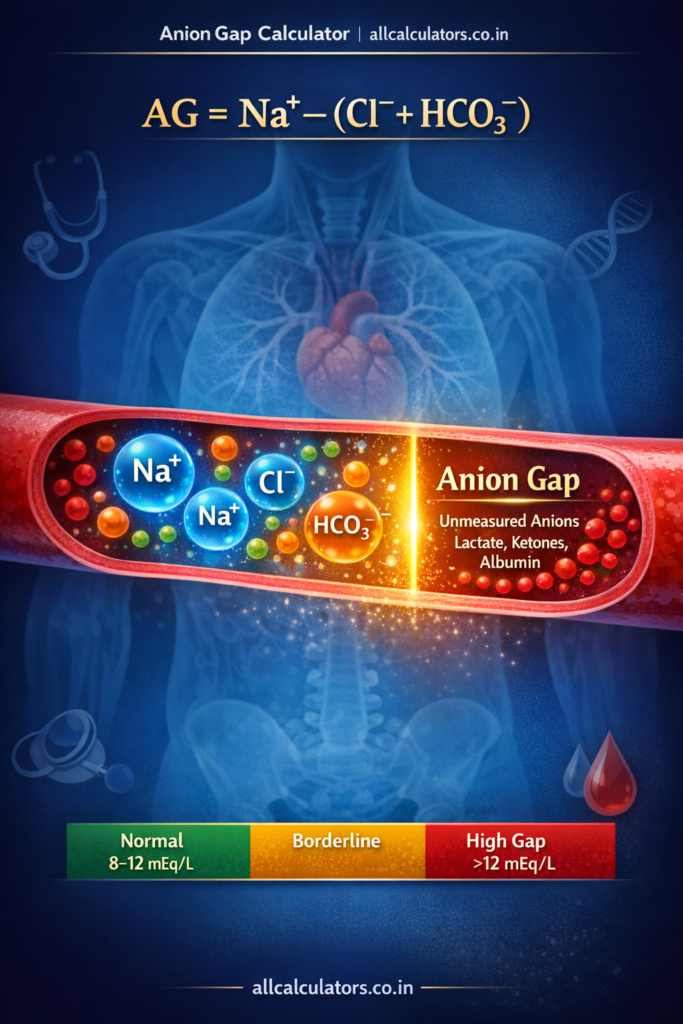
The anion gap is a mathematical expression of the difference between the primary measured cations (positively charged ions) and the primary measured anions (negatively charged ions) in blood serum or plasma. In simpler terms, it identifies the presence of “unmeasured” or “hidden” anions — negatively charged particles that standard electrolyte panels do not directly count. 🧪
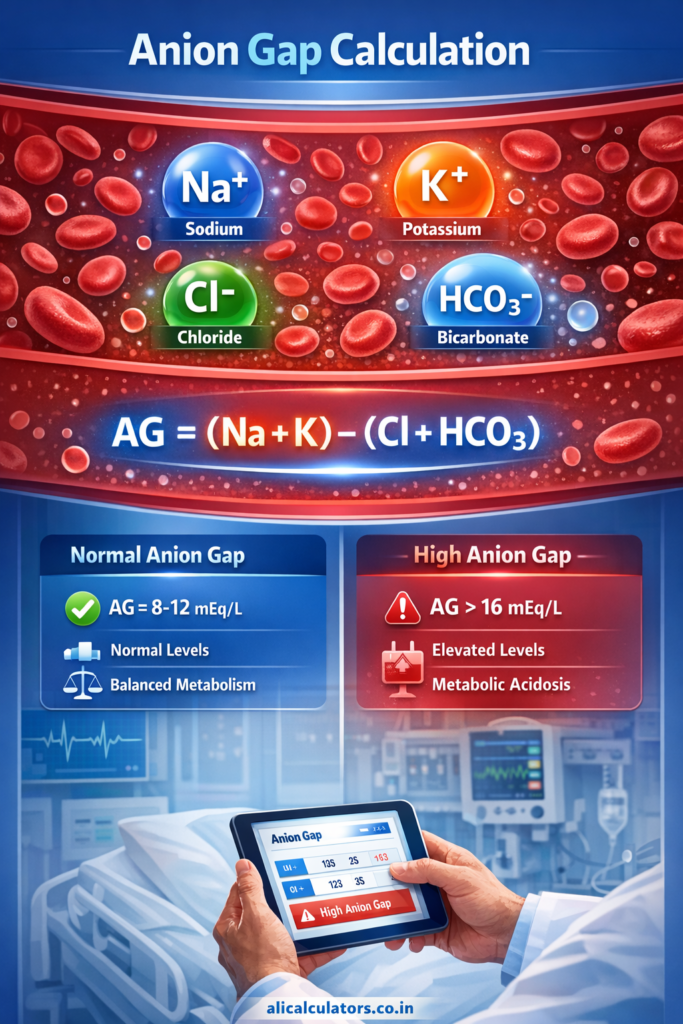
The most widely used formula for calculating the anion gap is: Anion Gap (AG) = Na⁺ − (Cl⁻ + HCO₃⁻)
Where:
- 🔵 Na⁺ = Serum Sodium (the dominant extracellular cation)
- 🟡 Cl⁻ = Serum Chloride (a measured anion)
- 🟢 HCO₃⁻ = Serum Bicarbonate (a measured anion and key acid-base buffer)
An alternate, less commonly used formula that also includes potassium is: AG = (Na⁺ + K⁺) − (Cl⁻ + HCO₃⁻)
Because potassium (K⁺) has a relatively small and stable contribution to the extracellular fluid, most clinicians — and this calculator — use the simplified three-variable formula for everyday clinical and educational purposes.
📊 What are Normal Anion Gap Values?
The reference ranges for the anion gap depend on which formula is used:
- ✅ Without Potassium: Normal AG = 8 to 12 mEq/L (some modern laboratories report 3–10 mEq/L)
- ✅ With Potassium: Normal AG = 12 to 16 mEq/L
These values represent the presence of unmeasured anions that naturally exist in healthy blood — primarily albumin (the most important contributor), along with phosphates, sulfates, and organic acids. When these values deviate significantly — either rising or falling — the body is sending a critical biochemical distress signal. 🚨
⚠️ High Anion Gap — What Does It Mean?
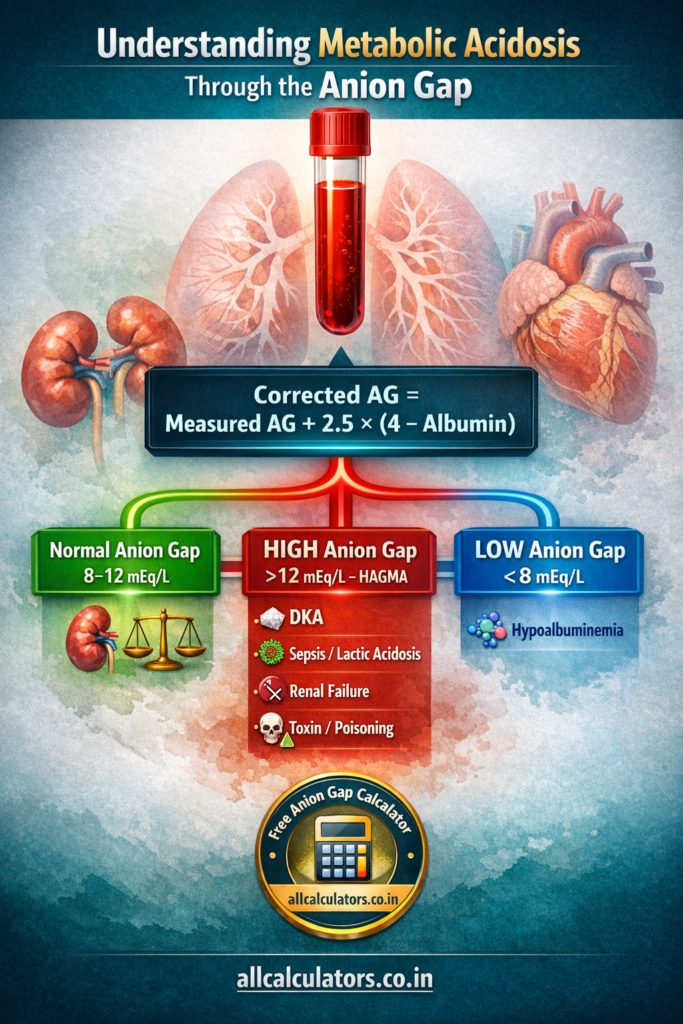
A high anion gap (generally above 12 mEq/L without potassium) signals high anion gap metabolic acidosis (HAGMA) — a condition where excess acid has accumulated in the bloodstream, consuming the bicarbonate buffer. The classic mnemonic GOLDMARK summarizes the major causes:
- 🧪 G — Glycols (Ethylene glycol / Propylene glycol poisoning)
- 🍬 O — Oxoproline (acetaminophen toxicity)
- 🥛 L — L-Lactate (lactic acidosis from sepsis, shock, hypoxia)
- 🦠 D — D-Lactate (short bowel syndrome)
- 🍺 M — Methanol (toxic alcohol ingestion)
- 💊 A — Aspirin/Salicylates (overdose)
- 🫁 R — Renal Failure (kidney failure → sulfate and phosphate buildup)
- 🍩 K — Ketoacidosis (diabetic DKA, alcoholic, starvation)
Of these, diabetic ketoacidosis (DKA), lactic acidosis, and renal failure are by far the most clinically common. In DKA, the body breaks down fat in the absence of sufficient insulin, generating ketone bodies (acetoacetate and beta-hydroxybutyrate) that flood the blood and drastically widen the anion gap. In lactic acidosis, oxygen deprivation — from septic shock, cardiac arrest, or severe hemorrhage — forces cells into anaerobic metabolism, producing massive quantities of lactate that overwhelm the body’s buffering systems. 💔
📉 Low Anion Gap — A Less Common But Equally Important Finding
While a low anion gap (below 8 mEq/L without potassium) is less frequently discussed, it carries its own diagnostic weight:
- 📉 Hypoalbuminemia (low albumin — seen in liver cirrhosis, nephrotic syndrome, malnutrition): This is the most common cause of a low or falsely normal anion gap, which is why albumin correction is so critical!
- 🔬 Multiple Myeloma (excess positively charged immunoglobulins narrow the gap)
- 💊 Bromide/Iodide poisoning (falsely elevates measured chloride)
- 🧪 Laboratory measurement errors
🧮 Albumin-Corrected Anion Gap — Why It Matters
Albumin is a negatively charged plasma protein that accounts for the majority of “normal” unmeasured anions. When a patient has low albumin (hypoalbuminemia), the measured anion gap may appear falsely normal — masking a potentially life-threatening high-anion-gap acidosis. This is especially dangerous in ICU patients, who frequently have low albumin. The correction formula is:
Corrected AG = Measured AG + 2.5 × (4.0 − Albumin [g/dL])
For example, a patient with a measured AG of 14 mEq/L and albumin of 2.0 g/dL has a corrected AG of: 14 + 2.5 × (4.0 − 2.0) = 14 + 5 = 19 mEq/L — a clearly elevated, clinically alarming value that would have been missed without correction! 😱
🔄 The Delta Ratio — Detecting Mixed Acid-Base Disorders
The anion gap becomes even more powerful when combined with the delta ratio (delta-delta), which compares the change in the anion gap to the change in bicarbonate: Delta Ratio = (AG − 12) ÷ (24 − HCO₃⁻)
- Delta < 0.4 → Hyperchloremic normal anion gap acidosis
- Delta 0.4–0.8 → Mixed HAGMA + normal AG acidosis
- Delta 1–2 → Pure HAGMA
- Delta > 2 → HAGMA + concurrent metabolic alkalosis
This nuanced analysis helps clinicians uncover mixed acid-base disorders that would otherwise be invisible. 🔍
🎓 Why Use the Anion Gap Calculator?
Whether you are a MBBS, BDS, or nursing student cramming for your biochemistry or pathophysiology exams 📚, a physician or emergency medicine resident quickly verifying a patient’s electrolyte results, or simply a curious, health-aware individual who just received a blood test report and wants to understand it better — this free online Anion Gap Calculator delivers instant, accurate results without complicated manual arithmetic. Simply enter the sodium, chloride, and bicarbonate values from your blood test report, and the calculator does the rest — providing a clear numerical result along with a reference-based interpretation. 🖥️✅
Understanding the anion gap is not merely academic: it is a gateway skill that bridges basic physiology with real-world critical care medicine, forming the foundation for understanding acid-base disorders, electrolyte imbalances, and the biochemical footprint of dozens of diseases. 🏥
🌍Applications in Daily Life
The anion gap calculator is not just a clinical tool—it has practical importance in everyday health awareness:
🏥 Medical Diagnosis – Helps doctors quickly detect metabolic acidosis using electrolyte imbalance data
📊 Lab Report Analysis – Individuals can better understand their blood test results
🧑⚕️ Student Learning Tool – Widely used in biology, nursing, and medical education
💉 Chronic Disease Monitoring – Useful for patients with diabetes or kidney disease
🚨 Emergency Situations – Critical in identifying poisoning or severe acidosis
📱 Health Awareness – Promotes proactive understanding of internal body chemistry
⚠️ Disclaimer
This Anion Gap Calculator is intended for educational and informational purposes only. It is not a substitute for professional medical advice, diagnosis, or treatment.
🩺 Always consult a qualified healthcare provider before making any medical decisions.
📉 Results may vary depending on lab standards and individual conditions.
🚫 Do not rely solely on this tool in emergency or critical situations.
📌 Related Calculator
❓ FAQs
❓ What is a normal anion gap value?
A normal anion gap typically ranges between 8–12 mEq/L (without potassium) and 12 ± 4 mEq/L (with potassium).
❓ What does a high anion gap mean?
A high anion gap indicates metabolic acidosis, often caused by conditions like diabetic ketoacidosis, kidney failure, or lactic acidosis.
❓ How do you calculate the anion gap?
The formula is: 👉 AG = Na⁺ − (Cl⁻ + HCO₃⁻) or 👉 AG = (Na⁺ + K⁺) − (Cl⁻ + HCO₃⁻).
❓ Why is the anion gap important?
It helps detect hidden metabolic disorders and evaluate acid-base balance in the body.
❓ Can the anion gap be low?
Yes, but it is rare. A low anion gap may result from low albumin levels or lab errors.