
⚡ Wheatstone Bridge Calculator
Rx = (R2 × R3) / R1
Table of Contents
✍️ Author & Academic Authority: Dr. Nitish Kr. Bharadwaj
📘 Qualifications: B.Sc., B.Ed., M.Sc., Ph.D. (Biochemistry), MBA (Financial Management)
⚡ Wheatstone Bridge Calculator-Introduction
Instantly Calculate Unknown Resistance in a Wheatstone Bridge Circuit 🔬
Electrical circuits form the backbone of modern electronics and electrical engineering. One of the most important and historically significant circuit configurations used for precise resistance measurement is the Wheatstone Bridge circuit. To simplify calculations and help students, engineers, and electronics enthusiasts solve resistance problems quickly, our Wheatstone Bridge Calculator provides an accurate and instant solution for determining the unknown resistance in a bridge circuit.
Whether you are studying physics, electrical engineering, electronics, or circuit analysis, this online Wheatstone Bridge Calculator allows you to calculate the unknown resistance using the classic Wheatstone Bridge formula within seconds.
🔎 What is a Wheatstone Bridge?
The Wheatstone Bridge is an electrical circuit used to precisely measure an unknown resistance by balancing two legs of a bridge circuit. The concept was originally developed by Samuel Hunter Christie in 1833 and later improved and popularized by Sir Charles Wheatstone in 1843, which is why the circuit is widely known as the Wheatstone Bridge.
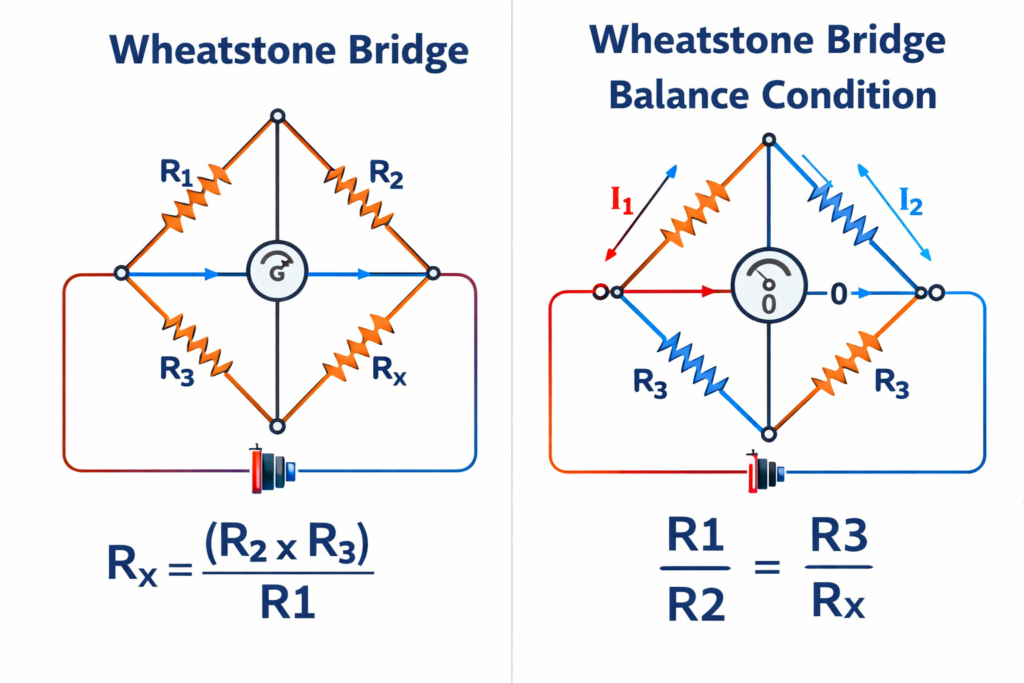
The circuit typically consists of four resistors arranged in a diamond shape, a voltage source, and a galvanometer. The bridge becomes balanced when the potential difference between two middle nodes becomes zero, meaning no current flows through the galvanometer.
This condition allows the unknown resistance to be calculated using a simple ratio equation.
⚙️ Wheatstone Bridge Formula
When the bridge is balanced, the relationship between the resistances is: R1 / R2 = R3 / Rx
Where:
- R1 = Known resistance
- R2 = Known resistance
- R3 = Known resistance
- Rx = Unknown resistance
Rearranging the equation gives: Rx = (R2 × R3) / R1
This formula forms the basis of the Wheatstone Bridge Calculator, allowing you to compute the unknown resistance instantly.
⚙️ Wheatstone Bridge Circuit Diagram
🧠 Why Use a Wheatstone Bridge Calculator?
Manual calculations can sometimes be time-consuming, especially when dealing with complex electrical circuits. Using an online Wheatstone Bridge resistance calculator offers several advantages:
✔ Instant calculation of unknown resistance
✔ Reduces human calculation errors
✔ Ideal for students solving physics assignments
✔ Useful for electrical engineers analyzing circuits
✔ Saves time in laboratory experiments
✔ Works on mobile and desktop devices
Instead of solving the formula manually every time, users can simply input the known resistor values and obtain the answer instantly.
🔬 How the Wheatstone Bridge Works
The Wheatstone Bridge works on the principle of null deflection. The circuit is arranged in a diamond configuration with four resistors.
The four arms are:
- R1 – First known resistor
- R2 – Second known resistor
- R3 – Third known resistor
- Rx – Unknown resistor
A galvanometer connects the midpoint between the resistors, and a power supply provides voltage.
When the bridge reaches equilibrium:
- The voltage difference across the galvanometer becomes zero.
- No current flows through the galvanometer.
- The ratio of resistances becomes equal.
This allows the unknown resistor to be determined with extremely high accuracy.
📐 Steps to Use the Wheatstone Bridge Calculator
Using the online Wheatstone Bridge calculator tool is simple:
1️⃣ Enter the value of R1 (known resistor)
2️⃣ Enter the value of R2
3️⃣ Enter the value of R3
4️⃣ Click the Calculate button
5️⃣ The calculator will instantly display the unknown resistance Rx
This tool eliminates the need for manual calculations and gives immediate results.
📊 Balanced vs Unbalanced Wheatstone Bridge
Balanced Wheatstone Bridge
The bridge is balanced when: R1 / R2 = R3 / Rx
Under this condition:
- No current flows through the galvanometer
- The bridge is in equilibrium
- The unknown resistance can be accurately determined
Unbalanced Wheatstone Bridge
If the ratios are not equal:
- Current flows through the galvanometer
- The bridge is unbalanced
- The unknown resistance cannot be calculated directly
The calculator assumes the balanced Wheatstone Bridge condition for accurate results.
🎓 Why Students and Engineers Use Wheatstone Bridge Calculators
The Wheatstone Bridge equation solver is commonly used in:
- Physics experiments
- Electrical engineering labs
- Sensor calibration
- Resistance measurement applications
Students preparing for exams such as JEE, NEET, engineering entrance tests, and university physics exams frequently encounter Wheatstone Bridge problems. This online physics calculator makes it easier to verify answers quickly.
⚡ Advantages of Wheatstone Bridge Circuits
The Wheatstone Bridge is widely used because of its high accuracy and sensitivity.
Key advantages include:
✔ Highly precise resistance measurement
✔ Detects extremely small resistance changes
✔ Works well in sensor applications
✔ Used in strain gauges and transducers
✔ Ideal for laboratory measurements
These features make the Wheatstone Bridge an essential circuit in electronics, instrumentation, and measurement systems.
🧮 Example Calculation
Suppose:
R1 = 100 Ω
R2 = 200 Ω
R3 = 50 Ω
Using the formula: Rx = (R2 × R3) / R1
Rx = (200 × 50) / 100
Rx = 100 Ω
The unknown resistance in the Wheatstone Bridge circuit is 100 ohms.
Our Wheatstone Bridge Calculator automatically performs this calculation instantly.
🔬 Applications in Daily Life ⚙️
Although the Wheatstone Bridge was originally developed for laboratory measurements, it is widely used in modern technology and everyday devices.
📏 Precision Resistance Measurement: Engineers use the Wheatstone Bridge resistance calculator concept to measure extremely small resistance values with high accuracy in electronic circuits.
🏗 Strain Gauge Sensors: Many industrial strain gauges use Wheatstone Bridge circuits to measure force, pressure, and deformation in bridges, buildings, and mechanical structures.
⚖ Digital Weight Scales: Electronic digital weighing machines use Wheatstone Bridge circuits with load cells to measure weight accurately.
🚗 Automotive Sensors: Modern vehicles use Wheatstone Bridge circuits in sensors such as:
- Pressure sensors
- Temperature sensors
- Fuel level sensors
🏥 Medical Equipment: Medical devices such as blood pressure monitors and biomedical sensors use Wheatstone Bridge configurations to detect tiny electrical changes.
🌡 Temperature Measurement: Temperature sensors like RTDs (Resistance Temperature Detectors) often use Wheatstone Bridge circuits to measure temperature precisely.
🔬 Scientific Research: Laboratories use Wheatstone Bridge circuits for high-precision resistance measurements and experimental physics setups.
⚠️ Disclaimer 📢
The Wheatstone Bridge Calculator available on this website is designed for educational and informational purposes only. While we strive to ensure the highest accuracy in our physics calculators, results generated by this tool should be used as a reference or learning aid only.
⚠️ Users should verify results independently before applying them in engineering projects, laboratory experiments, or professional electrical systems.
📚 All formulas used in this calculator are based on standard electrical engineering and physics principles, but real-world circuits may include additional factors such as temperature effects, resistance tolerance, and measurement errors.
By using this calculator, you acknowledge that AllCalculators.co.in is not responsible for any decisions or actions taken based on the results generated by this tool.
📌 Related Calculator
❓FAQs ⚡
❓ What is a Wheatstone Bridge Calculator?
A Wheatstone Bridge Calculator is an online physics tool used to calculate the unknown resistance in a Wheatstone Bridge circuit using the formula Rx = (R2 × R3) / R1.
❓ What is the Wheatstone Bridge formula?
The Wheatstone Bridge equation is: R1 / R2 = R3 / Rx
or Rx = (R2 × R3) / R1
This formula is used to determine the unknown resistance in a balanced Wheatstone Bridge circuit.
❓ When is the Wheatstone Bridge balanced?
A Wheatstone Bridge becomes balanced when the ratio of resistances in one branch equals the ratio in the other branch. At this point, no current flows through the galvanometer.
❓ Why is Wheatstone Bridge used?
The Wheatstone Bridge is used because it allows highly accurate measurement of unknown resistance and can detect extremely small changes in resistance.
❓ Where is Wheatstone Bridge used in real life?
The Wheatstone Bridge is commonly used in strain gauges, sensors, digital weighing machines, temperature detectors, and electronic measurement instruments.