
⚡ MOSFET Calculator
Calculate MOSFET Drain Current using the formula:
ID = k (VGS − Vth)2
Where:
k = Transconductance Parameter (A/V2)
VGS = Gate-Source Voltage (V)
Vth = Threshold Voltage (V)
📊 Result
✍️ Author & Academic Authority: Dr. Nitish Kr. Bharadwaj
📘 Qualifications: B.Sc., B.Ed., M.Sc., Ph.D. (Biochemistry), MBA (Financial Management)
⚡ MOSFET Calculator – Instantly Calculate MOSFET Current, Voltage & Power
The MOSFET Calculator is a powerful online physics and electronics tool designed to help students, engineers, and electronics enthusiasts quickly compute important parameters of a Metal Oxide Semiconductor Field Effect Transistor (MOSFET). MOSFETs are one of the most fundamental components used in modern electronics, ranging from microprocessors and power supplies to amplifiers, switching circuits, and motor controllers.
Understanding MOSFET calculations manually can often be complex because several formulas and electrical parameters are involved. Engineers typically need to calculate drain current ID = K × (VGS− VTH)2, gate voltage (VGS), power dissipation, and transconductance. This MOSFET calculator simplifies these complex calculations into a fast and accurate online tool.
Using this calculator, users can easily determine drain current using the MOSFET equation
ID = K × (VGS− VTH)2
where:
•ID = Drain Current
• K = Transconductance Parameter
• VGS = Gate-Source Voltage
• VTH = Threshold Voltage
This formula is widely used in electronics engineering and semiconductor physics to determine how much current flows through the transistor when the gate voltage exceeds the threshold voltage.
MOSFETs are voltage-controlled devices, meaning the current flowing between the drain and source terminals is controlled by the voltage applied to the gate terminal. Because of this property, MOSFETs consume very little input current and are extremely efficient. This efficiency is the reason MOSFETs are widely used in power electronics, switching regulators, and digital integrated circuits.
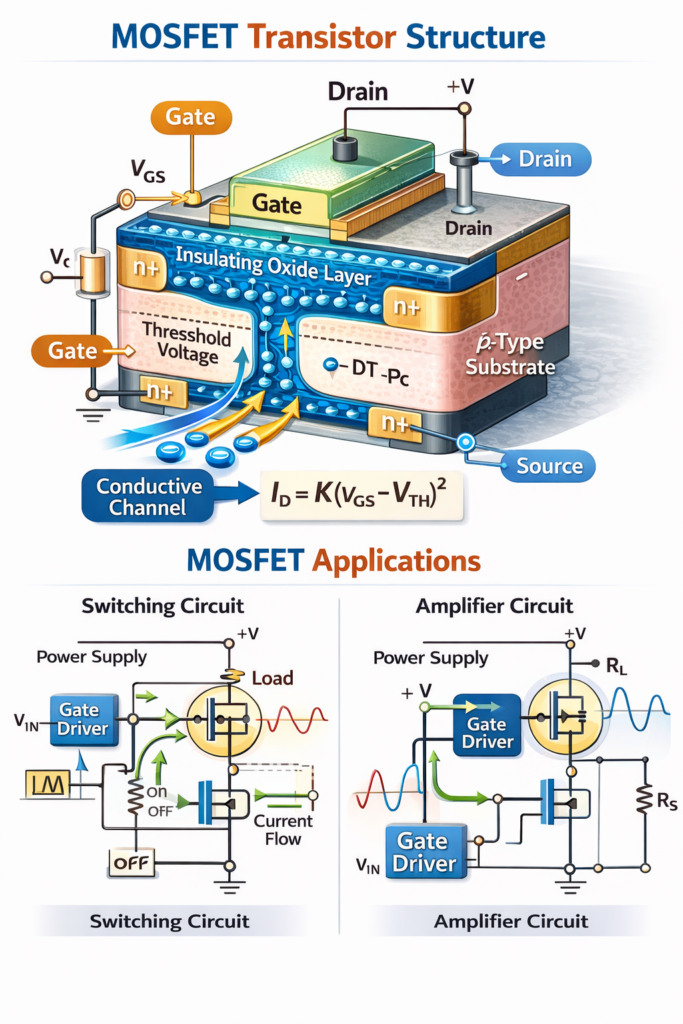
A MOSFET has three main terminals:
🔹 Gate (G)
🔹 Drain (D)
🔹 Source (S)
The gate terminal controls the conductivity between the drain and source. When the gate voltage exceeds the threshold voltage, a conductive channel forms and allows current to flow through the transistor.
There are two primary types of MOSFETs used in electronics:
⚡ N-Channel MOSFET
These are the most commonly used MOSFETs. They have higher electron mobility and therefore provide better conductivity and efficiency. N-channel MOSFETs are widely used in switching circuits and power supplies.
⚡ P-Channel MOSFET
These MOSFETs conduct when the gate voltage becomes negative relative to the source. They are commonly used in high-side switching applications.
In electronics design and analysis, MOSFET calculators are essential because manual calculations can be time-consuming and error-prone. Engineers frequently need to determine transistor parameters while designing circuits such as voltage regulators, switching converters, audio amplifiers, and digital logic gates.
For example, when designing a switching circuit using MOSFETs, engineers must ensure that the transistor operates within its safe operating area (SOA). Calculating current, voltage, and power dissipation helps prevent overheating and device failure.
Another important MOSFET parameter is power dissipation, which can be calculated using the formula:
P = VDS × ID
where:
• P = Power Dissipation
• VDS= Drain-Source Voltage
• ID = Drain Current
If the power dissipation exceeds the MOSFET’s rated value, the device may overheat and fail. Therefore, calculating this value accurately is critical in power electronics design.
MOSFET calculators are also useful for understanding transconductance, which measures how effectively the gate voltage controls the drain current. Transconductance is given by: gm = 2K(VGS − VTH)
This parameter is important in analog circuit design, particularly in amplifiers and signal processing circuits.
Modern electronics heavily rely on MOSFET technology. Billions of MOSFETs are integrated into microprocessors and memory chips inside computers, smartphones, and embedded systems. Without MOSFETs, the modern digital world would not exist.
Students studying physics, electronics engineering, electrical engineering, and semiconductor technology often encounter MOSFET calculations in their coursework. Using a MOSFET calculator allows them to quickly verify their answers, understand transistor behavior, and save time while solving complex circuit problems.
The MOSFET Calculator on https://allCalculators.co.in is designed to be extremely user-friendly. Simply enter the required electrical parameters such as gate voltage, threshold voltage, and device constant, and the calculator will instantly compute the correct result.
This tool is particularly useful for:
✔ Electronics engineering students
✔ Physics students studying semiconductor devices
✔ Circuit designers and hobbyists
✔ Electrical engineers working with power electronics
✔ Anyone learning about transistor operation
Because MOSFETs are used in nearly every modern electronic system, understanding how to calculate their operating parameters is an essential skill. This calculator eliminates the need for complex manual calculations and helps users quickly obtain accurate results.
Whether you are designing a power supply, amplifier, switching circuit, or digital logic system, the MOSFET calculator helps you analyze transistor behavior efficiently and reliably.
Applications in Daily Life ⚙️
MOSFETs play a crucial role in modern technology. Many devices we use every day rely on MOSFET switching and amplification circuits.
📱 Smartphones and Computers: Microprocessors inside smartphones and computers contain billions of MOSFET transistors that perform digital logic operations and enable computing.
⚡ Power Supplies: Switch-mode power supplies use MOSFET switching circuits to efficiently convert electrical energy.
🚗 Electric Vehicles: Electric vehicles rely heavily on MOSFET power transistors to control motors and battery systems.
🔋 Battery Management Systems: MOSFETs regulate charging and discharging of batteries in smartphones, laptops, and electric vehicles.
💡 LED Lighting Systems: Modern LED drivers use MOSFET circuits for efficient current control and power management.
🎧 Audio Amplifiers: MOSFET amplifiers provide high-quality audio amplification in home theaters and music systems.
🏭 Industrial Automation: MOSFET controllers regulate motors, robotics, and industrial machines.
Using a MOSFET calculator helps engineers design these systems safely and efficiently.
⚠️ Disclaimer
⚠️ The MOSFET Calculator available on this website is designed for educational, academic, and informational purposes only. While we strive to provide highly accurate results using standard MOSFET drain current formulas and semiconductor physics equations, the results should not be used as the sole basis for critical engineering decisions.
Users should always verify calculations using professional engineering tools, datasheets, and circuit simulation software before implementing designs in real-world applications.
AllCalculators.co.in does not assume responsibility for any errors, damages, or losses resulting from the use of this calculator. Always consult qualified electronics engineers or refer to official semiconductor documentation when designing electronic circuits.
📌 Related Calculator
❓ FAQs
❓ What is a MOSFET calculator?
A MOSFET calculator is an online tool used to calculate important MOSFET parameters such as drain current, gate voltage, threshold voltage, and power dissipation using standard semiconductor equations.
❓ What is the MOSFET drain current formula?
The drain current of a MOSFET in saturation region is calculated using: gm = 2K(VGS − VTH)
This formula determines how much current flows through the transistor when the gate voltage exceeds the threshold voltage.
❓ Why are MOSFETs important in electronics?
MOSFETs are essential semiconductor devices used in integrated circuits, power electronics, switching circuits, amplifiers, and digital systems.
❓ What is threshold voltage in a MOSFET?
Threshold voltage (VTH) is the minimum gate-source voltage required to turn the MOSFET ON and allow current to flow between drain and source.
❓ Where are MOSFETs used in real life?
MOSFETs are widely used in smartphones, laptops, power supplies, LED lighting systems, electric vehicles, motor controllers, and microprocessors.