
⚡ Generator Power Calculator ⚙️
Formula Used: P = V × I
Where:
P = Power (Watts) 🔋
V = Voltage (Volts) ⚡
I = Current (Amperes) 🔌
✍️ Author & Academic Authority: Dr. Nitish Kr. Bharadwaj
📘 Qualifications: B.Sc., B.Ed., M.Sc., Ph.D. (Biochemistry), MBA (Financial Management)
⚡ Generator Power Calculator – Easily Calculate Generator Size & Power Requirements
Electricity powers almost every part of modern life, from homes and offices to hospitals and industrial plants. However, power outages, remote work locations, construction sites, and emergency situations often require a reliable backup power source. This is where generators play a crucial role. Choosing the correct generator capacity is extremely important because an undersized generator may fail to power essential equipment, while an oversized generator wastes fuel and increases operational costs.
A Generator Power Calculator is an advanced physics-based tool designed to help users determine the required generator capacity in watts (W), kilowatts (kW), or kilovolt-amperes (kVA). By calculating the electrical load of appliances and equipment, this calculator helps determine the correct generator size for efficient performance and safety.
⚡ Generators convert mechanical energy into electrical energy using electromagnetic induction. When a generator rotates a coil inside a magnetic field, it produces electrical current. The total output power of the generator depends on several electrical parameters such as voltage (V), current (I), and power factor (PF).
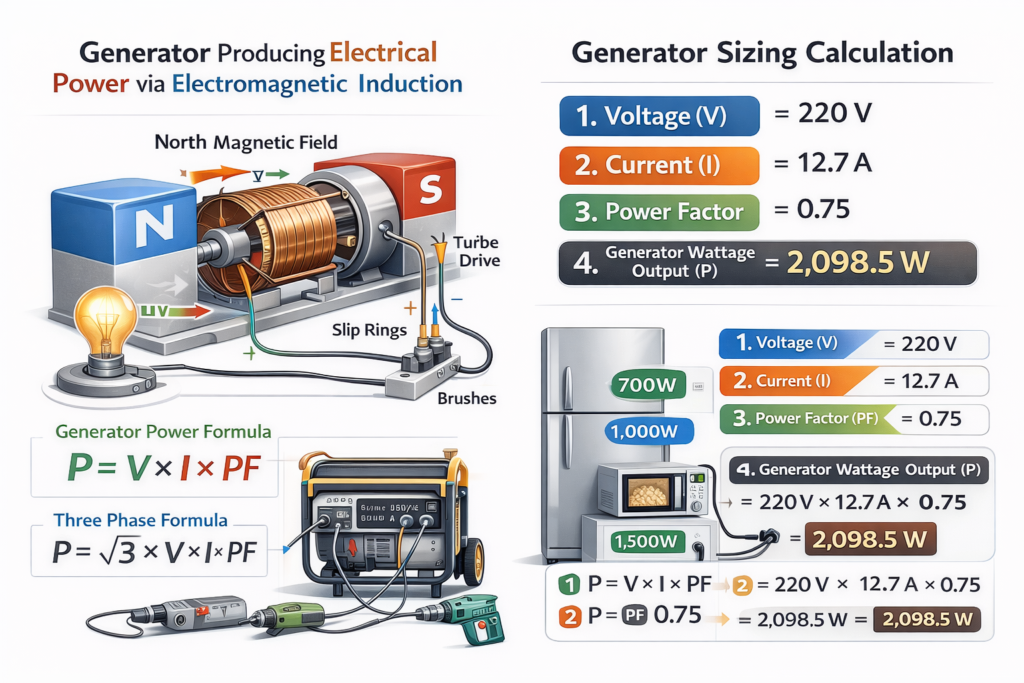
The most common electrical formulas used in generator power calculations are:
For Single Phase Systems
Power (Watts) = Voltage × Current × Power Factor
P = V × I × PF
For Three Phase Systems
P = √3 × V × I × PF
Where:
• P = Power output in watts
• V = Voltage (Volts)
• I = Current (Amperes)
• PF = Power factor (typically between 0.8 and 1)
Once the total wattage requirement is known, it can be converted to kilowatts:
kW = Watts / 1000
For generator sizing in kVA: kVA = kW / Power Factor
Understanding these relationships is essential for selecting the right generator capacity.
⚡ Why Generator Power Calculation is Important
Many people assume that a generator’s capacity should simply match the wattage of the appliances they want to power. However, this assumption is incorrect because certain devices such as air conditioners, refrigerators, motors, pumps, and compressors require additional power during startup. This is known as surge power or starting wattage.
For example:
• Refrigerator running wattage: 700W
• Refrigerator starting wattage: 2200W
If the generator cannot handle the starting surge, the appliance may fail to start or the generator may overload. Therefore, accurate generator power calculation is critical.
A Generator Power Calculator simplifies this process by allowing users to input values like voltage, current, and power factor to instantly determine generator power requirements.
⚡ Types of Generators That Require Proper Power Calculation
Generators are used in various environments, and each application requires precise sizing.
🏠 Home backup generators
🏢 Office standby generators
🏗 Construction site generators
🏥 Hospital emergency generators
🚜 Agricultural irrigation generators
🏕 Portable generators for camping
🚚 Mobile power generators for events
Each of these scenarios requires a specific generator capacity depending on the electrical load.
⚡ Generator Power Units Explained
Understanding electrical power units helps users interpret generator capacity correctly.
• Watts (W) – Basic unit of electrical power
• Kilowatts (kW) – 1000 watts
• Kilovolt-Amperes (kVA) – Apparent power in electrical systems
• Amperes (A) – Electric current
• Voltage (V) – Electrical potential difference
Most generators are rated in kW or kVA, while appliances are rated in watts.
⚡ Example Generator Power Calculation
Suppose an electrical system operates at:
Voltage = 230V
Current = 10A
Power Factor = 0.9
Using the formula: P = V × I × PF
P = 230 × 10 × 0.9
P = 2070 Watts
Convert to kilowatts: kW = 2070 / 1000
kW = 2.07 kW
This means the generator should be at least 2.5 kW to safely power the system while accounting for startup surges.
⚡ Advantages of Using an Online Generator Power Calculator
Using an online Generator Power Calculator offers several benefits:
✔ Instant generator size estimation
✔ Accurate power requirement calculation
✔ Prevents generator overload
✔ Helps save fuel and operating costs
✔ Improves electrical safety
✔ Ideal for students, engineers, electricians, and homeowners
Instead of manually performing calculations, users can instantly determine generator capacity using this calculator.
⚡ Who Should Use a Generator Power Calculator
This calculator is useful for many professionals and individuals.
👨🔧 Electricians planning electrical installations
👨🎓 Students studying electrical physics
👷 Engineers designing power systems
🏠 Homeowners choosing backup generators
🏗 Contractors running construction equipment
🚜 Farmers powering irrigation pumps
Accurate generator sizing ensures reliable power delivery and prevents equipment damage.
⚡ Generator Efficiency and Power Factor
Another important parameter in generator power calculations is power factor. Power factor represents how efficiently electrical power is used.
A power factor of 1 means all power is used effectively. Most electrical systems operate between 0.8 and 0.95.
Low power factor can increase current requirements and reduce generator efficiency.
⚡ Tips for Selecting the Right Generator Size
To ensure optimal generator performance, follow these tips:
✔ Calculate total running wattage
✔ Add starting wattage of motor-driven appliances
✔ Include safety margin (20–25%)
✔ Choose a generator with higher rated capacity than calculated load
This ensures the generator operates efficiently without overload.
⚡ Why This Generator Power Calculator Is Useful
The Generator Power Calculator on AllCalculators.co.in allows users to instantly determine generator power using standard electrical formulas. Whether you are calculating generator capacity for a home backup system, industrial equipment, or educational purposes, this tool simplifies the process and provides reliable results.
With growing dependence on electricity, understanding generator power requirements is becoming increasingly important. Using a reliable calculator ensures that the generator you select is efficient, safe, and capable of meeting your power needs.
🧠 Applications in Daily Life ⚡
⚡ Home Backup Power Planning: Homeowners use a generator wattage calculator to determine the generator size needed to run refrigerators, lights, fans, and essential appliances during power outages.
🏗 Construction Sites: Contractors rely on generator capacity calculators to power drilling machines, welding equipment, and heavy tools.
🏥 Hospitals & Medical Facilities: Hospitals require accurate generator sizing calculations to ensure uninterrupted power for life-saving equipment.
🚜 Agriculture & Irrigation: Farmers use generators to power irrigation pumps, tractors, and agricultural machinery in remote locations.
🎪 Outdoor Events & Mobile Businesses: Event organizers and food trucks calculate generator load to power lighting systems, sound equipment, and cooking appliances.
👨🎓 Education & Engineering Studies: Students studying physics and electrical engineering use generator power formulas to understand energy conversion and electrical load calculations.
⚠️ Disclaimer
The Generator Power Calculator available on this website is designed for educational and estimation purposes only. While the calculator uses standard electrical engineering formulas to estimate generator power requirements, the results may vary depending on real-world electrical conditions, equipment efficiency, startup surge requirements, and system configurations.
Users are strongly encouraged to consult a qualified electrician or electrical engineer before purchasing or installing a generator for residential, commercial, or industrial applications.
⚡ The website AllCalculators.co.in is not responsible for any equipment damage, electrical failures, or losses resulting from the use of calculated values.
Always verify electrical specifications and safety guidelines before operating generators.
📌 Related Calculator
❓FAQs
❓ What is a Generator Power Calculator?
A Generator Power Calculator is an online tool that helps estimate the electrical power required to run appliances or equipment using a generator. It calculates power based on voltage, current, and power factor.
❓ How do I calculate generator size for my home?
To calculate generator size, add the wattage of all appliances you want to run and include additional starting wattage for devices like refrigerators and air conditioners. A generator wattage calculator simplifies this process.
❓ What is the formula for generator power calculation?
The basic formula is: P = V × I × PF
For three-phase systems: P = √3 × V × I × PF
Where P is power, V is voltage, I is current, and PF is power factor.
❓ What size generator do I need for a house?
Most homes require generators between 3 kW and 10 kW, depending on the appliances and equipment being used.
❓ Why is generator sizing important?
Proper generator sizing prevents overload, improves efficiency, reduces fuel consumption, and ensures reliable power during outages.