
⚡ Watts to Amps Lux Calculator 💡
Watts → Amps : I = P / V
Lux : Lux = Lumens / Area
⚡ Watts to Amps Calculator
💡 Lux Calculator
✍️ Author & Academic Authority: Dr. Nitish Kr. Bharadwaj
📘 Qualifications: B.Sc., B.Ed., M.Sc., Ph.D. (Biochemistry), MBA (Financial Management)
⚡ Watts to Amps Lux Calculator – Convert Electrical Power & Light Intensity Instantly 💡
Electricity and light are fundamental parts of modern life. Whether you are studying physics, designing electrical systems, installing lighting, or simply trying to understand your home appliances, knowing how watts, amps, volts, and lux relate to each other is extremely important. The Watts to Amps & Lux Calculator is a powerful online physics tool that allows students, engineers, electricians, and everyday users to quickly calculate electrical current from power as well as evaluate light intensity values using lux measurements.
n electrical physics, watts (W) represent electrical power, amps (A) represent electric current, and volts (V) represent voltage. These three quantities are mathematically connected through the well-known Ohm’s Law and electrical power formula:
P = V × I
Where:
P = Power (Watts)
V = Voltage (Volts)
I = Current (Amps)
Using this equation, the current can easily be calculated by rearranging the formula:
I = P / V
This means if you know the power consumption in watts and the voltage supply, you can determine how much current flows through the circuit. This concept is essential for selecting correct wires, circuit breakers, power supplies, and electrical devices.
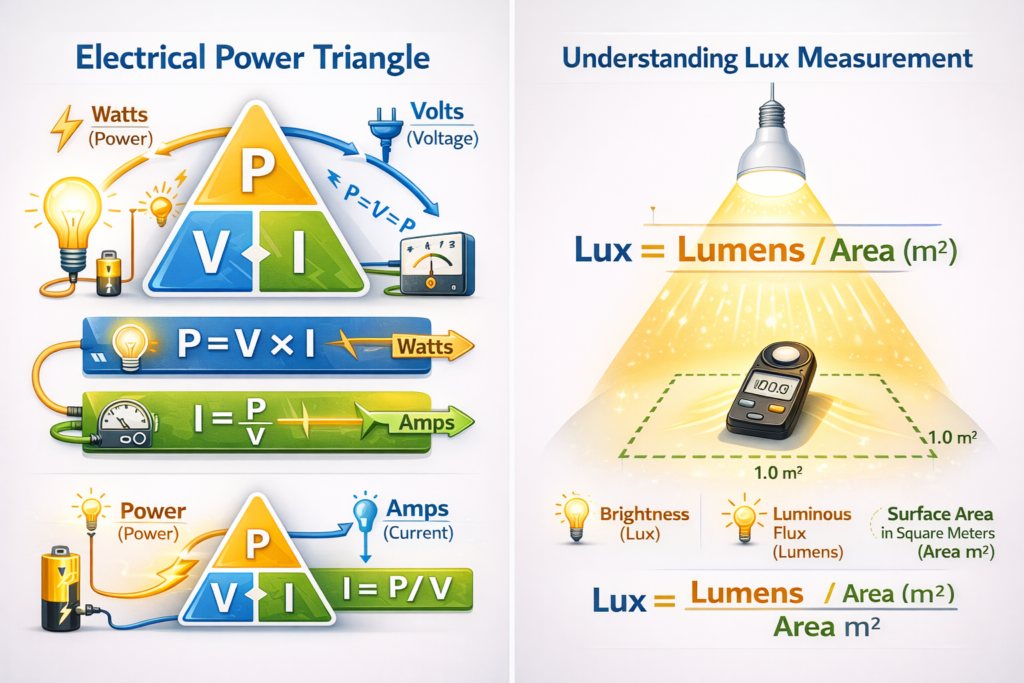
For example, if a device consumes 100 watts of power and runs on a 220-volt power supply, the current can be calculated as:
I = 100 / 220
I = 0.45 amps
This value tells electricians and engineers how much electrical current flows in the circuit.
Our Watts to Amps Calculator automates this process instantly. Instead of manually performing calculations, users simply enter the watt value and voltage value, and the tool provides accurate results immediately.
But electricity calculations are not limited to power and current alone. In lighting design and photometry, lux is another extremely important unit. Lux measures the intensity of light falling on a surface. It describes how bright an area appears and is widely used in architecture, interior design, photography, workplace lighting standards, and scientific research.
Lux is defined as:
1 lux = 1 lumen per square meter
In simple terms, lux measures how much luminous flux (light output) spreads over a specific area.
For example:
If a lamp produces 1000 lumens and spreads light across 10 square meters, the illumination level is:
Lux = Lumens / Area
Lux = 1000 / 10
Lux = 100 lux
This means the brightness on the surface is 100 lux.
Lighting professionals often use lux calculations to ensure environments meet proper illumination standards. For example:
Office workspace lighting typically requires 300–500 lux
Classrooms require around 500 lux
Hospitals require 1000 lux or more in surgical areas
Street lighting usually ranges between 10–50 lux
The Lux Calculator integrated in this tool helps determine illumination levels instantly by allowing users to input lumen values and surface area.
By combining both electrical power calculations and light intensity calculations, this online tool becomes extremely useful for multiple users including:
• Physics students learning electricity concepts
• Electrical engineering students solving circuit problems
• Electricians installing appliances and wiring systems
• Lighting designers calculating illumination requirements
• Architects planning lighting systems for buildings
• Photographers setting correct lighting conditions
• DIY hobbyists working with LED lights and power supplies
Another reason why watts to amps conversion is important is electrical safety. If a device draws more current than the wire or circuit breaker can handle, it may cause overheating, electrical fires, or system failure. By calculating current in advance, professionals can choose proper electrical components and prevent hazards.
Similarly, lux calculations help improve productivity, health, and comfort in indoor environments. Poor lighting can cause eye strain, headaches, and reduced work performance. Proper lux levels ensure comfortable and safe environments.
The Watts to Amps & Lux Calculator simplifies these calculations by providing instant results without complicated formulas. It is especially helpful for students preparing for physics exams because it reinforces core concepts like:
• electrical power equations
• Ohm’s law relationships
• current and voltage calculations
• photometric lighting measurements
• lumen and lux conversion
With the increasing demand for energy efficiency and smart lighting systems, understanding these units has become even more important in modern engineering and daily life.
For example, LED lighting systems require careful power calculations to determine driver capacity and energy consumption. By converting watts to amps, engineers can design efficient circuits and avoid overload conditions.
Similarly, smart homes and IoT lighting systems rely on precise lux measurements to automatically adjust brightness levels depending on ambient conditions.
This calculator is designed to provide accurate results, instant calculations, and a user-friendly experience so anyone can perform electrical and lighting calculations without needing advanced knowledge.
Whether you are solving homework problems, designing lighting systems, installing electrical appliances, or simply curious about electricity and illumination, this Watts to Amps & Lux Calculator provides a reliable and efficient solution.
Use the calculator above to quickly convert watts to amps and calculate lux illumination levels in seconds.
🌍 Applications in Daily Life ⚡💡
🏠 Home Appliance Power Calculation: Home appliances such as refrigerators, heaters, fans, and microwaves consume electrical power measured in watts. Using a watts to amps calculator, homeowners can determine how much current appliances draw and ensure circuits are not overloaded.
🔌 Electrical Wiring & Circuit Design: Electricians use watts to amps conversion formulas to select proper wire gauges, circuit breakers, and electrical panels to maintain safety and efficiency.
💡 Lighting Design & Interior Planning: Architects and lighting designers calculate lux levels to ensure proper illumination in offices, homes, classrooms, and commercial buildings.
🧑🎓 Physics & Engineering Education: Students learning electricity and photometry concepts frequently use watts to amps formulas and lux calculations when solving physics problems.
📷 Photography & Film Production: Photographers calculate lux intensity to adjust camera exposure, lighting placement, and studio brightness.
🏭 Industrial Safety Standards: Factories must maintain minimum lux levels in workspaces to comply with occupational safety guidelines.
🌆 Smart Cities & Street Lighting: City planners use lux calculations to design efficient street lighting systems that maintain visibility while minimizing energy consumption.
⚠️ Disclaimer
⚠️ The Watts to Amps & Lux Calculator is designed for educational and general informational purposes only. While the calculator uses standard electrical and photometric formulas, actual electrical systems may vary depending on power factors, circuit configurations, and equipment specifications.
🔌 Always consult a qualified electrician or electrical engineer when designing electrical circuits, installing wiring, or working with high-voltage systems.
💡 Lux calculations provided by this tool are theoretical estimates and may vary based on lamp efficiency, reflector design, environmental conditions, and light distribution patterns.
📚 This tool should be used as a learning aid for students, researchers, and professionals but should not replace professional engineering calculations in safety-critical systems.
📌 Related Calculator
❓ FAQs
⚡ What is the formula to convert watts to amps?
The watts to amps formula is Current (A) = Power (W) / Voltage (V). This equation comes from the electrical power formula P = V × I.
🔌 How many amps are in 1000 watts?
If the voltage is 220V, then Amps = 1000 ÷ 220 = 4.54 amps.
💡 What does lux measure?
Lux measures light intensity on a surface. It indicates how bright a specific area appears.
📊 What is the relationship between lumens and lux?
Lux is calculated as: Lux = Lumens / Area (m²)
It shows how much luminous flux spreads across a surface.
⚙️ Why is converting watts to amps important?
It helps determine electrical current flow so engineers and electricians can choose safe wires, breakers, and electrical components.
🌞 What lux level is good for reading?
Reading and office work usually require 300–500 lux for comfortable visibility.