
⚡ Voltage Drop Calculator
Formula Used
Vdrop = I × R
R = (ρ × L) / A
ρ = Resistivity of conductor
L = Wire Length
A = Cross-sectional Area
✍️ Author & Academic Authority: Dr. Nitish Kr. Bharadwaj
📘 Qualifications: B.Sc., B.Ed., M.Sc., Ph.D. (Biochemistry), MBA (Financial Management)
⚡ Voltage Drop Calculator – Calculate Electrical Voltage Loss Instantly
Electricity powers nearly every modern system — from household appliances 🏠 to massive industrial machines 🏭. However, whenever electricity travels through wires or conductors, some amount of voltage is lost due to resistance. This phenomenon is known as Voltage Drop.
The Voltage Drop Calculator is an essential physics and electrical engineering tool that helps students, electricians, engineers, and DIY enthusiasts quickly determine the voltage lost across a wire or electrical circuit. Instead of manually applying complex formulas and performing calculations, this online calculator instantly provides accurate results, saving both time and effort.
Whether you’re designing an electrical circuit 🔌, installing home wiring, analyzing power transmission systems, or studying electrical engineering concepts, understanding voltage drop is critical to maintaining efficient and safe electrical systems.
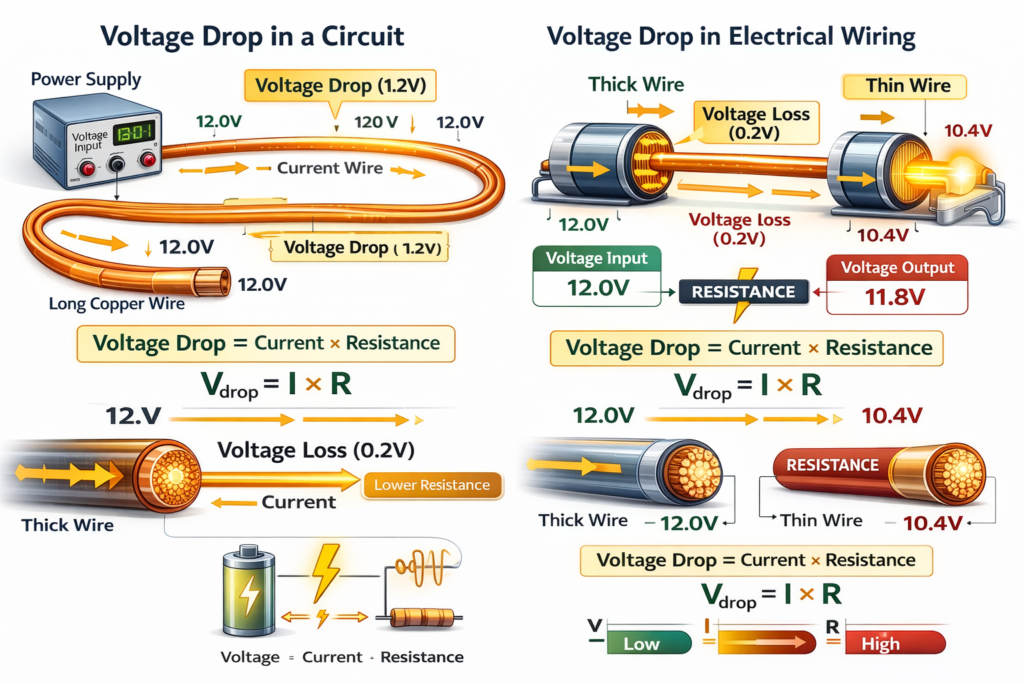
⚡ What is Voltage Drop?
Voltage drop refers to the reduction in electrical potential (voltage) as electric current flows through a conductor. This occurs because every conductor has resistance, which opposes the flow of electric current.
According to Ohm’s Law, voltage drop can be calculated using the equation:
Voltage Drop = Current × Resistance
Mathematically,
V = I × R
Where:
- V = Voltage Drop (Volts)
- I = Current (Amperes)
- R = Resistance (Ohms)
This formula indicates that voltage drop increases when either current increases or wire resistance increases.
For long wires, thin conductors, or high-current systems, voltage drop becomes more significant.
⚡ Why Voltage Drop Matters
Voltage drop is not just a theoretical concept in physics; it has major real-world consequences in electrical systems.
If voltage drop becomes excessive, several problems may occur:
⚠️ Electrical devices may not receive enough voltage to operate properly
⚠️ Motors may overheat and fail
⚠️ Lights may appear dim
⚠️ Power efficiency decreases
⚠️ Energy loss increases
For this reason, electrical codes such as the National Electrical Code (NEC) recommend that voltage drop should not exceed 3% for branch circuits and 5% overall.
Using a voltage drop calculator online ensures electrical systems remain within safe and efficient limits.
⚡ Voltage Drop Formula Used in Calculations
Different circuit types require different formulas for voltage drop calculation.
Single Phase Circuit
Voltage Drop = 2 × I × R × L
Where:
- I = Current
- R = Resistance per unit length
- L = Length of conductor
Three Phase Circuit
Voltage Drop = √3 × I × R × L
This formula is commonly used in industrial electrical systems and power distribution networks.
⚡ Factors Affecting Voltage Drop
Several physical and electrical factors influence voltage drop in a circuit.
1️⃣ Wire Length: The longer the wire, the greater the resistance and therefore the higher the voltage drop.
2️⃣ Current Flow: Higher electrical current increases the voltage drop proportionally.
3️⃣ Wire Material: Different materials have different resistivities.
For example:
Copper wire → low resistance
Aluminum wire → higher resistance
Copper is therefore commonly used in electrical wiring because it minimizes voltage loss.
4️⃣ Wire Diameter (Gauge): Thicker wires have lower resistance. Using a larger wire gauge significantly reduces voltage drop.
5️⃣ Temperature: Resistance increases with temperature. Therefore, hot wires experience greater voltage drop.
⚡ How the Voltage Drop Calculator Works
The Voltage Drop Calculator simplifies electrical calculations by instantly computing voltage loss based on input parameters.
Users typically need to enter:
✔ Current (Amps)
✔ Wire length (meters or feet)
✔ Resistance or wire gauge
✔ Supply voltage
After entering these values, the calculator quickly determines:
- Voltage drop
- Percentage voltage drop
- Remaining voltage at load
This eliminates the need for manual formulas and ensures fast and accurate results.
⚡ Example of Voltage Drop Calculation
Suppose an electrical circuit has:
Current = 10 A
Resistance = 0.5 Ω
Using Ohm’s Law:
Voltage Drop = 10 × 0.5
Voltage Drop = 5 V
This means that if the power supply provides 120 V, only 115 V reaches the device.
⚡ Benefits of Using an Online Voltage Drop Calculator
Using an online voltage drop calculator offers many advantages.
⚡ Instant calculations
⚡ Eliminates manual errors
⚡ Easy to use for students
⚡ Useful for electricians and engineers
⚡ Helps design efficient electrical systems
⚡ Improves energy efficiency
⚡ Supports educational learning
Because of these benefits, voltage drop calculators are widely used in engineering tools, educational websites, and electrical design software.
⚡ Voltage Drop and Energy Efficiency
Reducing voltage drop improves the overall efficiency of electrical systems.
Lower voltage drop means:
✔ Less energy wasted as heat
✔ Higher equipment lifespan
✔ Better electrical performance
✔ Reduced electricity costs
That is why engineers always calculate voltage drop before installing electrical wiring.
🏠 Applications in Daily Life ⚡
Voltage drop calculations are widely used in everyday electrical applications.
🏠 Home Electrical Wiring: Electricians calculate voltage drop when installing house wiring to ensure appliances receive the correct voltage.
🔌 Power Extension Cables: Long extension cords can cause voltage loss. Calculating voltage drop helps determine the correct cable thickness.
💡 Lighting Systems: Excessive voltage drop can make LED lights dim. Engineers calculate voltage drop to maintain brightness.
🚗 Electric Vehicles: Voltage drop calculations help optimize battery power distribution in electric cars.
☀ Solar Power Systems: Solar installers calculate voltage drop to prevent power loss between solar panels and inverters.
🏭 Industrial Machinery: Factories rely on voltage drop calculations to maintain stable voltage supply for heavy equipment.
🔋 Battery Circuits: In electronic devices and battery systems, voltage drop affects efficiency and performance.
⚠️ Disclaimer
This Voltage Drop Calculator is provided for educational and informational purposes only. While every effort has been made to ensure calculation accuracy, the results generated by this tool should be considered approximate estimates.
Electrical systems can vary depending on wire type, installation conditions, temperature, and electrical load characteristics.
Users should always consult a licensed electrician or qualified electrical engineer before making critical electrical design or installation decisions. By using this calculator, you acknowledge that AllCalculators.co.in is not responsible for any damages, losses, or incorrect interpretations resulting from the use of this tool.
📌 Related Calculator
❓ FAQs 🧠
⚡ What is voltage drop in an electrical circuit?
Voltage drop is the reduction in electrical voltage as current flows through a conductor due to resistance. It occurs naturally in all electrical wires and circuits.
⚡ How do you calculate voltage drop?
Voltage drop is calculated using Ohm’s Law: V = I × R. Where V is voltage drop, I is current, and R is resistance.
⚡ Why is voltage drop important?
Voltage drop affects the performance of electrical equipment. Excessive voltage drop can cause devices to malfunction, motors to overheat, and lights to dim.
⚡ What is the acceptable voltage drop in wiring?
Electrical standards recommend that voltage drop should not exceed 3% in branch circuits and 5% in total electrical systems.
⚡ Who uses voltage drop calculators?
Voltage drop calculators are commonly used by students, electricians, electrical engineers, solar installers, and industrial technicians.